Introduction
Have you ever received a text that simply says “DK” and wondered what the other person meant? This short abbreviation is easy to misunderstand if you have never seen it before.
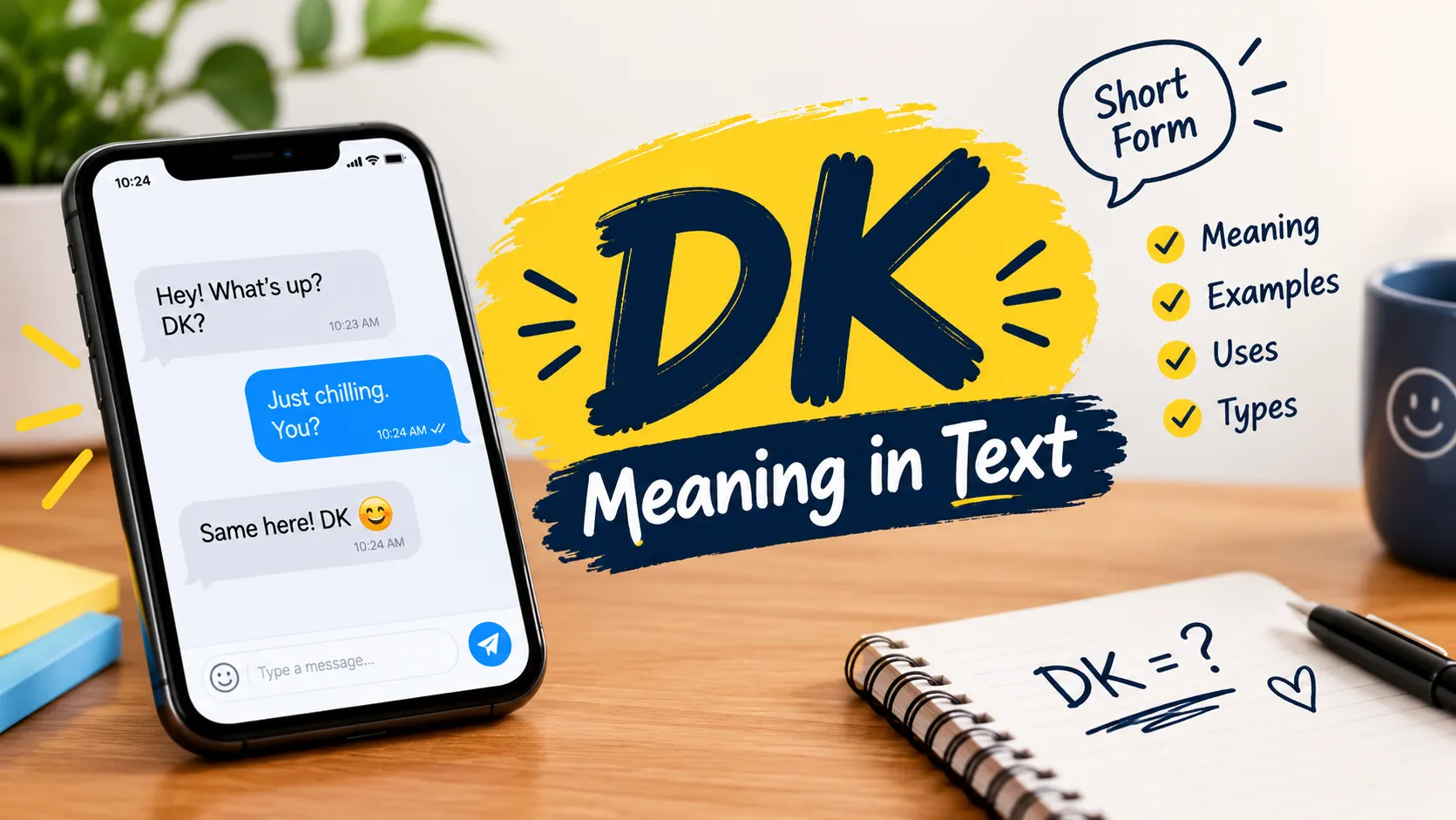
In texting, DK usually means “Don’t Know.” People use it as a quick, informal way to say they do not know the answer to a question or are unsure about something. For example, if you ask a friend when a movie starts and they reply “DK,” they mean they do not know the starting time.
You may see DK in text messages, group chats, and social media conversations. Its meaning can also change in other contexts. For example, DK can refer to Denmark in country-code settings or Donkey Kong in gaming discussions.
Understanding the surrounding conversation is the easiest way to identify the intended meaning. Below, you’ll find simple examples, the difference between DK and IDK, and natural ways to respond when someone sends you this abbreviation.
What Does DK Mean in Text?
DK means “Don’t Know” in informal text messages and online chats. It is a short abbreviation people use when they do not have the information someone is asking for.
For example:
Person A: Do you know when the party starts?
Person B: DK.
Meaning: The person does not know when the party starts.
DK is commonly used in casual conversations because it takes less time to type than a complete sentence. You might see it written as DK, dk, or Dk. In ordinary texting, capitalization usually does not change the meaning.
The abbreviation is informal, so it is most suitable for conversations with friends, family, or people who understand texting shorthand.
DK Meaning: Quick Summary
Here is a simple overview of the abbreviation and how people use it.
| Feature | Explanation |
| Abbreviation | DK |
| Common meaning | Don’t Know |
| Category | Text abbreviation |
| Pronunciation | Dee-kay, when spoken as the letters |
| Tone | Usually casual and neutral |
| Common settings | Text messages, online chats, and social media |
| Similar abbreviation | IDK |
| Is it offensive? | Not inherently |
| Best way to interpret it | Read the surrounding conversation |
The key point is that DK usually communicates a lack of knowledge or uncertainty. Other meanings are possible when the letters appear outside an ordinary texting conversation.
What Does DK Mean in Chat?
In online chat, DK usually works as a brief response to a question. It tells the other person that the sender does not know the answer.
Here are two examples:
Example 1
Alex: Who won the match?
Sam: DK, I missed it.
Sam is saying that he does not know who won because he did not watch the match.
Example 2
Mia: Is everyone coming tonight?
Emma: DK, ask Jake.
Emma does not have the answer and suggests asking someone else.
Depending on the message, DK can express uncertainty about facts, plans, decisions, or events. It does not necessarily mean that the sender is unwilling to help.
Examples of DK in Text Messages
The following conversations show how DK can appear in everyday messaging.
1. Asking About Plans
You: Are we meeting at 6?
Friend: DK yet.
Meaning: Your friend does not know the confirmed meeting time yet.
2. Asking About Someone
You: Where did Sarah go?
Friend: DK, sorry.
Meaning: Your friend does not know where Sarah went.
3. Talking About School or Work
You: When is the assignment due?
Classmate: DK. Check the class group.
Meaning: Your classmate does not know the deadline and suggests another source.
4. Casual Group Chat
Friend 1: Who is bringing snacks?
Friend 2: DK lol.
Meaning: The person does not know who is bringing snacks. The word “lol” adds a casual tone.
5. Making a Decision
You: Should we order pizza or burgers?
Friend: DK, either is fine.
Meaning: Your friend has no strong preference or has not decided.
6. Asking About an Event
You: Is the concert still happening?
Friend: DK, check their page.
Meaning: Your friend is unsure and recommends checking the event’s official page.
These are illustrative examples rather than quotations from actual Conversations. They demonstrate how the meaning of DK becomes clear when you read the entire exchange.
What Does DK Mean on Snapchat?
On Snapchat, DK generally means “Don’t Know” when it appears in a regular chat or private message.
For example:
You: Do you know the name of this song?
Friend: dk 🤷
Your friend does not know the song’s name. The shrug emoji reinforces the idea of uncertainty.
DK does not have a separate standard meaning simply because it appears on Snapchat. If you see the letters in a username, gaming conversation, or group name, consider those contexts before interpreting them.
What Does DK Mean on Instagram?
On Instagram, DK can have the same meaning in direct messages, comments, and casual conversations.
For example:
You: Where did you buy that jacket?
Friend: DK, maybe ask her.
Here, the sender does not know where the jacket came from.
You might also encounter lowercase dk in a comment or a story reply. The lowercase spelling usually does not change its meaning in ordinary texting.
However, DK in a username, brand name, or gaming-related post may refer to something else. Always consider the subject of the post before deciding what the abbreviation means.
What Does DK Mean on WhatsApp and TikTok?
On WhatsApp, DK may appear in one-to-one messages or group chats as a quick way to answer a question.
For example:
You: What time should we leave?
Friend: DK yet, waiting for Ali.
The sender has not confirmed the departure time.
On TikTok, the same abbreviation may appear in comments or private messages. Someone responding to a question about a video might write “DK” to indicate that they do not know the answer.
In gaming-related TikTok content, however, DK may refer to Donkey Kong. The topic and surrounding words help distinguish the two meanings.
The abbreviation itself does not have a different universal definition on either platform.
What Does DK Mean in Gaming?
In gaming conversations, DK can mean “Don’t Know” when someone uses it as an ordinary reply.
For example:
Player 1: When does the next round begin?
Player 2: DK.
The second player does not know the answer.
However, DK has other established associations in gaming:
- Donkey Kong: DK is a common abbreviation for the Nintendo character and video game franchise.
- Death Knight: In games that use this character class, DK can refer to a Death Knight.
Consider these examples:
- “DK when the tournament starts” — likely means “Don’t Know.”
- “I love the old DK games” — likely refers to Donkey Kong.
- “My DK needs better equipment” — may refer to a Death Knight character.
These meanings are not interchangeable. If “Don’t Know” does not make sense in the conversation, look at the game’s terminology and subject matter.
What Is the Difference Between DK and IDK?
DK and IDK express a similar idea, but their full forms are different.
| Abbreviation | Full form | Meaning |
| DK | Don’t Know | A brief way to express uncertainty |
| IDK | I Don’t Know | A direct statement of uncertainty |
| IDC | I Don’t Care | Expresses indifference |
| IK | I Know | Indicates knowledge or awareness |
| NVM | Never Mind | Suggests dropping or dismissing a topic |
For example:
Question: Do you know when the shop closes?
Reply 1: DK.
Reply 2: IDK.
Both replies communicate that the person does not know the closing time. IDK explicitly includes the word “I,” while DK is shorter.
DK and IDC are different. Saying you don’t know something does not mean you don’t care about it.
Similarly, NVM means “Never Mind,” not “Don’t Know.” Understanding these differences helps prevent misunderstandings in messages.
Is DK Rude in Texting?
DK is not inherently rude or offensive. It is usually a neutral, informal abbreviation. However, a very short reply can sometimes feel abrupt, depending on the situation and the relationship between the people communicating.
Compare these examples:
Friendly: “DK, sorry! I’ll ask around.”
This sounds helpful because the sender acknowledges the question and offers to assist.
Casual: “dk lol.”
This sounds relaxed and informal, depending on the conversation.
Potentially dismissive: “DK. Stop asking me.”
The additional words make the reply sound irritated. The negative tone comes from the full message rather than the abbreviation alone.
If someone sends you only DK, do not automatically assume that they are angry, ignoring you, or uninterested in talking. They may simply lack the information you requested.
What Does DK Mean From a Girl or a Guy?
When a girl or a guy sends DK in a text, it generally means “Don’t Know.” The abbreviation does not have a separate standard definition based on the sender’s gender.
The context can help you understand what the person is communicating.
For example:
You: Do you want to meet this weekend?
Them: DK yet.
The person is unsure about their plans or does not have enough information to confirm.
This message does not automatically mean they are rejecting you or losing interest. If you are trying to understand their feelings, pay attention to the broader conversation, whether they explain their uncertainty, and whether they suggest another time.
One short abbreviation is not enough to establish someone’s intentions.
How Should You Reply When Someone Says DK?
Your response depends on the question you asked and whether you need a definite answer.
Here are five natural ways to reply.
1. If the answer can wait
Them: “DK yet.”
You: “No worries, let me know when you find out.”
2. If you need the information soon
Them: “DK.”
You: “Okay, could you check and tell me when you know?”
3. If you’re making plans
Them: “DK if I can come.”
You: “That’s fine. Just let me know when you decide.”
4. If you can find the answer elsewhere
Them: “DK.”
You: “All good, I’ll check myself.”
5. If you want to keep the conversation casual
Them: “DK lol.”
You: “Haha, fair enough.”
These replies keep the conversation friendly without assuming that the sender has a negative attitude.
Other Meanings of DK
Although “Don’t Know” is the main interpretation to consider in ordinary texting, DK can have other meanings in specific settings.
DK as Denmark
DK is the two-letter country code for Denmark. You may encounter it in international identification systems, country-code lists, or internet addresses ending in .dk.
DK as Donkey Kong
In gaming discussions, DK often refers to Donkey Kong, the Nintendo character and franchise.
DK as Initials or a Name
And DK may represent a person’s initials, a username, a nickname, or part of a brand or Organization name.
DK in Specialized Contexts
Technical, professional, and community-specific documents sometimes use abbreviations that are not standard texting slang. In those situations, the relevant field or document can help establish the intended meaning.
The important distinction is that a meaning used in one setting should not automatically be applied to every conversation.
Common Misunderstandings About DK
Here are some mistakes to avoid when interpreting this abbreviation.
Mistake 1: Assuming DK always means Don’t Know.
Although that is the usual interpretation in ordinary texting, gaming, country codes, and names can give the letters other meanings.
Mistake 2: Thinking DK means I Don’t Care.
DK usually means “Don’t Know.” IDC means “I Don’t Care.” They express different ideas.
Mistake 3: Assuming DK is automatically rude.
The abbreviation is not inherently rude. The rest of the message and the conversation’s tone matter.
Mistake 4: Treating DK and IDK as completely different expressions.
Both commonly communicate a lack of knowledge. Their wording differs, but their practical meaning is very similar.
Mistake 5: Assuming DK reveals someone’s romantic feelings.
A reply of DK does not prove that someone is uninterested, annoyed, or avoiding you. Look for additional context before concluding.

- Related To Another Article: https://blessnesty.com/good-night-blessings/
People Also Ask
DK usually means “Don’t Know.” It is an informal abbreviation used when someone does not know the answer to a question or is unsure about something.
They communicate a similar meaning. DK stands for “Don’t Know,” while IDK stands for “I Don’t Know.” Both are common ways to express uncertainty in casual messages.
Lowercase dk usually has the same meaning as uppercase DK in ordinary texting. Capitalization is generally a stylistic choice and does not change the intended meaning.
No, not usually. DK means “Don’t Know,” whereas IDC means “I Don’t Care.” One communicates a lack of knowledge; the other expresses indifference.
In ordinary Snapchat conversations, DK usually means “Don’t Know.” The surrounding message, username, or topic can help identify whether the letters have another meaning.
Conclusion
The most common DK meaning in text is “Don’t Know.” People use it in casual messages and online chats when they lack information or feel uncertain about something.
You may encounter DK on Snapchat, Instagram, WhatsApp, TikTok, or in gaming conversations. Although the abbreviation is usually neutral, its intended meaning depends on the context.
Remember the difference between DK and IDK, and do not confuse either one with IDC. If someone sends you DK, start with “Don’t Know” as the likely interpretation and consider the rest of the conversation before assuming anything about their tone or intentions.
For more explanations of texting abbreviations and internet slang, Explore Related Guides on Blessnesty.com.