Introduction
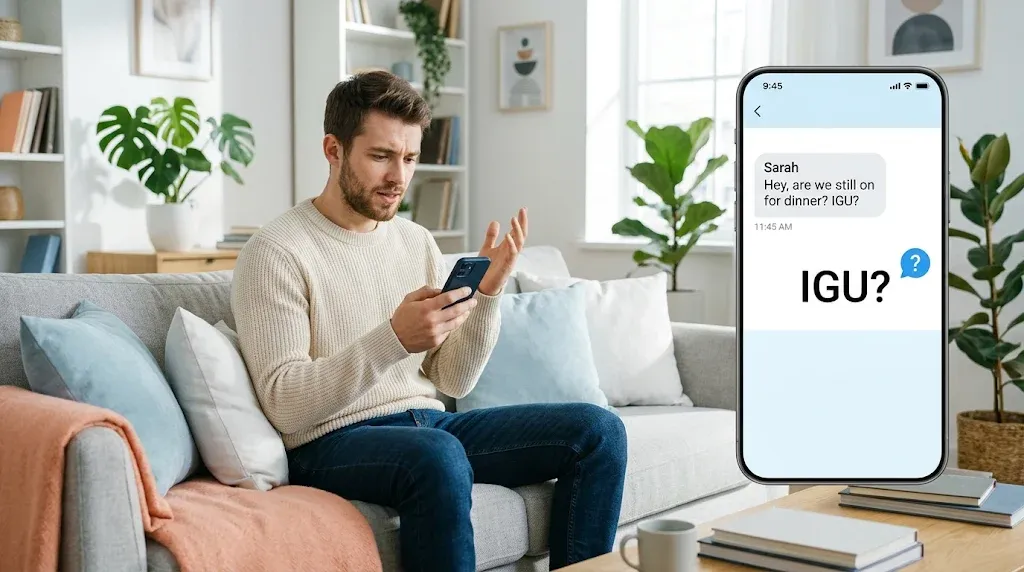
Have you received a message containing IGU and wondered what those three letters mean? You’re not alone. Internet slang and texting abbreviations can sometimes be confusing, especially when the same combination of letters has more than one interpretation.
The most commonly documented IGU meaning in text is “I Give Up.“ People use it when they feel frustrated, cannot solve a problem, want to stop trying, or jokingly admit defeat. However, in some informal online conversations, IGU may also mean “I Got You” or “I Get You,” depending on the context.
For example, someone struggling with a difficult assignment might text “IGU” to express that they have given up. On the other hand, someone replying to a request for help might use it to communicate support.
Understanding the conversation surrounding IGU is the best way to identify its intended meaning. In this guide, you’ll discover its different interpretations, texting examples, social media usage, and the best ways to respond when someone sends you IGU.
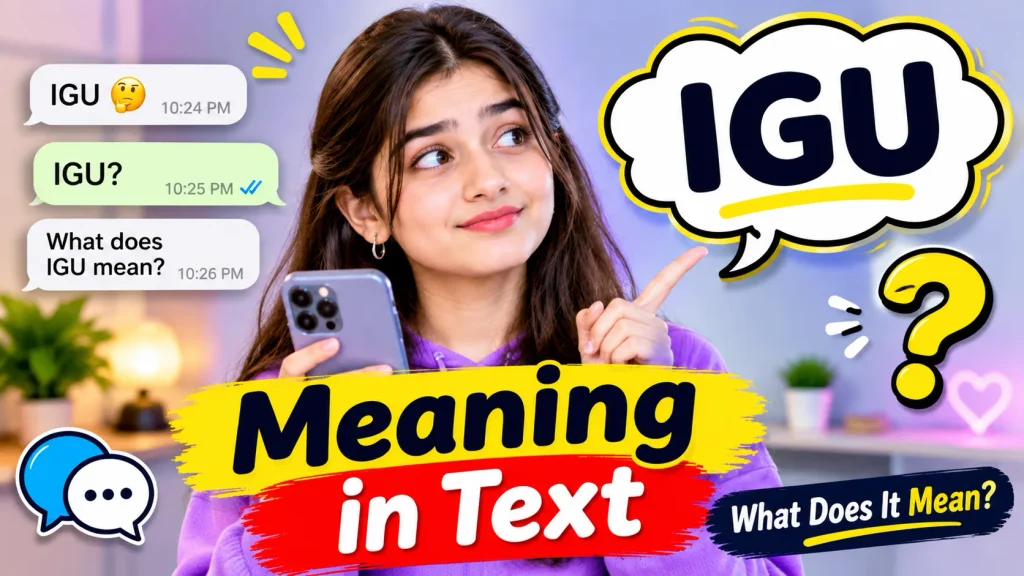
What Does IGU Mean in Text?
In text messages, IGU most commonly stands for “I Give Up.” It is an informal abbreviation that communicates surrender, frustration, or a decision to stop trying.
Someone might use IGU after repeatedly attempting something without success. It can also appear during a friendly argument, an online game, or a conversation about a difficult situation.
However, some people interpret IGU as “I Got You,” particularly when someone is offering assistance or reassurance.
Here is a quick breakdown:
| IGU Meaning | Explanation |
| I Give Up | Stopping an attempt or admitting defeat |
| I Got You | Offering help or reassurance |
| I Get You | Showing understanding or agreement |
Example:
Friend 1: Have you figured out this difficult question?
Friend 2: No, IGU. This makes no sense!
In this conversation, IGU means “I Give Up.” The sender is expressing frustration and deciding to stop trying.
The important thing to remember is that IGU is not always interpreted the same way. The surrounding message, situation, and tone help determine its intended meaning.
What Does IGU Stand For?
IGU is a three-letter abbreviation formed from the first letters of the words in a phrase.
When it means “I Give Up,” the letters represent:
- I: I
- G: Give
- U: Up
When someone uses it to mean “I Got You,” the letters represent:
- I: I
- G: Got
- U: You
The abbreviation makes longer expressions quicker to type, especially in casual conversations and online messaging.
Unlike widely recognized abbreviations such as LOL and BRB, IGU is relatively uncommon and can be harder to understand without context.
Different Meanings of IGU in Texting
IGU can communicate different messages depending on how someone uses it. Understanding these interpretations will help you avoid misunderstanding a conversation.
1. IGU Meaning: I Give Up
“I Give Up” is the best-documented texting interpretation of IGU.
People use it when they have tried something repeatedly but cannot achieve the desired result. It can communicate frustration, exhaustion, surrender, or playful defeat.
Common situations include:
- Giving up on a difficult assignment.
- Losing a game or friendly competition.
- Ending an argument because there is no point continuing.
- Feeling tired of solving a complicated problem.
- Admitting that something is too difficult.
Examples:
Example 1:
Friend 1: Did you finish fixing your computer?
Friend 2: No, I’ve tried everything. IGU!
Meaning: I’ve tried everything, and I give up.
Example 2:
Friend 1: You still haven’t beaten that game?
Friend 2: IGU 😂 That level is impossible.
Meaning: I’m giving up because the game is too difficult.
Example 3:
Friend 1: Who won the argument?
Friend 2: IGU. You win this time.
Meaning: I’m admitting defeat and ending the argument.
2. IGU Meaning: I Got You
Another informal interpretation of IGU is “I Got You.”
In this context, someone uses the abbreviation to show that they understand a request, are willing to help, or will take care of something.
It generally communicates reassurance and support.
People might use this interpretation when:
- Agreeing to help a friend.
- Accepting a request.
- Promising to complete a task.
- Reassuring someone who is worried.
- Confirming that they understand what needs to be done.
Examples:
Example 1:
Friend 1: Can you send me the notes after class?
Friend 2: IGU!
Meaning: I got you. I’ll send you the notes.
Example 2:
Friend 1: I forgot to bring my charger.
Friend 2: IGU, you can use mine.
Meaning: Don’t worry. I’ve got you covered.
Example 3:
Friend 1: Can you save me a seat?
Friend 2: IGU.
Meaning: Sure, I’ll save you a seat.
Remember that “I Got You” is an informal alternative Interpretation rather than the strongest documented dictionary meaning of IGU.
3. IGU Meaning: I Get You
In some informal conversations, IGU may be understood as “I Get You.”
This interpretation communicates understanding, agreement, or emotional connection.
Someone might use it when they understand another person’s feelings or relate to their experience.
Examples:
Example 1:
Friend 1: Nobody understands how stressful my exams are.
Friend 2: IGU. I’ve been through the same thing.
Meaning: I understand what you’re experiencing.
Example 2:
Friend 1: I just need some time alone.
Friend 2: IGU. Take your time.
Meaning: I understand your feelings.
This interpretation is less firmly established as a standard expansion, so avoid assuming it is what someone means without supporting context.
How to Understand IGU Based on Context
Because IGU can have opposite meanings, looking at the surrounding conversation is important.
For example, “I Give Up” communicates surrender, whereas “I Got You” communicates support.
Here are some useful clues:
| Conversation situation | Likely interpretation |
| Someone cannot solve a problem | I Give Up |
| Someone loses a game | I Give Up |
| Someone accepts a request | I Got You |
| Someone promises to help | I Got You |
| Someone discusses personal feelings | Possibly I Get You |
| Someone ends a frustrating discussion | I Give Up |
Pay attention to emojis, too.
- 😩 can suggest frustration or surrender.
- 😂 can suggest playful defeat.
- 👍 can support an interpretation of agreement or acknowledgment.
- ❤️ can add warmth or affection to a supportive message.
These are clues rather than fixed rules. The sender’s actual meaning depends on the conversation.
IGU Meaning in Different Conversations
The meaning of IGU can also become clearer when you consider who sent the message and what you were discussing.
IGU From a Girl
If a girl sends you IGU, it does not automatically have a romantic meaning.
She might be expressing frustration, offering help, or communicating that she understands your situation.
For example:
You: Can you help me choose an outfit?
Her: IGU, send me the pictures.
Here, she most likely means “I Got You.”
However:
You: Try solving this puzzle again.
Her: IGU 😭
Here, she is expressing defeat.
Always consider the message before IGU rather than assuming it indicates attraction.
IGU From a Guy
When a guy sends IGU, the meaning also depends on the conversation.
He might use it to admit defeat, agree to help, or show that he understands something.
Example 1:
You: Can you pick me up at 6?
Him: IGU.
Meaning: He has you covered.
Example 2:
You: You lost the game again!
Him: IGU 😂
Meaning: He’s admitting defeat playfully.
IGU Between Friends
Friends often use abbreviations to communicate quickly without typing complete sentences.
IGU might appear when someone needs help, is struggling with something, or wants to end a friendly argument.
Example:
Friend 1: I can’t understand this homework.
Friend 2: Same bro, IGU 😭
The intended meaning here is likely “I Give Up.”
IGU in a Romantic Conversation
IGU does not have one universally accepted romantic meaning.
In a romantic conversation, it may communicate support or understanding if the sender intends “I Got You” or “I Get You.”
For example:
You: I’m nervous about tomorrow.
Partner: IGU ❤️ Everything will be okay.
Here, the sender is probably using IGU as a supportive Expression.
However, if the conversation involves an argument or disagreement, it could mean “I Give Up.”
How Is IGU Used on Social Media?
IGU can appear in private messages, comments, and casual online conversations. Its intended meaning still depends on the surrounding words.
IGU on Snapchat
On Snapchat, IGU may appear in short messages between friends.
For example:
Friend: Can you send me your notes?
You: IGU.
Here, the intended message may be “I Got You.”
If someone sends IGU after struggling with something, it may instead mean “I Give Up.”
IGU on Instagram
On Instagram, you might encounter IGU in direct messages, story replies, or comment conversations.
Example:
Friend: Can you share my new post?
You: IGU ❤️
Here, IGU communicates that you will help.
IGU on TikTok
TikTok users often communicate through short comments and replies.
IGU may be used in response to a frustrating challenge, funny failure, or request for assistance.
Example:
User 1: This challenge is harder than it looks.
User 2: IGU 😭
Here, the sender is probably expressing defeat or frustration.
IGU on WhatsApp
On WhatsApp, IGU can appear in personal chats and group conversations.
Example:
Friend: Please bring my book tomorrow.
You: IGU!
Here, the sender is acknowledging the request and may mean “I Got You.”
The platform itself does not determine the abbreviation’s meaning. The surrounding conversation does.
Real Examples of IGU in Text Messages
Here are additional conversational examples to help you understand how IGU works in everyday messaging.
| Text conversation | Intended meaning |
| “This math problem is impossible. IGU.” | I Give Up |
| “Can you help me tomorrow?” “IGU.” | I Got You |
| “You win this time, IGU 😂” | I Give Up |
| “I can’t fix this phone anymore. IGU.” | I Give Up |
| “Save me a place at the table.” “IGU.” | I Got You |
| “I understand your situation. IGU.” | Possibly I Get You |
More Short Examples
- “IGU, this is too difficult.”
- “Fine, IGU. You were right.”
- “Don’t worry, IGU.”
- “IGU, I’ll take care of everything.”
- “I’ve tried five times. IGU 😩”
- “IGU, I understand what you mean.”
These examples show why context matters more than the abbreviation alone.
How to Reply When Someone Says IGU
The best response depends on which meaning the sender intends.
Here are some natural replies for different situations.
If IGU Means I Give Up
If someone is frustrated or admitting defeat, you can respond with encouragement.
- “Don’t give up yet!”
- “Take a break and try again.”
- “It’s okay, you’ll get it next time.”
- “Want me to help you?”
- “Haha, that bad?”
IGU Means I Got You
If someone is offering help, respond with appreciation.
- “Thank you so much!”
- “I appreciate it.”
- “You’re the best!”
- “Thanks, I owe you one.”
- “That’s really helpful.”
IGU Means I Get You
If someone is showing understanding, you can Acknowledge their support.
- “Glad you understand.”
- “Exactly!”
- “That’s what I mean.”
- “Thanks for understanding.”
- “I knew you’d get it.”
You’re Not Sure What IGU Means
If the context is unclear, the easiest solution is to ask.
You can reply:
“Do you mean I Give Up or I Got You?”
This prevents misunderstandings, especially when the two interpretations communicate completely different things.
Is IGU Positive, Negative, or Rude?
IGU is not automatically positive, negative, or rude. Its tone depends on the intended meaning and situation.
When it means I Give Up: It can sound frustrated, disappointed, sarcastic, or playful.
it means I Got You: It usually sounds supportive, friendly, and reassuring.
When it means I Get You: It can communicate understanding, agreement, or empathy.
For example, sending “IGU 😭” after losing a game may be humorous. However, sending “IGU” during a serious disagreement could suggest that someone is tired of arguing.
If you are unsure whether the sender is upset, consider the previous messages and their usual communication style.
Is IGU Still Used in 2026?
IGU appears in online texting and abbreviation references, but it is not among the most universally recognized texting shortcuts.
Its documented meaning, “I Give Up,” has a long history in computer and internet terminology. The Free On-line Dictionary of Computing (FOLDOC) recorded this meaning in an entry last updated in September 1999.
Today, people searching for IGU may also encounter informal explanations such as “I Got You.” This variation makes it especially important to understand the context before interpreting the message.
IGU can be useful in casual conversations, but writing the complete phrase is usually clearer when communicating with someone unfamiliar with the abbreviation.
IGU vs Similar Texting Abbreviations
And IGU can be confused with other short forms because they contain similar letters or communicate related ideas.
Here is how it compares with some common texting expressions.
| Abbreviation | Full Form | Meaning |
| IGU | I Give Up | Surrender or defeat |
| IG | Instagram / I Guess | Depends on context |
| IDK | I Don’t Know | Lack of knowledge |
| IDC | I Don’t Care | Lack of concern |
| IGT | I Got This | Confidence or reassurance |
| ILY | I Love You | Affection |
| IKR | I Know, Right? | Agreement |
| NVM | Never Mind | Dismissing or withdrawing something |
| FR | For Real | Agreement or emphasis |
IGU vs IG
IGU and IG are different abbreviations.
And IGU can mean “I Give Up” in texting, while IG commonly refers to Instagram or, in some conversational contexts, “I Guess.”
IGU vs I Got U
“I Got U” is simply an informal spelling of “I Got You.”
IGU can be used to express the same idea in some conversations, but it can also mean “I Give Up.” The surrounding message helps distinguish the two.
IGU vs IDK
IDK means “I Don’t Know,” while IGU can mean “I Give Up.”
For example:
- “IDK the answer” means the person does not know the answer.
- “IGU, this question is impossible” means the person has stopped trying.
Other Meanings of IGU Outside Texting
IGU is not limited to internet slang.
In technical and professional environments, it can have completely different meanings.
One established example is Insulating Glass Unit, a term used in the construction and glass industries.
An insulating glass unit consists of multiple panes of glass separated by a space and sealed together. It is commonly used in windows and glazing systems to improve thermal insulation.
For example, a construction professional discussing window specifications might use IGU to refer to an insulating glass unit rather than a texting abbreviation.
This is why the subject of the conversation matters.
If someone is discussing a difficult assignment, IGU might mean “I Give Up.” If they are discussing window manufacturing, it is more likely to mean “Insulating Glass Unit.”
- Related To Another Article: https://blessnesty.com/dyhm-meaning-in-text/
People Also Ask
IGU most commonly means “I Give Up” in established texting references. Some people also use it to mean “I Got You” or “I Get You” in informal conversations.
The best-documented texting full form is “I Give Up.” It can also be interpreted as “I Got You” depending on the conversation.
Yes, some informal slang websites describe IGU as “I Got You.” In this context, it communicates help, support, or reassurance. However, “I Give Up” is the better-documented texting definition.
When a girl sends IGU, she might mean “I Give Up” or “I Got You.” The intended meaning depends on what you were discussing. It does not automatically indicate romantic interest.
A guy may use IGU to express defeat, offer help, or show understanding. Read the surrounding conversation to identify the intended meaning.
Conclusion
The IGU meaning in text is most commonly “I Give Up,” an abbreviation people use to express frustration, surrender, or playful defeat. However, some informal conversations use IGU to mean “I Got You” or “I Get You.”
The most reliable way to understand the abbreviation is to consider the message surrounding it, the relationship between the people communicating, and the situation.
Whether you encounter IGU on WhatsApp, Snapchat, Instagram, TikTok, or in a regular text message, understanding its possible meanings will help you interpret the conversation and respond appropriately.
If you’re Exploring More Texting Abbreviations and internet slang, keep visiting Wordnesty for simple explanations, practical examples, and helpful communication guides.