Introduction
Have you received a message saying “AYE!” and wondered what the sender actually means? This short expression can be confusing, especially when you see it in Snapchat messages, Instagram DMs, TikTok comments, or WhatsApp conversations.
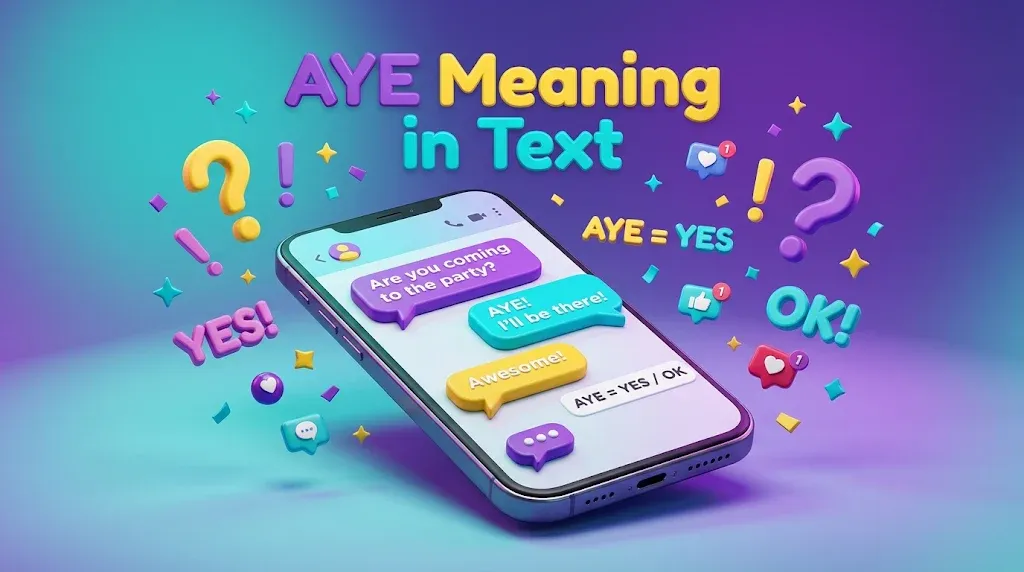
AYE usually means “yes,” “yeah,” or “I agree” in text messages. It is an informal affirmative expression that people use to confirm something, agree with an opinion, or respond positively. In some conversations, it can also be used like “hey” to get someone’s attention.
For example:
- Person 1: “Are you coming with us?”
- Person 2: “Aye!”
Here, AYE simply means “Yes!”
However, the expression can communicate different things depending on the surrounding words and conversational tone. It is also an established English word, rather than a modern texting abbreviation with a standard full form.
Let’s explore its meanings, social media usage, examples, and the best ways to respond.
What Does AYE Mean in Text?
In texting, AYE most commonly means “yes” or “yeah.” It is a casual way to agree with someone, answer a question, or confirm a plan.
For example:
Friend: “Are you ready for the movie?”
You: “Aye!”
Meaning: Yes, I’m ready.
Another example:
Friend: “That was an amazing performance.”
You: “Aye, absolutely!”
Meaning: Yeah, I agree.
The word AYE is traditionally associated with Scottish English and Northern English usage. It is also recognized in standard English dictionaries as an affirmative expression.
Although people use it informally in digital conversations, it is not exclusively internet slang.
AYE Meaning at a Glance
Here is a quick overview of what AYE can communicate in different situations.
| Expression | Meaning | Context |
| AYE | Yes or yeah | Answering a question |
| AYE! | Yes, absolutely! | Enthusiastic agreement |
| Aye, I agree | I agree | Supporting an opinion |
| Aye, listen! | Hey, listen! | Getting attention |
| AYEEE | Excitement or approval | Celebrating something |
| Aye aye | Understood, I’ll do it | Acknowledging instructions |
The most important meaning to remember is yes. Other interpretations depend on how the expression is used.
Different Meanings of AYE in Text Messages
AYE does not always communicate the same thing. Its meaning can change with the conversation.
1. AYE Means Yes or Yeah
This is the primary meaning. Someone may write AYE instead of yes or yeah when answering a question.
Example:
Friend: “Are you joining us for dinner?”
You: “Aye!”
Meaning: Yes, I’m joining you.
2. AYE Means I Agree
AYE can also communicate agreement with another person’s opinion, suggestion, or statement.
Example:
Friend: “We should definitely visit that place again.”
You: “Aye, it was amazing!”
Meaning: Yes, I agree with you.
3. AYE Means Okay or Understood
In certain conversations, AYE works as an acknowledgment. It indicates that someone has received or understood an Instruction.
Example:
Person 1: “Please send me the pictures tonight.”
Person 2: “Aye, I’ll send them.”
Meaning: Okay, I understand and will do it.
4. AYE as an Attention-Getter
Sometimes AYE is used at the beginning of a sentence to attract someone’s attention, similar to “hey.”
Example:
Friend: “Aye, look at this!”
You: “What happened?”
Meaning: Hey, take a look at this.
This is a contextual conversational use, not the main dictionary definition of AYE.
5. AYE as an Expression of Excitement
When someone writes “AYE!” or “AYEEE!”, the expression can communicate excitement, celebration, or approval.
Example:
Friend: “We finally won the competition!”
You: “AYEEE! That’s amazing!”
Meaning: You’re excited and happy about the news.
Extra letters and exclamation marks emphasize the emotion rather than creating a separate standard definition.
What Does AYE Mean From a Girl?
When a girl sends you “AYE,” she may be agreeing with you, confirming something, acknowledging your message, or trying to get your attention.
The actual meaning depends on the conversation.
Example 1: Agreeing with your suggestion
You: “Let’s go shopping tomorrow.”
Her: “Aye!”
Meaning: She agrees with your suggestion.
Example 2: Getting your attention
Her: “Aye, listen to me!”
Meaning: She wants you to pay attention.
Example 3: Responding enthusiastically
You: “You looked amazing today.”
Her: “Ayee, thank you!”
Meaning: She is responding positively or playfully.
Does AYE mean she likes you?
Not necessarily. AYE by itself does not prove romantic interest or flirting. Look at the overall conversation, her other messages, and whether she consistently shows interest.
What Does AYE Mean From a Guy?
When a guy texts AYE, he is generally saying yes, agreeing with something, acknowledging a message, or expressing enthusiasm.
Here are some examples:
Example 1: Confirming plans
You: “Are we still meeting tomorrow?”
Him: “Aye.”
Meaning: Yes, the plan is still on.
Example 2: Showing agreement
You: “That football match was incredible!”
Him: “Aye bro!”
Meaning: He agrees with your opinion.
Example 3: Expressing excitement
You: “We got the tickets!”
Him: “AYEEE!”
Meaning: He is excited about the news.
A guy’s use of AYE does not automatically indicate flirting. The surrounding conversation is much more important.
AYE Meaning on Snapchat, Instagram, TikTok, and WhatsApp
AYE generally has the same basic meaning across social media platforms. However, the way people use it can vary with the type of conversation.
AYE Meaning on Snapchat
On Snapchat, AYE can mean yes, yeah, or hey. People may use it in quick messages and informal conversations.
Example:
Friend: “Are you coming tonight?”
You: “Aye!”
Meaning: Yes, I’m coming.
Another example:
“Aye, you home?”
Meaning: Hey, are you home?
AYE Meaning on Instagram
On Instagram, people may use AYE in direct messages, story replies, and comments.
Example:
Person 1: “Your new picture looks amazing!”
Person 2: “AYEEE, thank you!”
Meaning: An enthusiastic and Appreciative Response.
AYE Meaning on TikTok
On TikTok, AYE or AYEEE may appear in comments to express excitement, approval, or enthusiasm.
Example:
“AYEEE 🔥 This video is amazing!”
Meaning: The commenter is showing excitement and appreciation.
AYE Meaning on WhatsApp
On WhatsApp, AYE can be used in casual conversations with friends, family members, and other contacts.
Example:
Person 1: “Are you coming tomorrow?”
Person 2: “Aye, definitely.”
Meaning: Yes, definitely.
Important: Snapchat, Instagram, TikTok, and WhatsApp do not give AYE completely different dictionary definitions. The context determines its intended meaning.
What Does AYE AYE Mean in Text?
“AYE AYE” is commonly associated with acknowledging an instruction and communicating that you understand and will follow it.
It is traditionally connected with the expression “Aye, aye, captain!”
In casual messages, it can mean:
- Okay, understood.
- Yes, I will.
- Got it!
- I’ll do that.
- Consider it done.
Example:
Friend: “Don’t forget to bring your laptop tomorrow.”
You: “Aye aye, captain! 😂”
Meaning: Okay, I won’t forget!
People also use this expression humorously to make an ordinary acknowledgment sound playful.
Is AYE an Acronym or Does It Have a Full Form?
No, AYE does not normally have a standard full form in texting.
Unlike common texting abbreviations such as:
- LOL = Laughing Out Loud
- BRB = Be Right Back
- IDK = I Don’t Know
- BTW = By The Way
AYE is generally an established English word meaning yes or expressing agreement.
People sometimes search for an AYE full form because they assume every short expression is an acronym. However, in ordinary text messages, AYE is not generally formed from the first letters of three separate words.
Specialized organizations or industries may use AYE as an acronym, but those meanings are separate from its everyday conversational meaning.
Is AYE Slang or a Real English Word?
AYE is a real English word that can also be used informally in everyday communication.
It has traditional regional associations, especially with Scottish English and Northern English. Cambridge Dictionary describes it as another word for yes, particularly in older, Northern English, or Scottish usage.
Its common meanings include:
- Yes or yeah.
- An affirmative response.
- Agreement or approval.
- An affirmative vote.
In modern messaging, people may use it as a casual alternative to yes or yeah.
Therefore, describing AYE as informal language is reasonable, but calling it Exclusively modern internet slang would be misleading.
Origin and History of AYE
AYE has a longer history than its use in modern text messages.
The word has traditionally been associated with Scottish and Northern English speech. It has also been used in formal voting situations, where an aye vote indicates support for a proposal.
For example:
“All those in favour say aye.”
Here, AYE means a vote in favour.
Another historical expression is “aye, aye, sir,” traditionally associated with acknowledging and following an instruction, particularly in nautical language.
Today, the word appears in informal speech, regional expressions, online messages, and playful conversations.
How to Reply When Someone Says AYE
Your response should match what the other person is trying to communicate.
Here are some natural replies:
| Their message | Possible reply |
| Aye! | Okay! |
| Aye, sure. | Sounds good! |
| Aye, I agree. | Exactly! |
| AYE 😂 | Haha, absolutely! |
| Aye, what’s up? | Not much, you? |
| Aye, I’m coming. | See you soon! |
| Aye aye, captain! | That’s the spirit! |
You can also use these short responses:
- Yeah, exactly!
- Alright!
- Got it!
- Sounds good.
- Absolutely!
- Haha, okay!
- What’s up?
- Perfect!
If you cannot understand the sender’s intention, simply ask, “Do you mean yes?”
AYE vs. Yeah vs. Yep vs. Aight
AYE, yeah, yep, and aight can all communicate agreement or acknowledgment, but they have slightly different conversational styles.
| Expression | Meaning | Typical tone |
| AYE | Yes or I agree | Informal, sometimes regional |
| Yeah | Yes | Casual and natural |
| Yep | Yes | Friendly and brief |
| Yup | Yes | Casual and direct |
| Aight | Alright or okay | Very informal |
Examples:
- “Are you coming?” → “Aye!” = Yes!
- “Are you coming?” → “Yeah!” = Yes!
- “Are you coming?” → “Yep!” = Yes!
- “Are you coming?” → “Aight!” = Okay!
These expressions are not always interchangeable. For example, aight usually communicates acceptance or acknowledgment, while AYE is more directly associated with an affirmative.
Examples of AYE in Real Text Conversations
Here are realistic examples showing how AYE might appear in everyday digital communication.
1. Between Friends
Friend 1: “Wanna play football today?”
Friend 2: “Aye, let’s go!”
Meaning: Yes, let’s play.
2. Making Plans
Person 1: “Meet me at 7 PM.”
Person 2: “Aye, I’ll be there.”
Meaning: Okay, I’ll be there.
3. Showing Agreement
Person 1: “This restaurant has the best food.”
Person 2: “Aye, no doubt!”
Meaning: Yes, I agree.
4. Getting Attention
Person 1: “Aye, check your phone!”
Person 2: “What’s up?”
Meaning: Hey, look at your phone.
5. Celebrating Something
Person 1: “We passed the exam!”
Person 2: “AYEEE! Congratulations!”
Meaning: Excitement and happiness.
6. A Playful Response
Person 1: “Finish your homework before gaming.”
Person 2: “Aye aye, boss! 😂”
Meaning: Okay, I’ll do it.
7. Confirming a Question
Person 1: “Did you receive my message?”
Person 2: “Aye.”
Meaning: Yes, I received it.
8. Agreeing With a Suggestion
Person 1: “Let’s watch a movie this weekend.”
Person 2: “Aye, sounds good!”
Meaning: Yes, I like that idea.
Does AYE Have Different Meanings Depending on Context?
Yes. Although AYE usually means yes, the surrounding conversation can influence its intended meaning.
Consider these examples:
- “Are you ready?” → “Aye.” = Yes.
- “Aye, listen!” = Hey, pay attention.
- “AYEEE! We did it!” = Excitement.
- “Aye, I agree.” = Agreement.
- “Aye aye, captain!” = Understood; I’ll follow your instruction.
Pay attention to these five clues:
1. The previous message: If someone asks a direct question, AYE is more likely to mean yes.
2. Punctuation: An exclamation mark may suggest excitement or emphasis.
3. Repeated letters: AYEEE often communicates enthusiasm.
4. Surrounding words: Words such as “listen,” “look,” or someone’s name may indicate that AYE is being used to attract attention.
5. Communication style: Friends may use AYE differently from people having a formal conversation.
The best way to understand the expression is to read the complete message rather than interpreting one word in isolation.
Common Misunderstandings About AYE
There are a few common mistakes people make when interpreting AYE.
1. Assuming AYE is always an acronym
AYE is generally an established English word, not an abbreviation with a standard texting full form.
2. Assuming it always means hey
Although it can be used to attract attention in some conversations, its primary affirmative meaning is yes.
3. Assuming AYEEE has a completely different definition
The additional letters usually emphasize excitement or enthusiasm.
4. Assuming AYE means romantic interest
A person using AYE is not necessarily flirting. It can simply be an ordinary response.
5. Assuming every social media platform gives it a different meaning
Its fundamental meaning generally stays the same across messaging platforms.
- Related To Another Article: https://blessnesty.com/wgy-meaning-in-text/
People Also Ask
AYE usually means yes, yeah, or I agree. It is an informal expression used to confirm something or show agreement in a conversation.
It can mean either, depending on context. As a reply to a question, it usually means yes. At the beginning of a sentence, it can sometimes work like hey to get someone’s attention.
A girl may use AYE to agree, confirm something, acknowledge your message, or get your attention. It does not automatically mean she is flirting.
A guy generally uses AYE to say yes, show agreement, acknowledge something, or express excitement.
AYEEE is an expressive variation of AYE. It commonly communicates excitement, enthusiasm, celebration, or approval.
Conclusion
Now you know that AYE’s meaning in text is usually “yes,” “yeah,” or “I agree.” It is an established English word that people also use informally in text messages, Snapchat, Instagram, TikTok, and WhatsApp.
Depending on the conversation, it can also work as an attention-getter or express excitement. Meanwhile, AYE AYE is commonly used to acknowledge instructions or respond playfully.
The easiest way to understand AYE is to look at the surrounding words and the tone of the conversation. When someone sends it to you, they are most likely agreeing, confirming something, or responding positively.
Explore More texting meanings to understand the expressions people use in everyday digital conversations.