Introduction
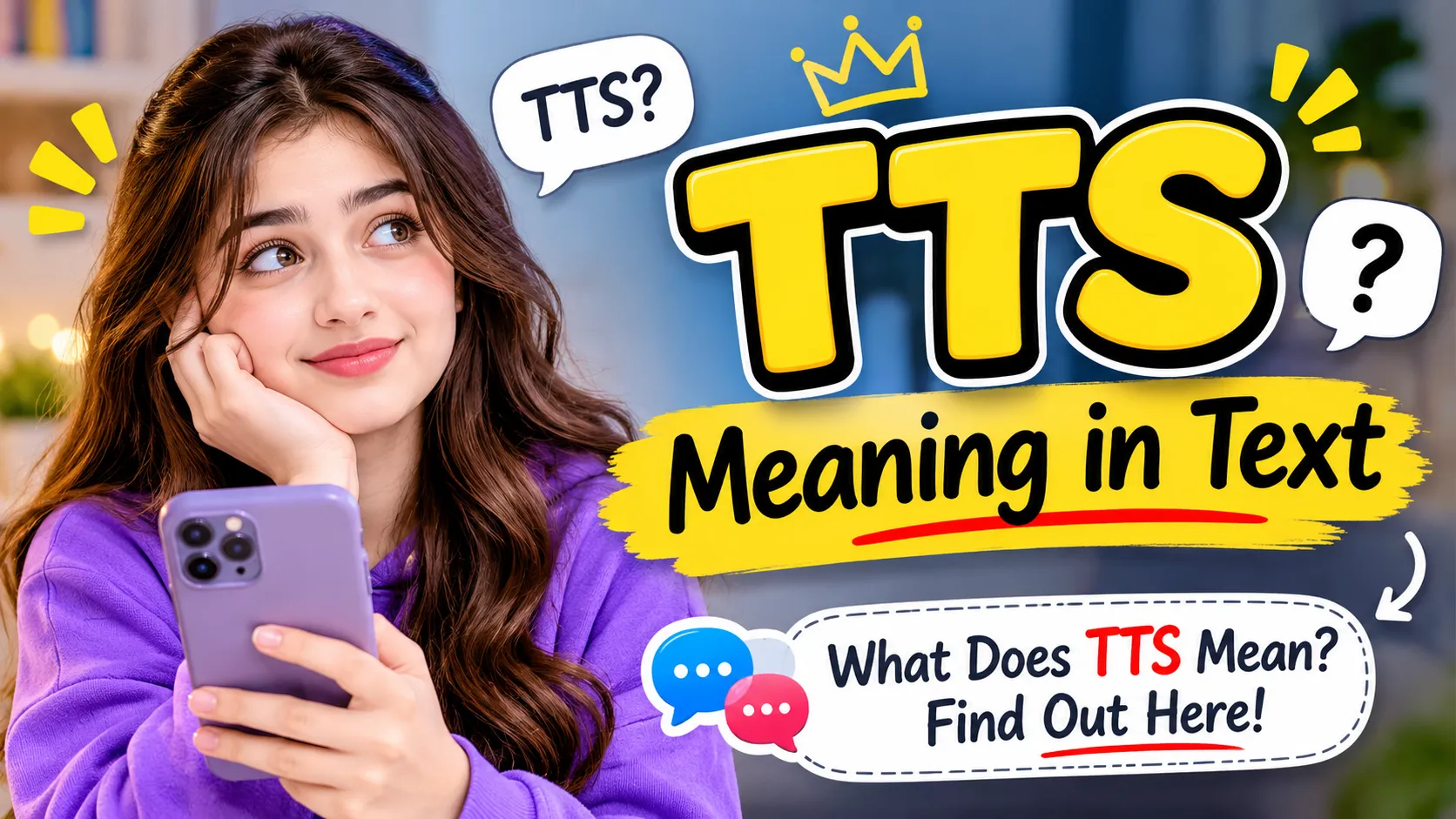
Have you received a message containing TTS and wondered what it means? This three-letter abbreviation can be confusing, especially when people use it in text messages, social media comments, gaming chats, and online discussions.
TTS most commonly stands for Text-to-Speech. It refers to technology that converts written words into spoken audio through a computer-generated or AI-powered voice. It allows people to listen to written content instead of reading it themselves.
However, the intended meaning can depend on the conversation. Some people may informally use TTS to mean “Talk to You Soon,” although this is not a widely established texting abbreviation.
In this guide, you’ll learn the full meaning of TTS, how people use it on Snapchat, TikTok, Instagram, and WhatsApp, what it means in different conversations, and how to reply naturally.
What Does TTS Mean in Text?
TTS means Text-to-Speech, a technology that converts written words into spoken audio using a digital voice.
In everyday online conversations, people commonly use TTS when discussing AI voices, automated narration, voice generators, and accessibility features.
For example:
- “I used TTS for my latest video.”
- “Can you add TTS to this script?”
- “My phone uses TTS to read notifications.”
In these examples, TTS refers to a tool or feature that reads written content aloud.
According to Cambridge Dictionary, TTS is the recognized abbreviation for Text-to-Speech.
English meaning – Cambridge Dictionary+1
Unlike common expressions such as LOL or BRB, TTS usually describes a technology rather than a feeling or reaction.
TTS Meaning at a Glance
Here’s a quick overview of the abbreviation and its common uses.
| Element | Meaning |
| Abbreviation | TTS |
| Full form | Text-to-Speech |
| Main category | Technology abbreviation |
| Basic definition | Converts written text into spoken audio |
| Common usage | AI voices, narration, accessibility |
| Social media usage | Automated video narration |
| Alternative interpretation | Talk to You Soon (informal) |
| Tone | Usually neutral |
Simple explanation: TTS allows a computer, phone, or application to speak written words aloud.
What Does TTS Stand For?
TTS stands for Text-to-Speech.
It is also known as speech synthesis. The technology takes written information and generates an audible voice that speaks the words.
For example, imagine typing:
“Welcome to my YouTube channel. Don’t forget to subscribe!”
A TTS application can convert that sentence into spoken audio without requiring you to record your own voice.
Modern TTS systems can offer:
- Different digital voices.
- Multiple languages and accents.
- Adjustable speaking speeds.
- Different voice styles.
- Natural-sounding AI narration.
- Automated reading of digital content.
Microsoft’s speech technology documentation also describes text-to-speech as converting text into humanlike synthesized speech.
Microsoft Learn+1
Does TTS Have More Than One Meaning?
Yes, the letters TTS can have different interpretations depending on the context.
However, not every possible expansion is equally established.
Here are the two interpretations most relevant to this article.
1. Text-to-Speech
This is the established and widely recognized meaning.
It refers to software or technology that converts written words into spoken audio.
Example:
“That video uses TTS for narration.”
Meaning: The video uses a computer-generated voice to speak its written script.
2. Talk to You Soon
Some people may informally use TTS as a shortened version of “Talk to You Soon.”
Example:
“I have to leave now. TTS!”
Meaning: The sender may be saying they will talk to you again soon.
However, this is not a universally recognized texting expansion. TTYS is a clearer abbreviation for “Talk to You Soon,” while TTYL means “Talk to You Later.”
How to identify the correct meaning
| Conversation context | Likely interpretation |
| AI voice discussion | Text-to-Speech |
| Video editing | Text-to-Speech |
| TikTok narration | Text-to-Speech |
| Accessibility features | Text-to-Speech |
| Phone reading messages aloud | Text-to-Speech |
| Casual goodbye | Possibly Talk to You Soon |
The surrounding words are more useful than the abbreviation alone.
How Is TTS Used in Text Messages?
People use TTS in messages when discussing digital voices, automated narration, or applications that read written content aloud.
Here are some natural examples:
- “Can you send me that TTS voice?”
- “I use TTS because I don’t like recording myself.”
- “My phone has a TTS feature.”
- “This video sounds like it has AI-generated TTS.”
- “You should try TTS for your next project.”
In all these examples, TTS refers to text-to-speech technology.
Sometimes, someone may use the abbreviation in a casual conversation-ending message. In that situation, consider the entire conversation before deciding what they mean.
TTS Meaning on Snapchat
On Snapchat , TTS generally refers to Text-to-Speech when people discuss automated voices, digital narration, or voice-related features.
For example:
Friend: How did you make your video speak?
You: I used TTS.
Friend: That voice sounds funny!
Here, TTS means the creator used a digital voice to read written words aloud.
You might also encounter TTS in conversations about:
- Automated video narration.
- AI-generated voices.
- Voice applications.
- Accessibility tools.
- Digital content creation.
There is no widely established Snapchat-specific Slang Meaning of TTS. Its intended meaning depends on the surrounding conversation.
TTS Meaning on TikTok
On TikTok, TTS usually means Text-to-Speech.
The abbreviation is especially relevant to automated narration, where a digital voice reads written words aloud in a video.
For example:
- “I used TTS for my TikTok.”
- “Which TTS voice is that?”
- “This TTS sounds so realistic.”
- “Can you add TTS to my video?”
Content creators can use text-to-speech for storytelling, tutorials, entertainment, educational videos, and voice narration.
If somebody comments “I love this TTS,” they are most likely talking about the generated voice.
TTS Meaning on Instagram
On Instagram, TTS generally refers to Text-to-Speech, particularly in conversations about Reels, Stories, and automated narration.
For example:
“Your Reel sounds better with TTS.”
This means the person likes the digital voice used in the video.
Other examples include:
- “Which TTS tool did you use?”
- “I want to try TTS for my next Reel.”
- “That automated voice sounds natural.”
- “Can you make a TTS version of this caption?”
In Instagram DMs, the meaning depends on the subject being discussed. If the conversation is about video editing or AI voices, Text-to-Speech is the stronger interpretation.
TTS Meaning on WhatsApp
On WhatsApp, TTS can refer to technology that reads written messages or notifications aloud.
For example:
“My phone uses TTS to read my WhatsApp notifications.”
This means the device converts written notifications into spoken audio.
People may also mention TTS when discussing:
- Accessibility features.
- Reading long messages aloud.
- Voice applications.
- Digital assistants.
- Automated speech technology.
If someone sends only “TTS” without explaining the context, don’t automatically assume it is a common WhatsApp slang expression.
TTS Meaning on Facebook, Discord, Reddit, and X
TTS can also appear on other online platforms, but its meaning generally remains connected to the conversation.
| Platform | Possible usage |
| Discussions about digital voices and video narration | |
| Discord | Text-to-speech bots and spoken chat messages |
| Technology discussions and AI-generated narration | |
| X (Twitter) | Posts about voice generation and accessibility |
| Gaming chats | Reading written chat messages aloud |
For example, someone on Discord might ask:
“Can you enable TTS for the server?”
They are likely asking for a feature that reads messages aloud.
The abbreviation does not necessarily have a separate meaning on each platform.
- Related To Another Article: https://blessnesty.com/ikyfl-meaning-in-text/
TTS Meaning From a Girl or Guy
TTS does not have a different established meaning depending on whether a girl or guy sends it.
The intended interpretation depends on the conversation, not the sender’s gender.
When a girl sends TTS:
If she says, “I used TTS for my video,” she is probably talking about a text-to-speech voice.
If she sends it while ending a conversation, she might informally mean that she will talk to you soon.
When a guy sends TTS:
The same principle applies. He might be discussing an automated voice, a video, an accessibility feature, or an informal goodbye.
TTS is not inherently romantic, flirty, or suggestive.
Is TTS Slang or an Abbreviation?
TTS is primarily a Technology Abbreviation, not traditional internet slang.
Traditional texting abbreviations often represent common expressions or reactions.
For example:
| Abbreviation | Full form |
| LOL | Laughing Out Loud |
| BRB | Be Right Back |
| IDK | I Don’t Know |
| TTYL | Talk to You Later |
| TTYS | Talk to You Soon |
| TTS | Text-to-Speech |
People may use TTS casually in social media comments, gaming chats, and direct messages, but its established meaning remains connected to speech technology.
Examples of TTS in Real Conversations
The following examples demonstrate how TTS can appear in different everyday situations.
Example 1: Discussing a video
Alex: “How did you create that voice?”
Sam: “I used TTS.”
Meaning: Sam used text-to-speech technology to generate the voice.
Example 2: Phone notifications
Alex: “Why is my phone reading everything aloud?”
Sam: “Your TTS feature might be enabled.”
Meaning: A text-to-speech feature may be reading the written content.
Example 3: TikTok narration
Alex: “Your TikTok has a funny voice.”
Sam: “That’s the TTS voice I selected.”
Meaning: Sam selected an automated narration voice.
Example 4: Gaming conversation
Alex: “Can the game read chat messages aloud?”
Sam: “Yes, turn on TTS.”
Meaning: The game can use text-to-speech to read messages.
Example 5: Casual goodbye
Alex: “I have to finish my homework. TTS!”
Sam: “Sure, talk soon!”
Meaning: Alex might be using TTS informally to mean Talk to You Soon.
Example 6: AI voice discussion
Alex: “Can AI read my article for me?”
Sam: “Yes, you can use a TTS generator.”
Meaning: A text-to-speech application can convert the article into spoken audio.
How to Reply When Someone Says TTS?
Your reply should match what the other person is discussing.
If they’re talking about text-to-speech technology, you can respond with:
- “Which TTS voice did you use?”
- “That voice sounds really natural!”
- “Can you show me how to use it?”
- “That’s a cool feature.”
- “I want to try that too.”
If they’re using TTS as an informal goodbye, you could reply:
- “Talk soon!”
- “Sure, catch you later!”
- “Okay, take care!”
- “See you later!”
- “Sounds good!”
You’re unsure what they mean, simply ask:
“What do you mean by TTS?”
Asking for clarification is better than assuming the wrong interpretation.
Is TTS Rude, Flirty, or Friendly?
No, TTS is not inherently rude, flirty, or offensive.
Its tone depends on the context in which someone uses it.
- Friendly: Someone shares a useful text-to-speech tool.
- Neutral: Someone explains that their phone reads messages aloud.
- Casual: Someone informally uses TTS while ending a conversation.
- Funny: Someone uses an exaggerated digital voice in a meme.
- Professional: Someone discusses automated narration for a project.
You cannot determine someone’s feelings or intentions from the abbreviation alone.
How Does Text-to-Speech Technology Work?
Text-to-speech technology takes written words and converts them into audio that a device can play through speakers or headphones.
A simplified process looks like this:
- Text input: A user enters written content into an application.
- Text processing: The software analyzes words and sentence structure.
- Speech generation: A speech synthesis system generates the spoken output.
- Audio playback: The generated voice is played through an audio device.
Modern AI-powered systems can produce natural-sounding speech with different voices, languages, and speaking styles.
The MDN Web Speech API Documentation explains that speech synthesis allows applications to read text content aloud using available digital voices.
MDN+1
Common uses of TTS technology
- Reading digital books aloud.
- Creating automated video narration.
- Supporting people who have difficulty reading.
- Providing spoken website content.
- Generating voiceovers for presentations.
- Reading notifications and digital messages.
And TTS is therefore useful beyond social media slang and everyday messaging.
TTS vs. STT: What’s the Difference?
TTS and STT are related technologies, but they perform opposite tasks.
| Feature | TTS | STT |
| Full form | Text-to-Speech | Speech-to-Text |
| Input | Written text | Spoken audio |
| Output | Spoken audio | Written text |
| Main function | Reads text aloud | Converts speech into text |
| Common use | Voice narration | Voice typing |
Example: You type a sentence, and your phone reads it aloud.
STT example: You speak a sentence, and your phone converts your speech into written words.
An easy way to remember the difference is that TTS speaks text, while STT writes speech.
MDN+1
Common Misunderstandings About TTS
There are several misconceptions about this abbreviation.
1. TTS always means Talk to You Soon.
Incorrect. Text-to-Speech is the established meaning. The alternative goodbye interpretation is informal and less established.
2. TTS is always internet slang.
Incorrect. It is primarily a technology abbreviation.
3. TTS has a different meaning on every social media platform.
Not necessarily. The general meaning usually remains Text-to-Speech when discussing digital voices.
4. TTS and STT are the same thing.
Incorrect. TTS converts written text into audio, while STT converts spoken audio into text.
5. TTS is a romantic abbreviation.
There is no established romantic meaning associated with TTS.
Understanding these differences helps prevent confusion when reading online conversations.
People Also Ask
TTS most commonly means Text-to-Speech. It refers to technology that converts written words into spoken audio. In some informal conversations, it might also mean Talk to You Soon.
The most widely recognized full form is Text-to-Speech. It describes technology that reads written words aloud using a computer-generated or AI-powered voice.
Some people may informally use TTS to mean Talk to You Soon, especially when ending a conversation. However, TTYS is a clearer and more recognizable abbreviation for that expression.
On Snapchat, TTS generally refers to Text-to-Speech when people discuss digital voices, automated narration, or voice-related features. It does not have a widely established Snapchat-specific slang meaning.
On TikTok, TTS means Text-to-Speech. It commonly describes an automated voice that reads written text aloud in a video.
Conclusion
Understanding TTS Meaning In Text becomes easier when you consider the surrounding conversation.
TTS most commonly stands for Text-to-Speech, a technology that converts written words into spoken audio. It frequently appears in discussions about AI voices, video narration, accessibility features, and digital communication.
You might also encounter an informal interpretation meaning Talk to You Soon, although this is less established than the technology-related meaning.
Whether you see TTS on Snapchat, TikTok, Instagram, WhatsApp, or in an ordinary text message, always consider the context before deciding what someone means.
Now that you understand its full form, common uses, and possible interpretations, you can recognize TTS more confidently in everyday online conversations.