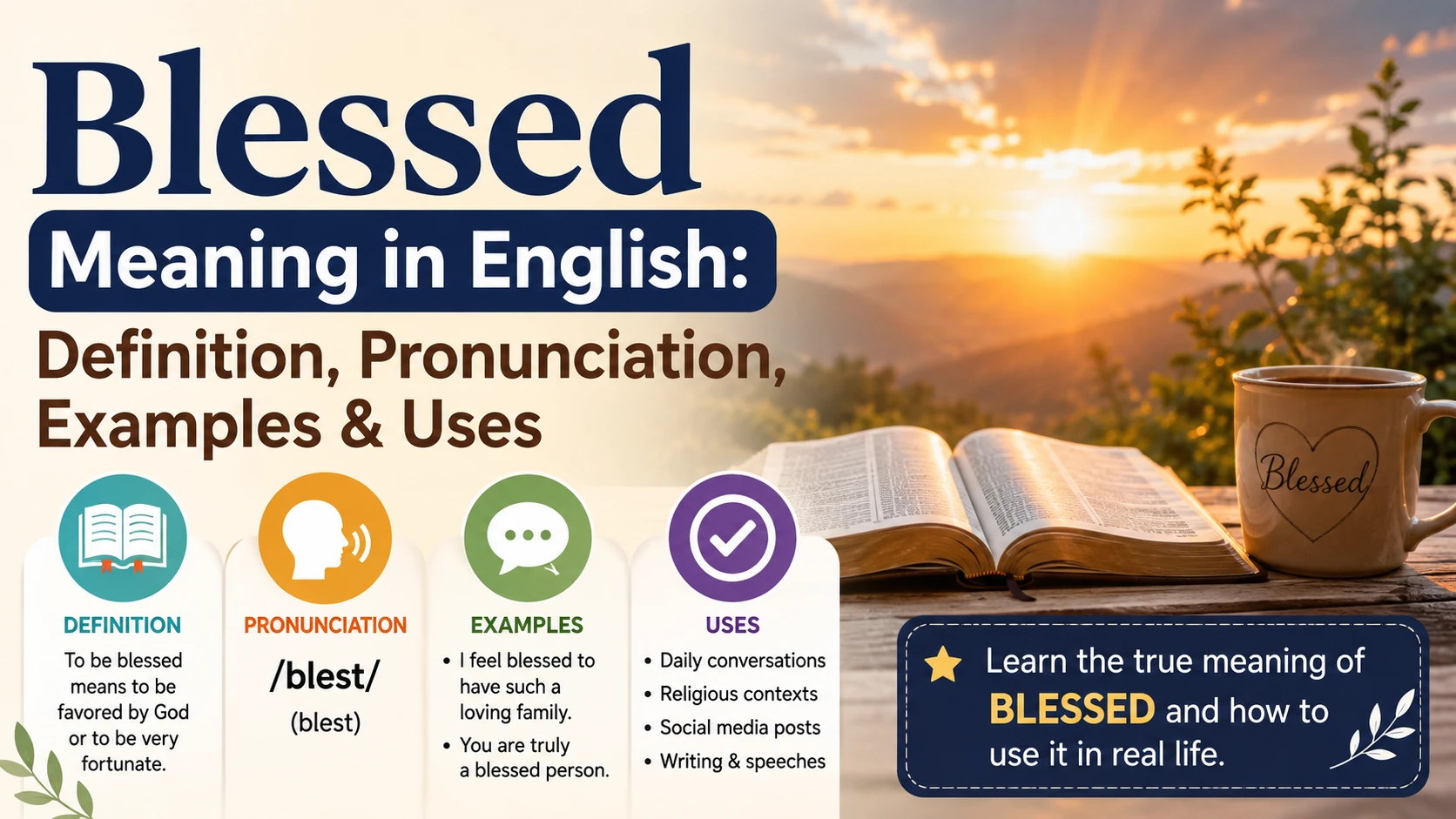
If you are searching for the blessed meaning in English, you may have noticed that this word can express several related ideas. In everyday English, blessed often means fortunate, grateful, happy, favored, or thankful for something valuable. In religious contexts, it can have a deeper meaning connected with holiness, divine favor, sacredness, or spiritual happiness.
The exact meaning of blessed depends on the context in which it is used. For example, “I feel blessed” usually expresses gratitude for the good things in someone’s life, while “a blessed place” may refer to something considered holy or sacred. The phrase “blessed with” commonly means being fortunate to have a particular quality, talent, relationship, opportunity, or advantage.
Blessed Meaning in English
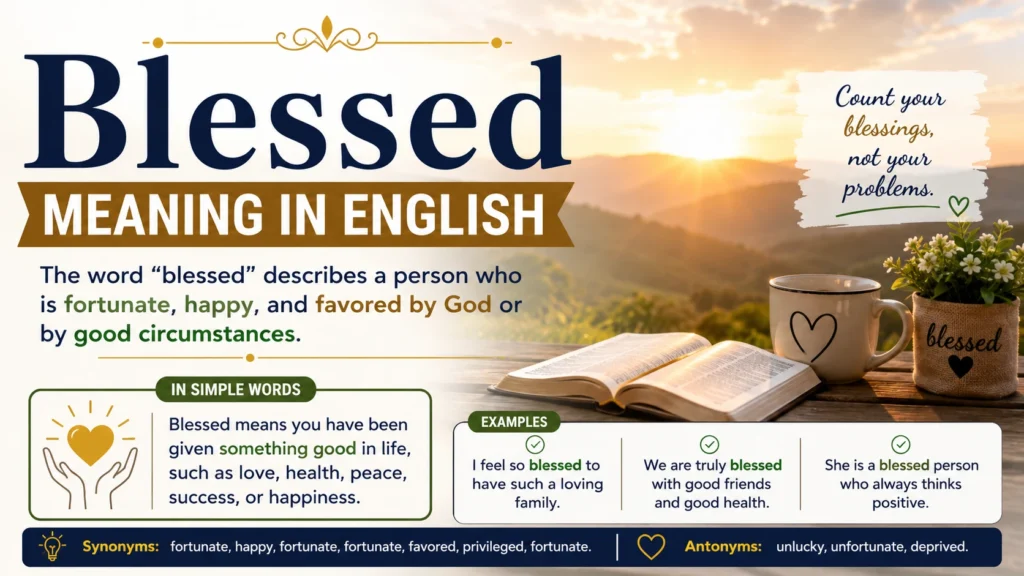
The word blessed generally means fortunate, grateful, favored, happy, holy, sacred, or spiritually favored, depending on the situation.
In everyday English, blessed commonly describes a person who feels thankful for the positive things in life. It can refer to family, friendships, opportunities, talents, achievements, peaceful experiences, or other things that someone deeply values.
For example:
- I feel blessed to have such supportive friends.
- She is blessed with a beautiful singing voice.
- We are blessed to have a loving family.
- He felt blessed after receiving the opportunity.
- It was a blessed moment of peace.
The word therefore carries more emotional warmth than simply saying that something is good or fortunate.
Blessed Meaning in Simple English
In simple English, blessed can mean having something good, valuable, fortunate, meaningful, or spiritually important.
The meaning changes according to the context. When someone says “I feel blessed,” they are usually saying that they feel fortunate and grateful. In religious language, blessed may describe someone or something that is holy, spiritually favored, or connected with divine goodness.
A simple way to remember the word is:
Blessed Pronunciation
The first is /ˈblesɪd/, which sounds approximately like “BLESS-id.” This pronunciation is common when blessed is used as an adjective, especially in expressions involving religious or emotional meaning.
The second is /blest/, which sounds like “blest.” This pronunciation is also used in English, particularly in religious, literary, or traditional contexts.
The spelling remains blessed, although blest can appear as a less common literary or poetic form.
Examples of Pronunciation in Context
- I feel blessed to have a wonderful family.
- She was blessed with exceptional talent.
- The blessed event brought everyone together.
- The phrase was read from a religious text.
Understanding both pronunciations can help English learners recognize the word when listening to conversations, reading literature, or encountering religious language.
Blessed Meaning in the Bible and Religion
In the Bible and other religious contexts, blessed can have a deeper meaning than simply being lucky or successful.
It may refer to holiness, sacredness, divine favor, spiritual happiness, God’s goodness, or God’s help and protection. The exact meaning depends on the passage and the translation being used.
Importantly, blessed does not necessarily mean wealthy, successful, or free from difficulties in a religious context. A person may be described as blessed because of spiritual qualities, faith, hope, righteousness, peace, or a relationship with God.
For example:
- The blessed person remained faithful during difficult times.
- The holy place was considered blessed.
- They prayed for a blessed life filled with peace and faith.
- The passage describes those who are blessed because of their spiritual condition.
Thus, the religious meaning of blessed should always be understood from the surrounding passage rather than from the word alone.
What Does “I Feel Blessed” Mean?
The phrase “I feel blessed” usually means “I feel fortunate, grateful, or thankful for the good things in my life.”
Someone might say “I feel blessed” when talking about:
- Family
- Friends
- Love
- Health and well-being
- Career opportunities
- Personal achievements
- Talents
- Special experiences
- Peaceful moments
- Support from others
For example:
“I feel blessed to have such caring parents.”
Here, blessed means that the speaker feels fortunate and grateful because of their parents.
The expression can be religious, but it does not always have a religious meaning. Many people use it in ordinary conversation simply to communicate sincere appreciation.
What Does “Blessed With” Mean?
The phrase “blessed with” means fortunate to have something valuable or desirable.
It is commonly followed by a noun describing a talent, quality, relationship, opportunity, ability, or advantage.
Examples include:
- She was blessed with a beautiful voice.
- He is blessed with wonderful children.
- They were blessed with supportive friends.
- She was blessed with natural talent.
- We are blessed with a great opportunity.
In these examples, blessed with does not necessarily mean that the speaker is making a religious statement. It often simply emphasizes appreciation for something valuable.
Blessed vs. Lucky vs. Fortunate
Blessed, lucky, and fortunate can have similar meanings, but they are not always interchangeable.
Lucky usually emphasizes favorable circumstances or unexpected good fortune.
Fortunate is a more neutral or formal way of describing a favorable situation.
Blessed often adds a stronger sense of gratitude, personal value, favor, or spiritual meaning.
Compare these examples:
- I was lucky to get the job.
- I was fortunate to get the job.
- I feel blessed to have this opportunity.
All three sentences describe a positive situation, but the emotional tone changes. Lucky focuses on good fortune, fortunate sounds more neutral, while blessed often expresses deeper appreciation.
Blessed vs. Blessing
The Blessed and blessing come from the same word family, but they have different grammatical functions.
Blessed is generally an adjective:
I feel blessed.
Blessing is generally a noun:
My family is a blessing.
A simple way to remember the difference is:
Blessed describes; blessing names.
A person may feel blessed because they have received a blessing.
For example:
My children are a blessing, and I feel blessed to have them.
Here, blessing identifies something valued, while blessed describes the person’s emotional or fortunate state.
Blessed Synonyms
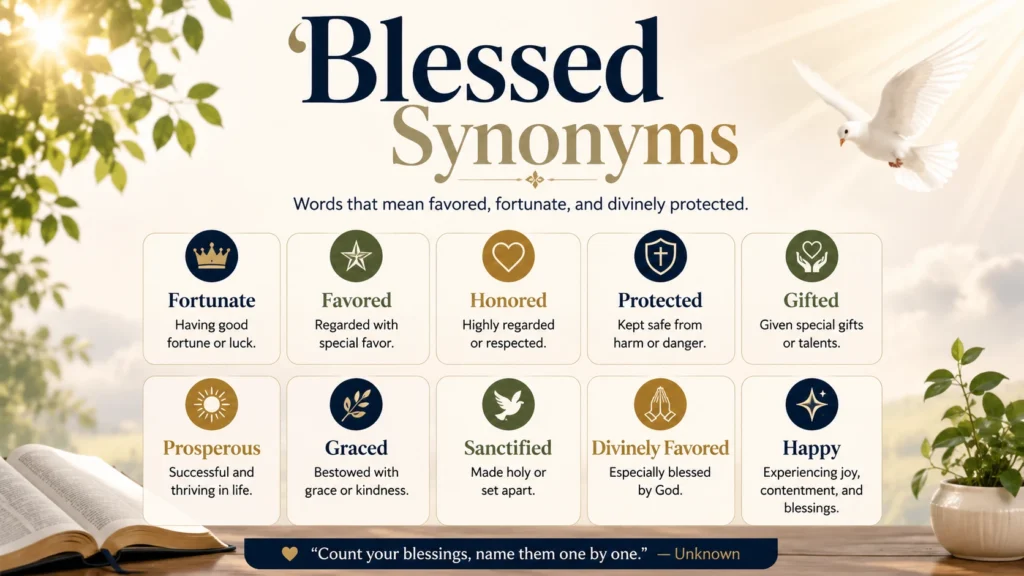
The best synonym for blessed depends on the meaning intended.
When Blessed Means Fortunate
Useful synonyms include:
- Fortunate
- Lucky
- Favored
- Privileged
- Gifted
Example:
I feel fortunate to have such wonderful friends.
When Blessed Means Holy
Possible synonyms include:
- Holy
- Sacred
- Divine
- Hallowed
- Revered
- Sanctified
Example:
The site is considered sacred by the community.
When Blessed Expresses Happiness or Gratitude
Depending on the sentence, related words may include:
- Grateful
- Happy
- Peaceful
- Content
- Joyful
- Blissful
However, these words are not perfect replacements in every sentence. The surrounding context determines which synonym best preserves the original meaning.
Blessed Antonyms
The opposite of blessed also depends on the intended meaning.
When blessed means fortunate, possible opposites include:
- Unfortunate
- Unlucky
- Disadvantaged
- Cursed
Blessed means happy or peaceful, possible contrasts include:
- Unhappy
- Troubled
- Distressed
- Miserable
When blessed refers to something holy or sacred, the appropriate opposite depends heavily on the specific religious or literary context.
Common Expressions With Blessed
The word blessed appears in many common English expressions.
“I Feel Blessed”
This means:
I feel fortunate and grateful for the good things in my life.
Example:
I feel blessed to have such supportive people around me.
“Blessed With”
This means:
fortunate to have something valuable or desirable.
Example:
She was blessed with natural musical talent.
“Have a Blessed Day”
This expression is often used as a warm wish for someone’s day. It can have a religious tone, but depending on the speaker and context, it may also simply express kindness and goodwill.
Example:
Have a blessed day and take care.
“Blessed Life”
A blessed life can refer to a life filled with meaningful relationships, gratitude, peace, faith, happiness, or valuable experiences.
“Blessed Event”
This expression can refer to an important or joyful event. In some contexts, it has traditionally been used as a polite reference to the birth of a child.
Blessed Example Sentences
Here are practical examples showing how blessed works in different contexts:
- I feel blessed to have a loving family.
- She is blessed with a wonderful singing voice.
- We are blessed with supportive friends.
- He considers every opportunity a blessing.
- They had a peaceful and blessed experience.
- She feels blessed whenever she thinks about her children.
- The community considers the place holy and blessed.
- He believes his faith has made him spiritually blessed.
- I am blessed to have another opportunity to learn.
- She was blessed with great patience and kindness.
These examples show why context is important. Blessed can communicate fortune, gratitude, spiritual favor, holiness, or appreciation.
Is Blessed Always a Religious Word?
No. Blessed is not always a religious word.
Although the word has strong religious associations, especially in biblical and spiritual language, it is also widely used in everyday English.
For example:
I feel blessed to have wonderful friends.
This sentence can simply express gratitude. The speaker does not necessarily mean that they are making a formal religious statement.
By contrast:
The blessed object was used during the religious ceremony.
Here, blessed has a clearly religious or sacred meaning.
Therefore, the context and the speaker’s intention determine whether blessed is religious, emotional, or simply conversational.
Blessed in Everyday English
People may describe themselves as blessed when they want to acknowledge something meaningful in their lives. The word can make a statement sound warmer and more heartfelt than words such as lucky or fortunate.
For example:
This sentence communicates more than simple good fortune. It suggests that the speaker values the relationship and feels genuine gratitude.
The word is especially common in conversations and social expressions involving family, friendship, personal achievements, opportunities, peace, and memorable experiences.
Blessed Meaning in Different Contexts
The meaning of blessed becomes clearer when you look at the context.
| Context | Meaning of Blessed |
| Everyday English | Fortunate or grateful |
| Personal relationships | Thankful to have valuable people |
| Opportunities | Fortunate to receive an opportunity |
| Talents | Gifted or fortunate to possess an ability |
| Religion | Spiritually favored or holy |
| Sacred settings | Holy or consecrated |
| Emotional expression | Deeply grateful or appreciative |
| Peaceful experiences | Comforting or deeply welcome |
This range explains why a single dictionary-style definition cannot fully capture every use of blessed.
Common Mistakes With the Word Blessed
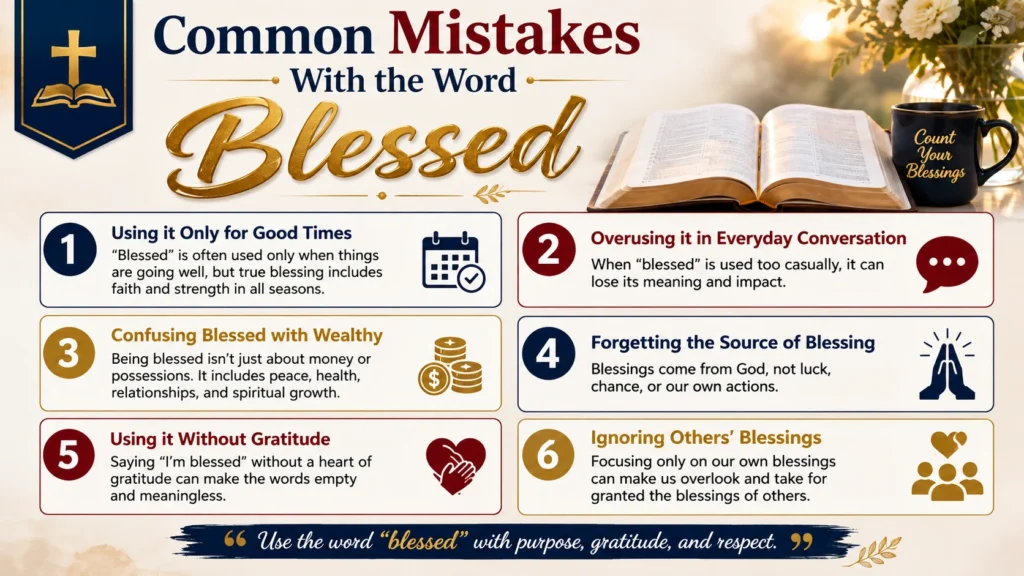
Assuming Blessed Always Means Lucky
Blessed can mean fortunate, but it can also refer to holiness, divine favor, gratitude, or spiritual meaning.
Assuming Blessed Is Always Religious
The word has religious roots and uses, but everyday speakers often use it simply to express gratitude.
Confusing Blessed With Blessing
Remember that blessed generally functions as an adjective, while blessing is generally a noun.
Ignoring Context
The surrounding words often reveal whether blessed means fortunate, grateful, holy, favored, or something else.
People Also Ask
What Is the Blessed Meaning in Simple English?
In simple English, blessed can mean fortunate, grateful, favored, happy, or holy, depending on the context. When someone says “I feel blessed,” they usually mean that they feel.
What Does “Blessed With” Mean?
“Blessed with” means fortunate to have something valuable or desirable. It can refer to talents, abilities, relationships, opportunities, qualities, or advantages.
What Is the Difference Between Blessed and Blessing?
For example, “I feel blessed” uses blessed as an adjective, while “My family is a blessing” uses blessing as a noun.
Conclusion
The Blessed Meaning in English is broad and depends strongly on context. It can describe someone who is fortunate, grateful, happy, favored, or deeply appreciative, while in religious contexts it can refer to something holy, sacred, spiritually favored, or connected with divine goodness. Expressions such as “I feel blessed” and “blessed with” are especially common in everyday English and often communicate sincere gratitude.
The easiest way to understand blessed is to look at the words surrounding it and ask what idea the speaker is expressing. In one sentence it may mean fortunate, in another grateful, and in another holy or spiritually favored. Once you understand these contexts, you can use blessed naturally and accurately in everyday conversation, writing, and religious discussions.