Correct Spelling, Meaning & Examples
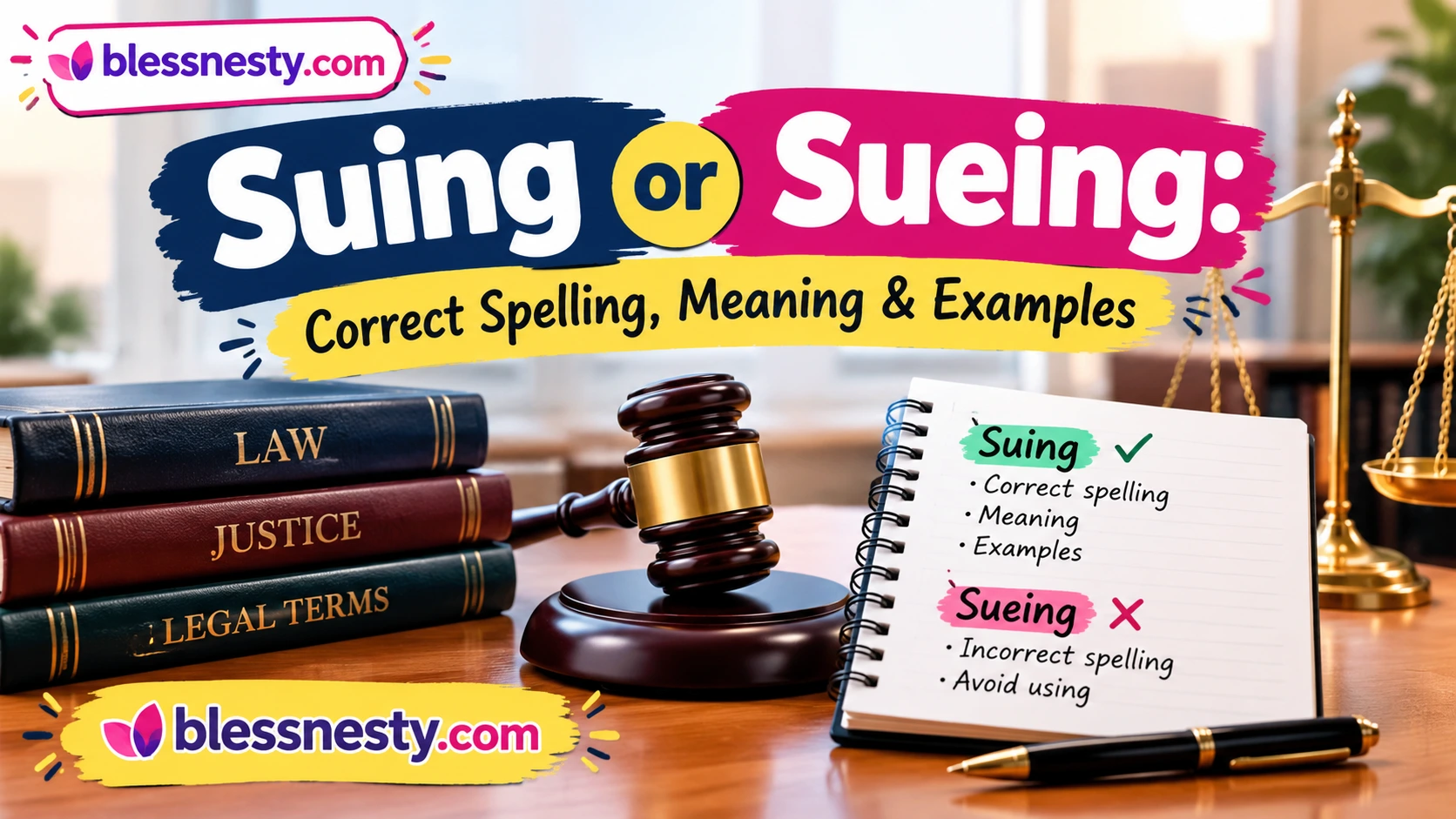
Have you ever wondered whether to write Suing or Sueing? The two spellings look similar, but only one is standard English.
Suing is the correct spelling. It is the -ing form of the verb sue, which means to take legal action against a person or organization. Sueing is a common spelling mistake, not an accepted alternative in standard English.
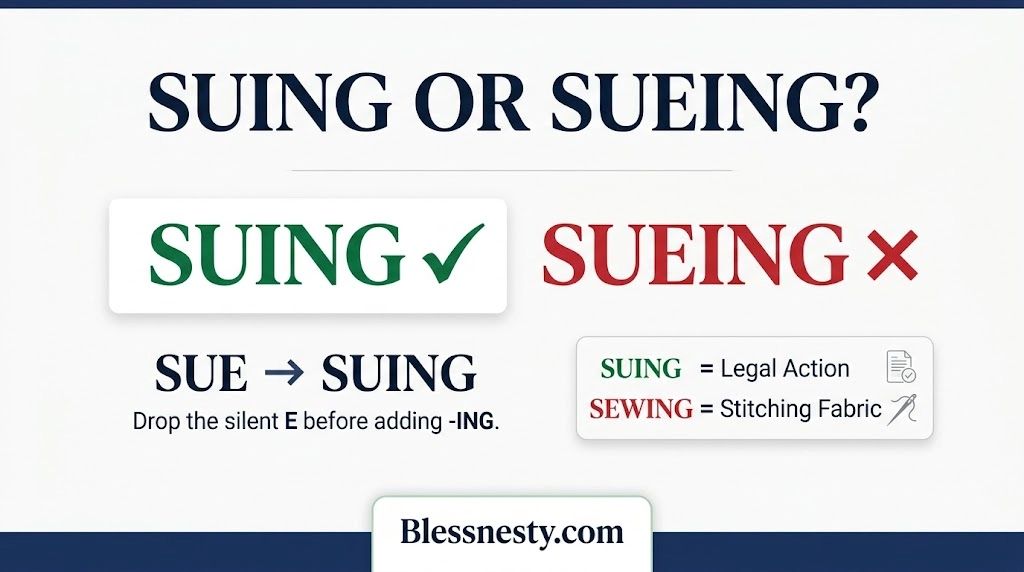
The confusion comes from the final letter in sue. Many English verbs ending in a silent e drop that letter before adding -ing. Therefore, the correct transformation is sue → suing, not sue → sueing.
Whether you are writing an email, completing an assignment, proofreading an article, or discussing a legal dispute, knowing this spelling rule helps you communicate clearly. This guide explains the meaning of suing, its grammatical forms, practical sentence examples, and the difference between suing and sewing.
Suing or Sueing: Which Spelling Is Correct?
Suing is correct; sueing is incorrect in standard English. Use suing when describing the act of taking legal action or when referring to that activity as a noun.
| Word | Status | Example |
| Suing | Correct | The customer is suing the company. |
| Sueing | Misspelling | The customer is sueing the company. |
| Sue | Correct base verb | They plan to sue. |
| Sued | Correct past tense | She sued her former employer. |
| Sewing | Different word | He is sewing a button onto his shirt. |
The spelling suing is used in both American and British English. It does not change according to the country or the context in which the word appears.
Quick answer: Remember sue → suing. Drop the final e before adding -ing.
What Does Suing Mean?
Suing means taking legal action against a person, company, or organization. It is the present participle of the verb sue and can also function as a gerund, which means an -ing form used as a noun.
For example:
- The customer is suing the manufacturer over an alleged product defect.
- The employee is considering suing the employer.
- The company is suing a supplier over a contract dispute.
- Suing can involve substantial legal costs.
In the first three examples, suing describes an action. In the fourth, it names the activity itself.
The precise legal meaning depends on the circumstances and jurisdiction. These examples explain English usage rather than provide legal advice.
Why Is Suing Correct Instead of Sueing?
The spelling follows the common English convention of dropping a silent final e before adding a suffix that begins with a vowel.
The transformation has three simple steps:
- Begin with the base verb: sue.
- Remove the final e: su.
- Add -ing: suing.
The result is suing, not sueing.
Other familiar examples include:
| Base verb | Correct -ing form |
| Make | Making |
| Write | Writing |
| Use | Using |
| Hope | Hoping |
| Drive | Driving |
| Sue | Suing |
English spelling has exceptions. For example, dye becomes dyeing, and agree becomes agreeing. However, sue follows the usual pattern.
The Silent-E Rule: How to Add -ing to Sue
The silent-e rule is useful for students, English learners, writers, and editors.
Generally, when a verb ends in a silent e, remove that letter before adding -ing.
Consider these examples:
| Base verb | Correct form | Common error |
| Hope | Hoping | Hopeing |
| Dance | Dancing | Danceing |
| Ride | Riding | Rideing |
| Confuse | Confusing | Confuseing |
| Argue | Arguing | Argueing |
| Sue | Suing | Sueing |
The rule is a general spelling convention, not an exception-free law. Cambridge Dictionary’s grammar guidance explains both the usual rule and exceptions such as dyeing and agreeing.
For the verb sue, the standard form is unambiguous: suing.
Suing vs. Sueing: Key Differences
The distinction between suing and sueing is a spelling difference, not a difference in meaning.
| Feature | Suing | Sueing |
| Standard Spelling | Yes | No |
| Standard grammatical form | Yes | No |
| Appropriate for formal writing | Yes | No |
| Separate standard meaning | Yes, from sue | No |
| Correct in standard US English | Yes | No |
| Correct in standard UK English | Yes | No |
Correct: The homeowner is suing the contractor over the disputed repairs.
Incorrect: The homeowner is sueing the contractor over the disputed repairs.
The intended meaning remains understandable in the second sentence, but the spelling should be corrected.
If you encounter sueing in a draft, replace it with suing unless you are quoting the error or discussing it specifically.
Suing in a Sentence: 10 Clear Examples
Examples make it easier to recognize the word’s grammatical function and understand how it appears in different contexts.
- Workplace: The employee is suing the employer over alleged discrimination.
- Business: The company is suing its former supplier over a contract dispute.
- Consumer rights: The customer is considering suing the manufacturer over an alleged defect.
- Property: The homeowner is suing the contractor over unfinished repairs.
- Publishing: The author threatened to sue over the unauthorized use of copyrighted material.
- Transportation: The passenger is suing the airline over an alleged injury.
- Education: The family is considering suing the school district.
- Everyday conversation: She asked a lawyer whether suing would be worthwhile.
- Gerund: Suing can be expensive and time-consuming.
- News-style writing: The company announced that it was suing a competitor over an alleged contractual violation.
These are illustrative examples, not reports of verified legal cases.
How to Use Suing in Formal and Everyday Writing
The spelling remains the same in every context, although the wording and level of formality may change.
Everyday conversation
People often use suing when discussing a possible legal dispute.
Example: “He’s thinking about suing the company.”
Academic writing
The word may appear in discussions of litigation, legal systems, or disputes involving organizations.
Example: “The study examines factors associated with individuals suing organizations.”
Business communication
Professional emails may refer to a party considering legal action over a disagreement.
Example: “The organization is reviewing its options before deciding whether to sue.”
Legal writing
The term may describe a party pursuing a claim through the courts.
Example: “The claimant is suing the defendant for an alleged breach of contract.”
Choose language appropriate to the situation, especially when writing about an actual dispute. A spelling guide does not determine whether a legal claim is valid.
Is Suing the Same in American and British English?
Yes. Suing is the standard spelling in both American and British English.
Some words have regional spelling differences, such as color and colour. The word suing is not one of them.
| English variety | Correct spelling |
| American English | Suing |
| British English | Suing |
| Canadian English | Suing |
| Australian English | Suing |
If you are writing for an international audience, use suing. There is no need to change it for a particular regional style guide.
Sue, Sues, Sued, and Suing: Verb Forms Explained
Learning the different forms of sue helps prevent grammatical mistakes as well as spelling errors.
| Verb form | Grammatical use | Example |
| Sue | Base form | They plan to sue. |
| Sues | Third-person singular present | She sues when she believes a claim is justified. |
| Sued | Simple past | The company sued its former partner. |
| Sued | Past participle | The company has sued the supplier. |
| Suing | Present participle | The customer is suing the retailer. |
| Suing | Gerund | Suing may be expensive. |
Use the base form after modal verbs:
- They may sue.
- She might sue.
- We could sue.
Use suing in continuous constructions:
- They are suing.
- She was suing.
- We have been suing.
The grammatical structure determines which verb form you need, but sueing is not the standard spelling of the -ing form.
- Explore More: https://blessnesty.com/clothes-quotes-captions/
Suing vs. Sewing: Meaning and Spelling
The Suing and sewing look and sound similar, but their meanings are entirely different.
Suing means taking legal action against a person or organization.
Example: “The customer is suing the company.”
Sewing means joining or repairing fabric with a needle and thread, or using a sewing machine.
Example: “She is sewing a button onto her jacket.”
| Word | Meaning | Example |
| Suing | Taking legal action | He is suing the contractor. |
| Sueing | Nonstandard misspelling | Avoid writing “sueing.” |
| Sewing | Stitching fabric | She is sewing a shirt. |
A simple memory aid is to connect suing with a lawsuit and sewing with stitches.
Choosing the correct word matters because one letter can change the intended meaning.
Common Suing Spelling Mistakes to Avoid
1. Keeping the final e
Incorrect: “The tenant is sueing the landlord.”
Correct: “The tenant is suing the landlord.”
Remove the final e before adding -ing.
2. Using the wrong verb form
Incorrect: “She is sued the company.”
Correct: “She is suing the company.”
Use is suing for the present continuous. Use sued for the simple past: “She sued the company last year.”
3. Confusing suing with sewing
Incorrect: “The customer is sewing the manufacturer over the dispute.”
Correct: “The customer is suing the manufacturer over the dispute.”
Use sewing for fabric and suing for legal action.
4. Assuming the spelling changes by country
Incorrect assumption: “Sueing is the British spelling.”
Correct explanation: Suing is standard in both British and American English.
5. Repeating the keyword unnaturally
A useful article does not need to repeat “suing or sueing” in every paragraph. Use natural variations such as correct spelling, verb form of sue, and silent-e rule where they help readers.
Easy Ways to Remember the Correct Spelling
Use these Techniques to make the spelling easier to remember.
1. Memorize the transformation.
Think of sue → suing. The final e disappears before -ing is added.
2. Compare familiar verbs.
Remember to use → using and make → making. These examples reinforce the general pattern.
3. Associate the word with its meaning.
Connect suing with a lawsuit or legal action. This helps distinguish it from sewing.
4. Read the complete sentence.
Try: “The company is suing its supplier.” Seeing the word in context helps reinforce its spelling and grammatical function.
5. Proofread important documents.
Check academic assignments, professional emails, articles, and other formal documents for the common typo sueing.
The key rule is simple: sue becomes suing, not sueing.
Practice Quiz: Suing or Sueing?
Test your knowledge with these five quick questions.
1. Which spelling is correct?
A. Sueing
B. Suing
2. Complete the sentence:
“The company is _____ its former supplier.”
A. Sueing
B. Suing
3. What is the past tense of sue?
A. Sued
B. Suing
4. Which word means stitching fabric?
A. Suing
B. Sewing
5. Which sentence is correct?
A. “She is sueing the contractor.”
B. “She is suing the contractor.”
Answer key
- B — Suing
- B — Suing
- A — Sued
- B — Sewing
- B — She is suing the contractor.
If you answered all five correctly, you understand the main spelling distinction and the basic verb forms.
People Also Ask
A:Suing is the correct spelling in standard English. Sueing is a misspelling and should be corrected in ordinary writing.
A:The verb sue generally follows the silent-e convention. Remove the final e before adding -ing to produce suing.
A:Sueing is not the standard spelling of the verb sue in modern English. You may encounter it as a typo or when someone is discussing the misspelling itself.Q4:What does suing mean?Z
A:Suing means taking legal action against a person or organization. It is the present participle of sue and can also function as a gerund.
A:Yes. Suing is the standard spelling in American English.
Final Verdict
When choosing between Suing or Sueing, always use suing in standard English. It is the present participle and gerund form of sue, a verb meaning to take legal action against a person or organization.
The spelling follows a familiar English convention: drop the final silent e before adding -ing. The same spelling is used in American and British English.
Keep the distinction simple:
- Correct: Sue → Suing
- Incorrect: Sue → Sueing
- Different word: Sew → Sewing
Once you remember this pattern, you can write confidently in everyday conversations, academic work, professional communication, and articles about legal disputes.