Mindful Turning Knitting into Your Daily Meditation, present-moment attention to the ordinary act of knitting. Instead of rushing to finish a scarf, sweater, blanket, or gift, you slow down and notice the movement of your hands, the texture of the yarn, your breathing, and the rhythm of each stitch.
Knitting can therefore become more than a creative hobby. It can serve as a simple form of moving meditation, giving your hands something purposeful to do while providing your attention with a calm place to rest.
What Is Mindful Knitting?
Mindful knitting combines ordinary knitting with principles of mindfulness. Traditional knitting often focuses on completing a row, following a pattern, or finishing a project. Mindful knitting shifts attention toward the experience of knitting itself.
As you knit, notice:
- The softness or texture of the yarn
- The movement of the needles
- The tension of the thread
- The position of your hands
- The rhythm of the stitches
- Your breathing
- Sounds around you
- Physical tension in your shoulders
- Thoughts and emotions as they arise
You do not need to empty your mind. The goal is simply to notice what is happening and gently bring your attention back to the present activity.
Why Can Knitting Feel Like Meditation?
Knitting naturally contains several elements that can support focused attention. Your hands repeat familiar movements while your eyes follow stitches and your fingers work with the yarn. For experienced knitters, some movements become familiar enough that attention can settle into the rhythm of the activity.
The important distinction is that knitting itself is not automatically meditation. If you are rushing through a complicated pattern, checking your phone constantly, or worrying about finishing quickly, you may simply be knitting.
Mindfulness comes from the quality of attention you bring to the activity.
Mindful Knitting vs. Traditional Meditation
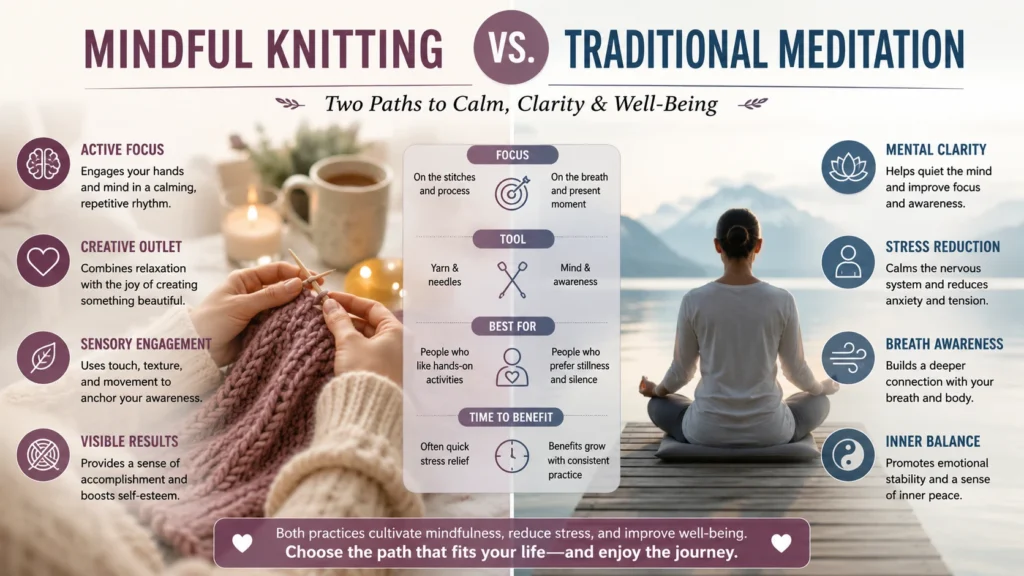
Mindful knitting and traditional Meditation share the goal of cultivating awareness, but they use different anchors.
Traditional meditation may involve focusing on the breath, bodily sensations, sounds, or another object of awareness. Mindful knitting adds movement, tactile sensations, repetition, and creativity.
| Mindful Knitting | Traditional Meditation |
| Uses yarn and stitches as anchors | Often uses breath or sensations |
| Involves gentle hand movement | May involve sitting still |
| Provides tactile feedback | Often emphasizes internal awareness |
| Creates a physical project | Usually creates no physical object |
| May suit people who dislike sitting still | Can be practiced without a creative activity |
Neither approach needs to replace the other. Mindful knitting can simply provide another way to practice present-moment awareness.
Potential Benefits of Mindful Knitting
Mindful knitting should be viewed as a well-being and creative practice rather than a medical treatment. Research is promising but should not be exaggerated.
Potential benefits include greater present-moment awareness, a calming pause during the day, creative expression, patience, a sense of achievement, social connection, and a predictable daily routine.
One simple mindfulness cycle is:
stitch → breath → sensation → stitch
Whenever your attention wanders, you return to the activity. That return is not a failure. It is the practice.
How to Turn Knitting Into Daily Meditation
You do not need an elaborate meditation room or expensive equipment. Yarn, needles, a suitable project, and a few intentional minutes are enough.
Choose a Simple Project
For mindful knitting, simplicity is usually helpful. Choose something familiar enough that you do not have to constantly stop and decode complicated instructions.
Good options include:
- Simple scarves
- Garter-stitch projects
- Stockinette projects
- Repetitive blankets
- Simple dishcloths
- Basic cowls
- Straightforward gifts
The objective is to keep your hands engaged without requiring constant problem-solving.
Create a Comfortable Space
Before starting, make your environment supportive of focused attention.
Put your phone on silent, adjust the lighting, support your back, and keep your knitting supplies nearby. You do not need complete silence; you simply want to reduce unnecessary distractions.
Pause Before the First Stitch
Instead of immediately picking up your needles, take 30 to 60 seconds to arrive.
Relax your shoulders, notice your posture, take a comfortable breath, and check how you feel.
You might silently say:
“For the next ten minutes, I don’t need to rush.”
This creates a transition between the rest of your day and your practice.
Begin With Your Breath
Take several natural breaths without trying to force them to become extremely deep.
Notice the air entering and leaving, the movement of your chest or abdomen, and any relaxation in your shoulders. Then begin knitting while allowing the breath to remain one possible anchor.
Notice the Yarn
Bring attention to the physical qualities of the yarn.
Is it soft, smooth, warm, thick, rough, lightweight, or elastic?
Notice how it moves between your fingers. This simple sensory awareness can turn an ordinary material into an anchor for mindfulness.
Notice Each Stitch
Pay attention to the sequence of movement:
Insert → wrap → pull through → move → repeat.
You do not need to stare intensely at every stitch. Simply notice the rhythm and return to it whenever your attention drifts.
Notice Your Thoughts
Your mind will wander. You may remember work, think about tomorrow, replay a conversation, or wonder when the project will be finished.
Instead of fighting the thought, notice it and gently return to:
breath + hands + yarn + stitch.
End With Appreciation
When your session ends, pause before immediately reaching for your phone.
Ask yourself:
- How do I feel now?
- What did I notice?
- Did my body relax?
- What was difficult?
- What did I enjoy?
Then put your project away intentionally. This gives the practice a clear beginning and ending.
The 10-Minute Mindful Knitting Method
A short practice is enough to begin.
Sit comfortably, remove distractions, and breathe naturally.
Notice your body, feet, posture, and shoulders.
Knit slowly and focus on your hands, yarn, needles, stitches, and breathing.
Notice when your mind wanders and gently return to the knitting.
Stop, breathe, and identify one word describing your experience, such as calm, restless, focused, grateful, or curious.
There is no wrong answer. The purpose is awareness, not achieving a particular emotional state.
A 20-Minute Mindful Knitting Practice
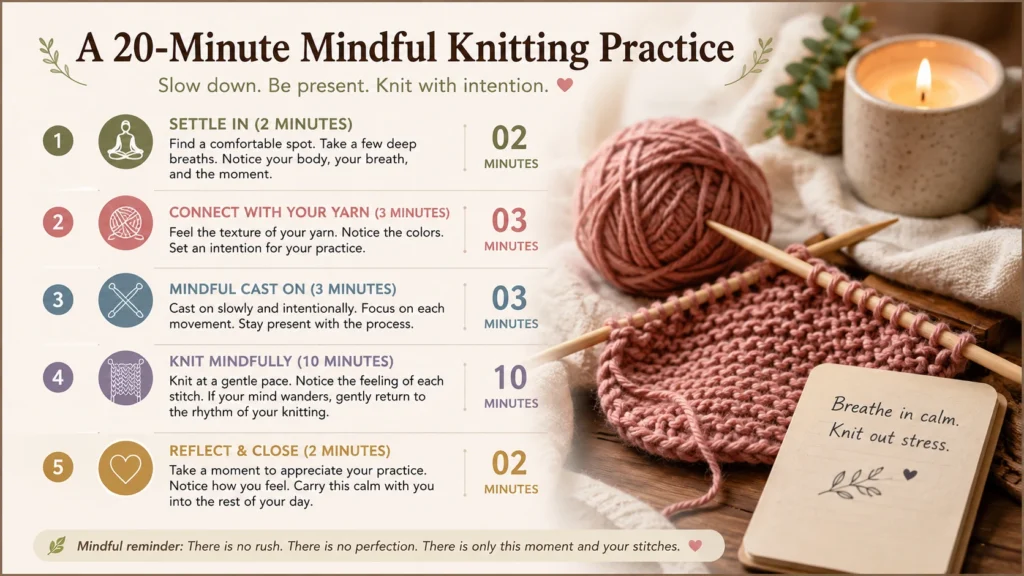
When ten minutes feels Comfortable, extend the practice.
- Breathing and body awareness
- Sensory awareness of yarn and needles
- Rhythmic knitting
- Observe thoughts without following them
- Gratitude and reflection
The goal is not to reach a special mental state. It is to practice returning your attention whenever it wanders.
Best Knitting Patterns for Mindfulness
Not every knitting project provides the same experience.
Garter stitch can be particularly useful for beginners because its repetitive structure is easy to recognize.
Simple stockinette can offer a predictable rhythm once you are comfortable with the technique.
Repetitive blankets provide long periods of repeated movement and make gradual progress visible.
Simple scarves are another practical starting point because they require relatively little pattern interpretation.
Projects made for someone meaningful can also introduce gratitude or appreciation into the practice, but there is no need to force positive emotions.
How to Use Breathing While Knitting
Breathing can work as an anchor without requiring every stitch to match a particular breath.
Try:
Notice the inhale → notice the stitch → notice the exhale → continue.
Do not make the process rigid. Different knitting patterns naturally have different speeds, so awareness matters more than perfect synchronization.
What If Your Mind Keeps Wandering?
Wandering thoughts are normal.
When you notice that your attention has moved elsewhere, use this simple process:
Notice → acknowledge → return.
For example:
“I’ve been thinking about work.”
Then:
“Back to the yarn.”
There is no need to criticize yourself or force the thought away. Returning your attention is itself part of mindfulness.
What If Knitting Becomes Frustrating?
Knitting is not automatically relaxing. Dropped stitches, tangled yarn, complicated patterns, uncomfortable posture, or repeated mistakes can make a session frustrating.
If that happens, try:
- Switching to a simpler project
- Taking a short break
- Relaxing your grip
- Checking your posture
- Choosing a different yarn
- Adjusting your needles when appropriate
- Shortening the session
- Putting the difficult project aside
Mindfulness does not mean forcing yourself to remain calm while becoming increasingly irritated. Sometimes the mindful choice is to stop.
Mindful Knitting While Watching TV or Listening to Music
You can knit while watching television, but the experience is different from dedicated mindful knitting.
If entertainment is your main goal, your attention will naturally move between the screen and your project. That is perfectly reasonable.
For a more focused practice, consider quiet music, nature sounds, an audiobook, a familiar program, or silence. Entertainment knitting and mindful knitting can coexist, but they are not exactly the same activity.
Morning vs. Evening Mindful Knitting
Both morning and evening sessions can work.
A morning practice can provide a calm transition into the day. Try five to fifteen minutes after waking or breakfast.
An evening practice can help create a transition between daytime responsibilities and personal time. Try ten to twenty minutes before your normal bedtime routine.
The best time is ultimately the one you can repeat consistently.
A 7-Day Mindful Knitting Challenge
Start small rather than trying to change your entire routine at once.
Knit for five minutes and notice your hands and yarn.
Spend the first minute noticing your breathing.
Focus on the texture and physical qualities of the yarn.
Notice every time your thoughts wander and gently return.
When you make a mistake, pause before reacting.
Choose an intention such as peace, patience, gratitude, creativity, or presence.
Reflect on what worked, what distracted you, which time of day felt best, and whether you want to continue.
How to Build a Long-Term Mindful Knitting Habit
Consistency matters more than creating a perfect routine.
Keep a small knitting project somewhere visible and convenient. Start with five minutes rather than waiting for a free hour.
You can also connect knitting with something you already do:
Tea → knitting
Dinner → knitting
Work break → knitting
Evening routine → knitting
This type of habit stacking makes the practice easier to remember.
Most importantly, do not judge every session by how peaceful it felt. Some days will be focused, while others will be distracted. Flexibility is part of the practice.
Common Mindful Knitting Mistakes
One common mistake is believing you must completely empty your mind. Mindfulness is not necessarily about having zero thoughts. It is about noticing thoughts without automatically following them.
Another mistake is becoming obsessed with finishing the project. When the finished object becomes the only goal, you can lose awareness of the process.
Choosing an overly difficult pattern can also make knitting feel more like problem-solving than meditation. Constant notifications and treating distraction as failure create additional obstacles.
How Long Should You Knit for Meditation?
A practical starting point is 5–10 minutes per day. If that feels comfortable, gradually move toward 15–20 minutes.
Longer sessions are not automatically better. A focused ten-minute practice can be more intentional than an hour of distracted knitting.
Is Mindful Knitting Good for Beginners?
Yes. Beginners can use simple knitting exercises as opportunities to practice attention.
Start with one simple stitch, a small project, comfortable yarn, manageable needles, and short sessions. It can also help to separate learning the mechanics of knitting from practicing mindfulness. Once the technique becomes familiar, less attention is needed for figuring out what to do next.
Can Knitting Replace Meditation?
Mindful knitting can serve as a mindfulness practice, but it should not be presented as a universal replacement for every form of meditation.
Different meditation practices have different purposes and structures. Mindful knitting may be especially appealing to people who enjoy creative activities, prefer tactile experiences, dislike sitting still, or want to incorporate mindfulness into an existing hobby.
A useful way to think about it is meditation through making.
What Does the Research Actually Say?
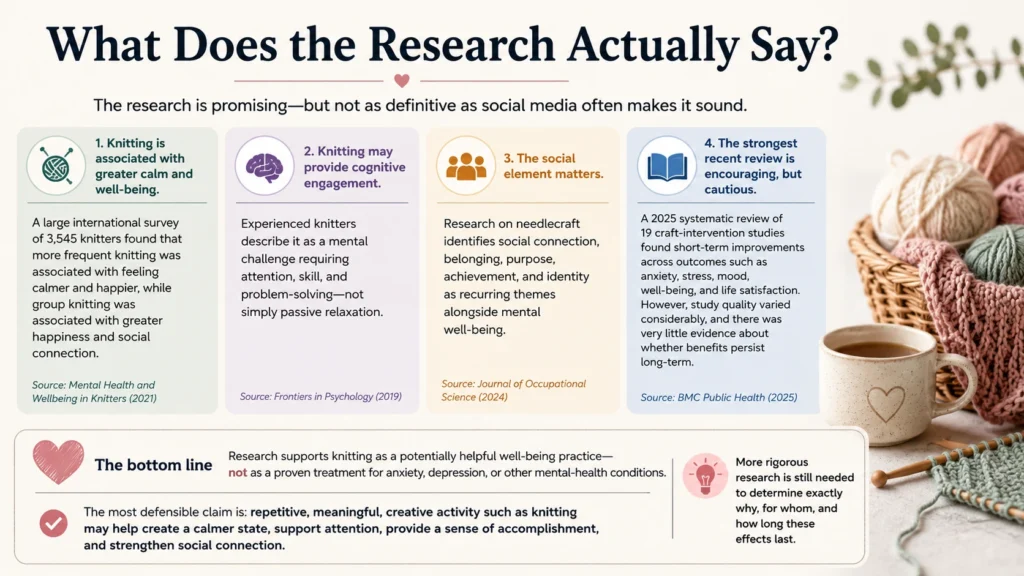
A 2013 International survey of 3,545 knitters found relationships between knitting frequency and reported feelings of calm and happiness. Group knitting was also associated with social connection. Researchers described knitting as having therapeutic potential while emphasizing the need for further research.
A 2024 qualitative study explored knitting as a way to slow down, focus, and structure everyday life. A 2024 scoping review of needlecraft identified themes including mental well-being, social connection, belonging, purpose, achievement, satisfaction, identity, family, culture, and legacy.
A 2025 systematic review of craft-based interventions found improvements in mood and life satisfaction across the studies reviewed, while noting that evidence for long-term effects remains limited.
The responsible takeaway is simple: knitting appears promising as a supportive well-being and creative practice, but it should not be marketed as a proven treatment for mental-health conditions.
People Also Ask
Is knitting a form of meditation?
Knitting can become a form of meditation when you intentionally use it to practice focused, present-moment awareness. The repetitive movements, tactile sensations, and rhythm can provide useful anchors for attention.
How does knitting help with mindfulness?
Knitting gives you concrete sensations and movements to observe. You can focus on the yarn, needles, stitches, breathing, and bodily sensations while repeatedly returning from distractions to the activity.
How long should a mindful knitting session be?
Start with five to ten minutes. If you enjoy the practice, gradually increase to fifteen or twenty minutes. There is no requirement to practice for a specific length of time.
Conclusion
Mindful knitting does not require perfect Concentration, an impressive project, or an empty mind. It simply asks you to slow down enough to notice the yarn, the needles, your breathing, your thoughts, and the movement of each stitch.
Research increasingly suggests that knitting and other needlecraft activities may contribute to aspects of well-being such as relaxation, mood, creativity, social connection, purpose, and achievement, although the evidence is still developing and should not be overstated.