Introduction
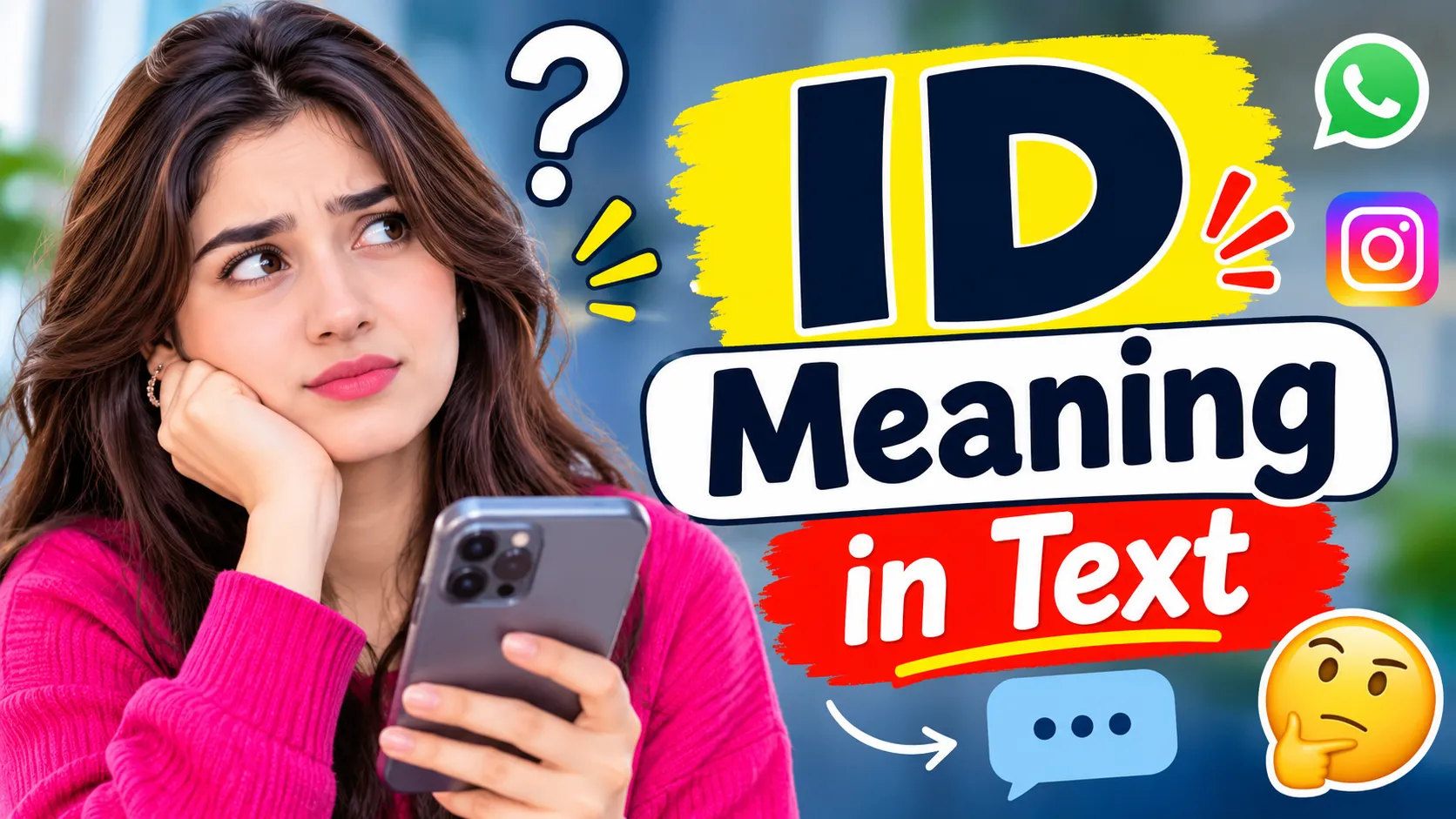
Have you ever received a message containing “ID” or “id” and wondered what the sender meant? This abbreviation can be confusing because its meaning changes depending on the sentence, capitalization, and conversation.
ID in text usually means Identification, referring to an identity document, account identifier, or information used to recognize someone. However, lowercase “id” can also be an informal way of typing “I’d,” meaning “I would” or “I had,” without the apostrophe. In social media comments, “ID?” can mean “identify this” when someone wants to know the name of a song, outfit, product, or other item.
The easiest way to understand ID is to look at the complete message rather than focusing on the two letters alone.
In this guide, you’ll learn the different meanings of ID in texting, how people use it on Snapchat, Instagram, TikTok, and WhatsApp, and how to respond when someone sends it to you.
What Does ID Mean in Text?
In text messages, ID most commonly means identification. It can refer to an identity document, personal identification details, or an identifier associated with an online account.
For example:
- “Bring your ID tomorrow.” = Bring your identification document.
- “What’s your ID?” = What is your account identifier?
- “Can you ID this song?” = Can you identify this song?
- “id love to meet you.” = I’d love to meet you.
The lowercase form deserves special attention. Some people type “id” instead of “I’d” because they leave out the apostrophe when messaging quickly.
Therefore, ID does not have one fixed meaning in every conversation. The words around it help you understand what the sender is trying to communicate.
Quick Meaning of ID in Text
Here is a simple overview of the different ways you may encounter ID online.
| Form | Meaning | Example |
| ID | Identification | Bring your ID. |
| id | Informal spelling of I’d | I’d love to go. |
| ID? | Identify this | Song ID? |
| User ID | Account identifier | Send your user ID. |
| IDK | I don’t know | IDK what happened. |
Remember that ID and IDK are different abbreviations. IDK has an additional letter that changes its meaning completely.
What Does ID Stand For?
ID is commonly used as a short form of identification. In digital environments, it can also refer to an identifier that distinguishes one account, user, device, or record from another.
Here are some common examples:
- ID: Identification.
- ID card: Identification card.
- Photo ID: A document containing a photograph used to confirm identity.
- User ID: An identifier assigned to a user.
- Account ID: A unique identifier associated with an account.
- Player ID: An identifier used to recognize a gaming account.
For example, when someone says “I need your ID for registration,” they may be asking for identification information. When a gaming friend asks for your player ID, they usually want the identifier needed to find your account.
Different Meanings of ID in Text Messages
The meaning of ID depends on how it appears in a message. Let’s explore its most useful interpretations.
1. ID Means Identification
Identification is the standard meaning of ID. It refers to a document or information that helps establish who someone is.
You may see this abbreviation in conversations about travel, school, employment, registration, or verification.
Examples:
- “Don’t forget your ID for the airport.”
- “I need my student ID for registration.”
- “They asked me to show my ID.”
- “Your ID is required to enter the building.”
- “I left my ID at home.”
In these situations, ID refers to an identification document or credential.
2. id Means I’d
In informal texting, people sometimes leave out apostrophes to type more quickly. As a result, “id” may be used instead of “I’d.”
The contraction “I’d” has two standard meanings:
I’d = I would
Examples:
- “id love to come.” = I’d love to come.
- “id help you if I could.” = I’d help you if I could.
- “id rather stay home.” = I’d rather stay home.
- “id definitely try that.” = I’d definitely try that.
I’d = I had
Examples:
- “id already finished my work.” = I’d already finished my work.
- “id never seen that movie before.” = I’d never seen that movie before.
- “id forgotten about the meeting.” = I’d forgotten about the meeting.
The grammar of the sentence helps you identify which meaning is intended.
For instance, “I’d love to see you” expresses what someone would like to do, while “I’d already seen it” describes something that had happened earlier.
Although lowercase “id” can appear in casual messages, writing “I’d” with the correct apostrophe is clearer.
3. ID Means Identify
ID can also be used as an informal verb meaning “identify.”
This usage is particularly helpful when someone wants to know the name or details of something they have seen.
Examples:
- “Can someone ID this song?”
- “Please ID these shoes.”
- “Does anyone know how to ID this plant?”
- “Can you ID the movie in this clip?”
- “Someone please ID this product.”
For example, if a person uploads a video with an unfamiliar song and another user comments “Song ID?”, they are asking someone to identify the track.
4. ID Means Identity or Account Identifier
In online conversations, ID can refer to a Digital Identifier connected to a person’s account.
You might encounter it in gaming communities, social networking apps, websites, and other online services.
Examples:
- “Send me your gaming ID.”
- “What’s your Discord ID?”
- “I changed my account ID.”
- “Add me using my player ID.”
- “I can’t find your user ID.”
An account ID and username are not necessarily the same thing. Some services use unique numerical or alphanumeric identifiers, while others use usernames or handles that people can search for.
Does Lowercase id Mean I’d?
Yes, lowercase “id” can represent “I’d” in informal messages when the sender omits the apostrophe.
However, it is important not to assume this meaning every time you see those letters.
Compare these examples:
| Message | Intended meaning |
| I’d love to visit. | I’d love to visit. |
| id rather stay home. | I’d rather stay home. |
| Bring your ID. | Bring your identification. |
| What’s your user ID? | What’s your account identifier? |
A useful way to interpret lowercase “id” is to replace it mentally with “I’d” and see whether the sentence makes grammatical sense.
If it does, the sender may have intended the contraction.
What Does ID? Mean in Comments?
When someone writes “ID?” in a social media comment, they are often asking another person to identify something.
The question may refer to a song, outfit, product, movie, location, or another item shown in a photograph or video.
Examples:
- “Song ID?” = What is the name of this song?
- “Outfit ID?” = Where can I find this outfit?
- “Shoe ID?” = What brand or model are those shoes?
- “Movie ID?” = Which movie is this?
- “Location ID?” = Where was this picture taken?
The question mark comments look like a short identification request.
This use is especially understandable in communities where people regularly ask for product recommendations, music information, and identification help.
ID Meaning on Social Media
ID does not have a separate universal meaning on every social media platform. Its interpretation depends on what someone is discussing.
Here is how it may appear across different platforms.
ID Meaning on Snapchat
On Snapchat, ID can refer to an account identifier or username when someone wants to find or add another user.
Examples:
- “What’s your Snap ID?”
- “Send me your Snapchat ID.”
- “I can’t find your account ID.”
- “Share your ID so I can add you.”
If someone asks for your Snap ID, they probably want information that helps them locate your account.
However, in a sentence such as “id love that,” lowercase “id” may simply mean “I’d love that.”
ID Meaning on Instagram
On Instagram, ID may refer to an account identifier, username, or a request to identify something shown in a post.
Examples:
- “What’s your IG ID?” = What’s your Instagram account name?
- “Drop your ID below.” = Share your account details.
- “ID this outfit.” = Identify the outfit.
- “Can someone ID this song?” = Tell me the song’s name.
In Instagram comments, the meaning is often connected to the photograph or Reel being discussed.
ID Meaning on TikTok
On TikTok, “ID?” can appear in comments when viewers want to identify something in a video.
Examples:
- “Song ID please!” = What is the name of the song?
- “Outfit ID?” = Where can I find this outfit?
- “Can someone ID this creator?” = Who is this creator?
- “Movie ID?” = What movie is shown in this clip?
Music-related comments are one example of this usage. Someone may want to know the title or artist of a track playing in a video.
ID Meaning on WhatsApp
On WhatsApp, ID can appear in private messages, group conversations, and professional discussions.
Its meaning depends on the subject being discussed.
Examples:
- “Please send your ID for verification.” = Identification information.
- “What’s your gaming ID?” = Gaming account identifier.
- “I’d love to meet you.” = I’d love to meet you.
- “Can you ID this picture?” = Can you identify what is shown?
ID does not have a special WhatsApp-only slang definition.
ID Meaning From a Girl or Guy
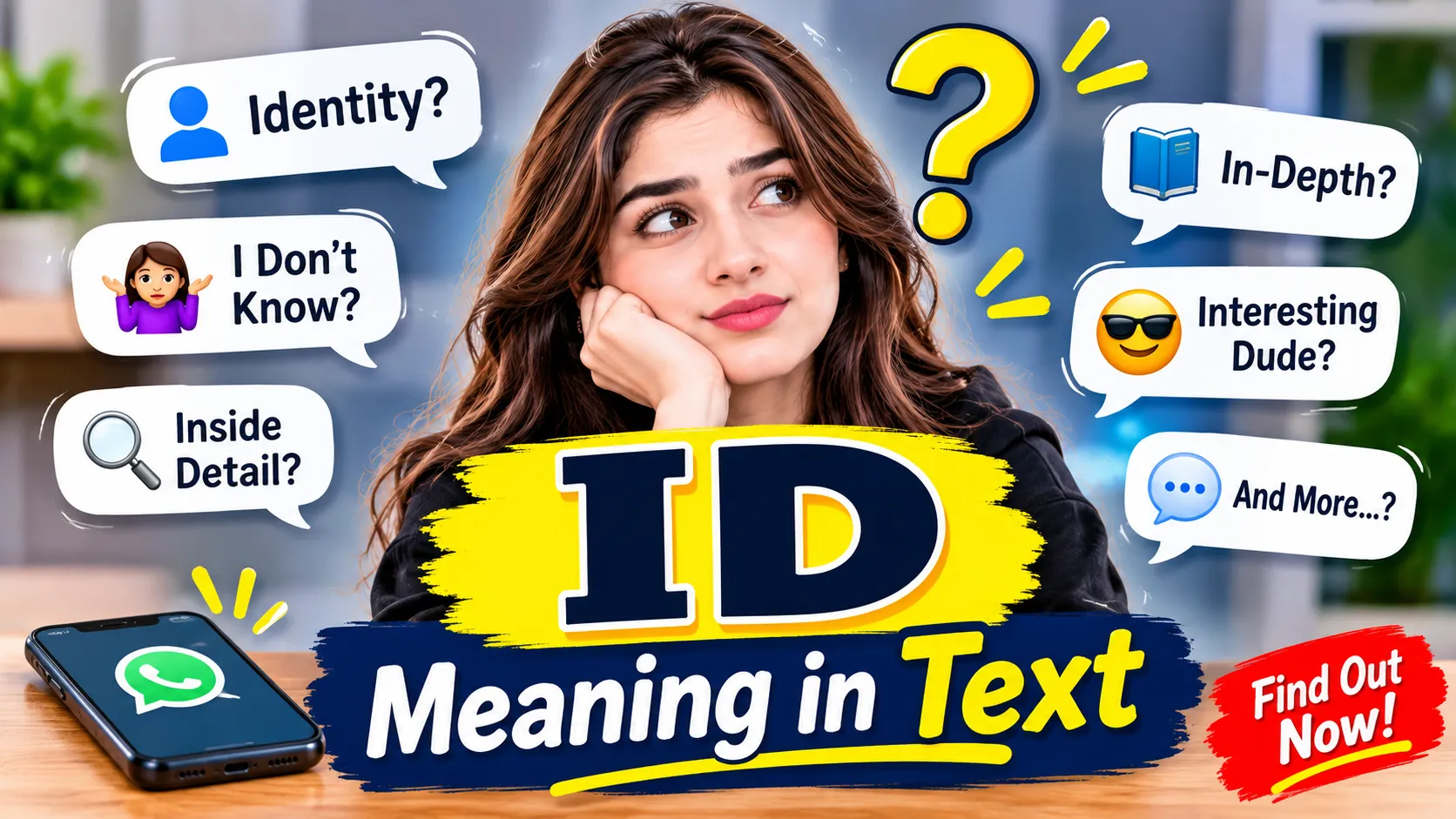
Does ID mean something different when a girl or guy sends it?
Not necessarily. The sender’s gender does not automatically change the abbreviation’s meaning.
The actual sentence and conversation are much more useful clues.
When a Girl Sends ID
- “id love to see you.” = I’d love to see you.
- “What’s your ID?” = She may be asking for your account identifier.
- “Can you ID this dress?” = She wants to identify the dress.
- “Send me your Snap ID.” = She wants information to find your Snapchat Account.
When a Guy Sends ID
- “id go with you.” = I’d go with you.
- “Send me your ID.” = He may want your account identifier.
- “ID this song bro.” = He wants you to identify the song.
- “Bring your ID tomorrow.” = He is reminding you to bring identification.
ID is not automatically romantic, flirty, or affectionate. Always consider the complete message before deciding what the sender means.
ID vs. IDK: What’s the Difference?
And ID and IDK are different abbreviations, even though they share the first two letters.
ID usually refers to identification, an identifier, or an informal spelling of “I’d” in a sentence.
IDK stands for “I don’t know” and is used when someone does not have an answer or is unsure about something.
Here is a simple comparison:
| Abbreviation | Meaning | Example |
| ID | Identification | Bring your ID. |
| IDK | I don’t know | IDK what happened. |
| IDC | I don’t care | IDC about that. |
| IDM | I don’t mind | IDM where we go. |
| IDEK | I don’t even know | IDEK what to say. |
For example:
- “ID?” can be a request to identify something.
- “IDK” means the person does not know.
- “id love to come” may mean “I’d love to come.”
The additional letters make an important difference.
Real Examples of ID in Text Conversations
These illustrative conversations show how ID can appear in different everyday situations.
1. Identification Example
Person A: What should I bring tomorrow?
Person B: Just bring your ID.
Meaning: Bring your identification document.
2. Instagram Account Example
Person A: How can I find you on Instagram?
Person B: I’ll send you my ID.
Meaning: I’ll share my account details or username.
3. Casual Chat Example
Person A: Would you come to the party?
Person B: I’d love to!
Meaning: I’d love to!
4. Music Identification Example
Person A: Did you like the song in that video?
Person B: Yeah, but what’s the ID?
Meaning: What’s the name of the song?
5. Gaming Example
Person A: How can I add you to the game?
Person B: I’ll send my player ID.
Meaning: I’ll share my gaming account identifier.
6. Friendly Conversation Example
Person A: Do you want to hang out this weekend?
Person B: I’d definitely come.
Meaning: I’d definitely come.
7. Shopping Example
Person A: I love those sneakers!
Person B: Same! Can someone ID them?
Meaning: Can someone identify the sneakers or tell us where to buy them?
8. School Example
Person A: Did you get inside the examination hall?
Person B: Yes, they checked my student ID.
Meaning: They checked my student identification card.
9. Social Media Example
Person A: I can’t find your second account.
Person B: I’ll send you the ID.
Meaning: I’ll share the account identifier.
10. Everyday Conversation Example
Person A: Would you try that restaurant?
Person B: I’d love to!
Meaning: I’d love to!
11. Fashion Example
Person A: Where did you buy that jacket?
Person B: I don’t remember the brand. Someone might ID it.
Meaning: Someone may be able to identify the jacket.
12. Travel Example
Person A: Are we ready to check in?
Person B: Yes, but keep your ID with you.
Meaning: Keep your identification document available.
How to Reply When Someone Asks for ID
Your response depends on what the other person is asking.
Here are some natural replies for Different Situations.
| If someone says… | You can reply… |
| “What’s your ID?” | “Which ID do you need?” |
| “Send me your ID.” | “Sure, what do you need it for?” |
| “Can you ID this song?” | “Let me check the song name.” |
| “What’s your Snap ID?” | “I’ll send you my username.” |
| “ID this outfit.” | “I’ll try to find the outfit.” |
| “Bring your ID.” | “Sure, I’ll bring it.” |
| “Song ID?” | “I’ll try to find the track.” |
Privacy tip: If someone asks you to send an identity document, passport, or sensitive personal information through an unfamiliar chat, verify why they need it before sharing anything. A social media username is not the same as a government-issued identification document.
Is ID Formal or Informal?
ID is used in both formal and informal communication, but its meaning depends on the situation.
In professional environments, ID commonly refers to identification or an account identifier. For example, an employee ID, customer ID, or student ID.
In casual texting, lowercase “id” may be used instead of “I’d” when someone leaves out the apostrophe.
Examples:
- Formal: “Please provide your identification.”
- Professional: “Please bring your ID.”
- Casual: “I’d love to join you.”
For emails, official documents, and professional messages, use correct spelling and punctuation. Writing “I’d” instead of “id” makes your meaning clearer.
- Related To Another Article: https://blessnesty.com/mbb-meaning-in-text/
Common Misunderstandings About ID
People sometimes misunderstand ID because they assume every abbreviation has only one meaning.
Here are five mistakes worth avoiding.
1. Assuming ID always means identification
In a sentence such as “id love to go,” the sender may mean “I’d love to go.”
2. Confusing ID with IDK
IDK means “I don’t know.” ID alone does not automatically have that meaning.
3. Assuming ID always means username
An account ID and a username may be different things depending on the service.
4. Ignoring punctuation
“ID?” under a music video can be a request for the name of the track.
5. Assuming it has a romantic meaning
ID does not automatically indicate flirting or affection. The surrounding conversation provides the necessary context.
People Also Ask
ID usually means identification, but lowercase “id” can represent “I’d,” meaning “I would” or “I had.” It can also be used as a request to identify something.
ID commonly stands for identification. In online conversations, it can also refer to an account identifier or appear as an informal spelling of “I’d.”
It can. For example, “id love to meet you” means “I’d love to meet you.” The apostrophe is omitted in informal typing.
On Snapchat, ID generally refers to an account identifier or username when someone wants to find or add you. Lowercase “id” can also mean “I’d” in a sentence.
On Instagram, ID can refer to an account identifier. In comments, “ID?” may ask someone to identify a song, outfit, or product.
Conclusion
Understanding ID meaning in text is easier when you pay attention to the surrounding conversation. Most commonly, ID refers to identification, an account identifier, or a request to identify something.
Lowercase “id” can also represent “I’d,” meaning “I would” or “I had,” when someone leaves out the apostrophe.
Whether you see ID on WhatsApp, Instagram, Snapchat, TikTok, or in an ordinary text message, don’t assume it always has the same meaning. Look at the complete sentence and consider the context before interpreting it.
If you enjoy learning about texting abbreviations, Explore More Meaning Guides to understand the short expressions people use in everyday online conversations.