Introduction
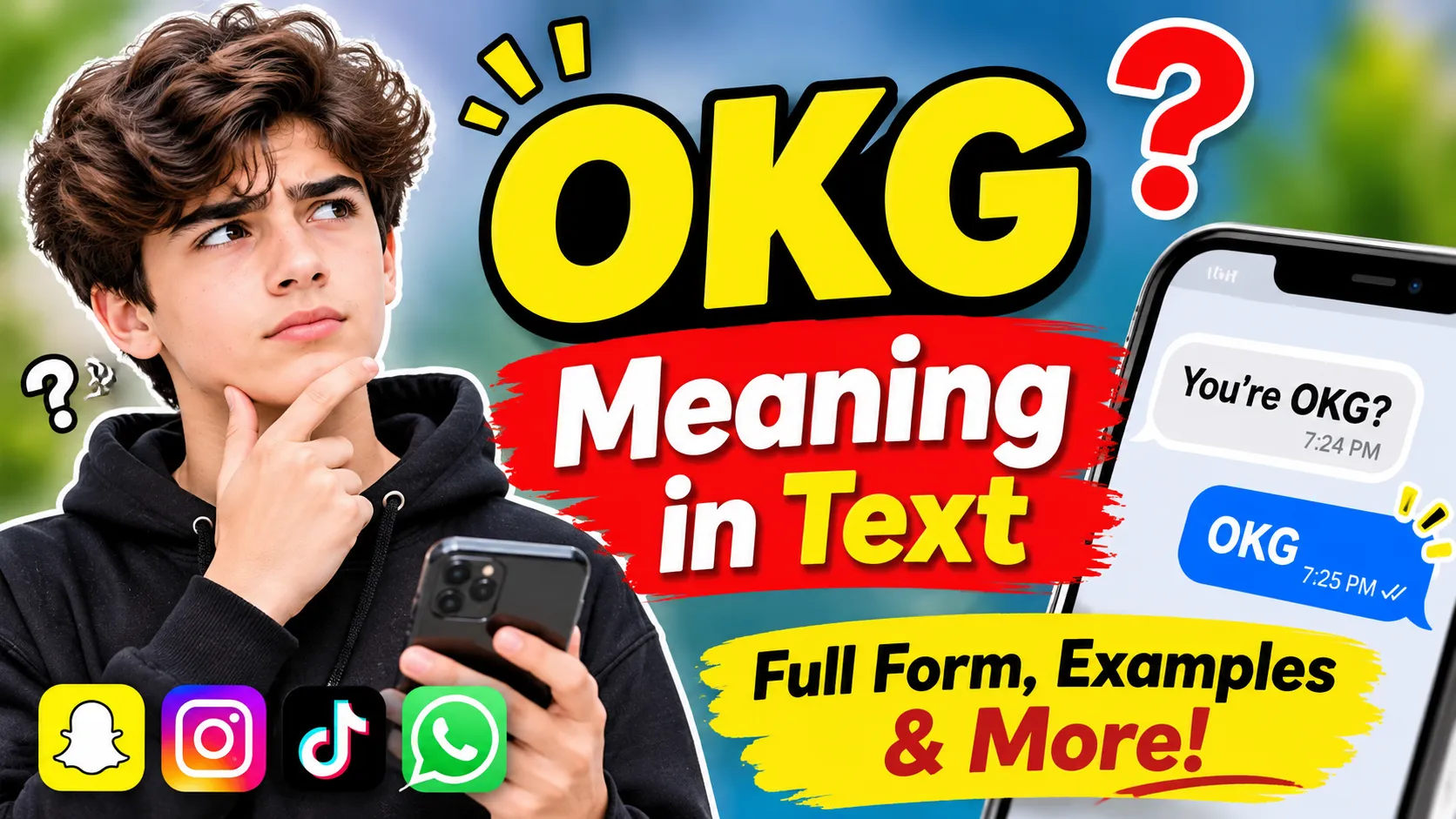
Have you ever received a message saying “OKG” and wondered what those three letters actually mean? Short internet expressions can be confusing, especially when they look similar to familiar abbreviations like OK and OMG.
The OKG meaning in text is not universally established. It is a nonstandard expression that may represent personal shorthand, an informal variation such as “Okay, Good” or “Okay, G,” or a typing mistake for “OMG.” The intended meaning depends on the sender and the conversation.
You might encounter OKG in WhatsApp messages, Instagram DMs, Snapchat conversations, TikTok comments, or other online discussions. However, there is no confirmed universal definition that applies to every situation.
In this guide, we’ll explore the possible meanings of OKG, its use in texting and social media, what it might mean when a guy or girl sends it, and how to respond without misunderstanding the message.
What Does OKG Mean in Text?
OKG is a nonstandard texting abbreviation without one universally accepted meaning. Depending on the context, someone might use it to communicate acknowledgment, casual agreement, personal shorthand, or an unintended variation of OMG.
Some possible interpretations include:
- Okay, Good: A possible way to acknowledge information positively.
- Okay, G: An informal expression in which G is used to address a friend or buddy.
- Okay, Got It: A possible personal abbreviation for confirming understanding.
- OMG typo: An accidental typing variation when someone intends to express surprise or excitement.
For example:
Person 1: I’ll meet you at the restaurant at 7.
Person 2: OKG.
Here, the sender might be acknowledging the arrangement.
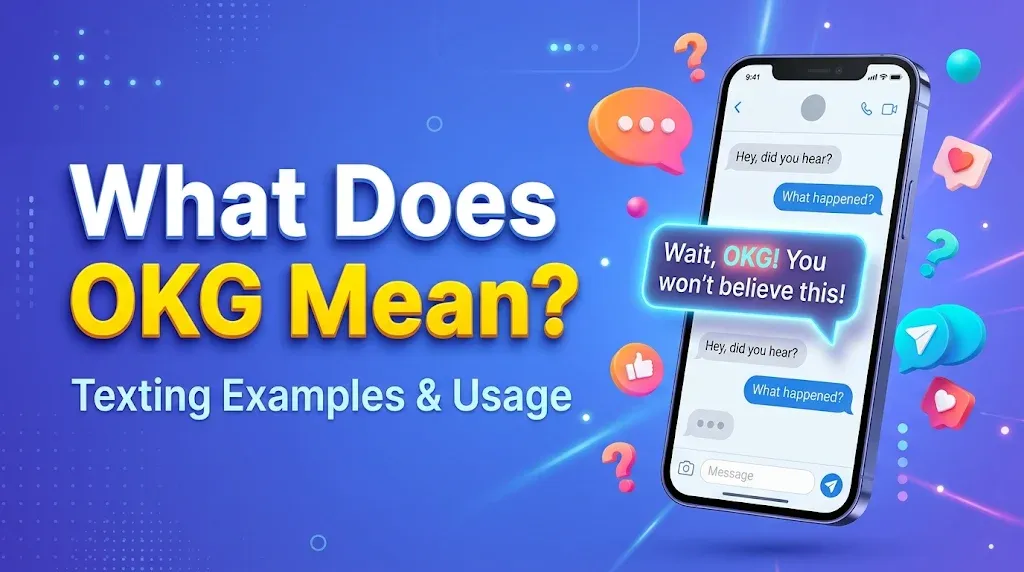
However, if someone sends “OKG!!!” after hearing surprising news, they might have intended to type OMG.
The important thing is that OKG does not have a fixed meaning. Understanding the surrounding conversation is the best way to interpret it.
OKG Meaning: Quick Summary
Here is a quick overview of the expression and its possible interpretations.
| Detail | Explanation |
| Term | OKG |
| Category | Texting slang / abbreviation |
| Standard full form | None established |
| Possible interpretation | Okay, Good |
| Another interpretation | Okay, G |
| Other possibility | Personal shorthand |
| Possible confusion | OMG typo |
| Tone | Depends on context |
| Usage | Informal digital conversations |
| Best way to understand it | Read the surrounding message |
Remember that these are possible interpretations, not officially established or equally common definitions.
What Does OKG Stand For?
OKG does not have one officially recognized full form in everyday texting.
Unlike LOL (Laughing Out Loud), BRB (Be Right Back), and OMG (Oh My God), OKG is not a widely standardized abbreviation.
Different people may assign different meanings to the letters depending on their personal communication habits.
Here are some interpretations you might encounter:
1. Okay, Good
One possible interpretation is “Okay, Good.”
Someone might use this expression to acknowledge information or show that something is acceptable.
Example:
A: Your appointment is confirmed for tomorrow.
B: OKG, thanks!
In this conversation, the intended message could be an informal acknowledgment.
2. Okay, G
Another possible interpretation is “Okay, G.”
In some informal slang conversations, G is used as a friendly way to address someone, similar to buddy, bro, or friend.
Example:
A: I’ll bring your headphones tomorrow.
B: OKG, appreciate it!
This interpretation makes more sense if the sender regularly uses G when talking to friends.
3. Okay, Got It
Some people may interpret OKG as personal shorthand for “Okay, Got It.”
It could be used when acknowledging instructions or confirming that a message has been understood.
Example:
A: Please send me the pictures after dinner.
B: OKG.
However, this is not a standardized expansion. You should not assume that everyone uses OKG this way.
4. A Possible Typing Mistake for OMG
OKG may also appear when someone accidentally types the wrong letter while trying to write OMG.
OMG stands for “Oh My God” and is commonly used to express surprise, excitement, shock, or disbelief.
Example:
A: I just won two concert tickets!
B: OKG!!!
If the conversation clearly expresses excitement, the sender might have intended to write OMG.
Is OKG a Real Texting Abbreviation?
OKG can appear in individual online conversations and discussions about texting slang, but it is not a widely standardized abbreviation with one accepted definition.
This distinction matters because not every combination of letters found in a message is an established internet slang term.
People frequently create their own shortcuts, shorten phrases, make typing mistakes, or use expressions that are understood only within their friendship groups.
For example, two friends might agree that OKG means “Okay, Good.” Someone outside that friendship may interpret the same letters differently.
Therefore, it is more accurate to describe OKG as a context-dependent expression rather than a universally recognized texting abbreviation.
OKG Meaning in Different Conversations
The meaning of OKG can depend on the subject being discussed and the Relationship between the people communicating.
Let’s explore some possible situations.
In Private Text Messages
In a private conversation, someone might use OKG as a quick acknowledgment.
Example:
A: I’ll call you when I get home.
B: OKG.
The sender may simply be confirming that they received the information.
In Friendship Conversations
Friends sometimes use personal abbreviations and informal expressions that make sense within their social circle.
Example:
A: Bro, I’ll bring your charger tomorrow.
B: OKG.
Here, the sender might be using a personal shorthand or a casual acknowledgment.
In Group Chats
In group conversations, OKG might appear as a short response to plans or suggestions.
Example:
A: Everyone should arrive before 9 PM.
B: OKG.
The response may indicate that the person understands the arrangement.
In Romantic Conversations
If someone you like sends OKG, avoid assuming that it has a romantic meaning.
It could simply be an acknowledgment, a personal abbreviation, or a typing mistake.
Look at the complete conversation rather than trying to identify someone’s feelings through three letters.
OKG Meaning on Social Media
OKG does not have a confirmed platform-specific meaning. Its interpretation generally depends on the person using it and the discussion in which it appears.
OKG on WhatsApp
On WhatsApp, someone might use OKG in a private message or group chat when responding to everyday information.
Example:
A: I’ll send you the location.
B: OKG.
The message could be an acknowledgment or personal shorthand.
OKG on Instagram
In Instagram DMs, OKG might appear in casual conversations, replies, or discussions between friends.
Example:
A: I uploaded the pictures from yesterday.
B: OKG, I’ll check them!
The exact intention depends on the sender.
OKG on Snapchat
On Snapchat, users often communicate through short messages and informal expressions.
Example:
A: We’re going shopping tomorrow.
B: OKG!
This could be a casual response, although the abbreviation itself has no established Snapchat-specific definition.
OKG on TikTok
You might encounter OKG in TikTok comments or direct messages.
For example, someone could write it while reacting to a video or responding to another user’s comment.
However, do not assume that OKG is a special TikTok trend or officially recognized TikTok abbreviation.
OKG on Facebook and Other Platforms
The same principle applies to Facebook, Discord, Reddit, and X.
The platform alone does not determine what OKG means. The conversation and the sender’s usual communication style are more useful clues.
OKG Meaning From a Guy
If a guy sends you OKG, it does not automatically mean that he is flirting, expressing romantic interest, or trying to communicate a hidden message.
There are several possible interpretations:
- Acknowledgment: He may simply be confirming that he received your message.
- Agreement: He might be responding positively to a suggestion.
- Friendly expression: He could be using G as a casual way of addressing you.
- Typing mistake: He may have intended to write OMG.
- Personal shorthand: He might use OKG in his own texting style.
Example:
You: I’ll see you tomorrow!
Him: OKG.
This could simply be a casual acknowledgment.
To understand his intention, consider what you were discussing before he sent the message.
OKG Meaning From a Girl
When a girl sends OKG, the abbreviation does not automatically have a special romantic or emotional meaning.
She might be using it as a casual response, personal shorthand, or an unintended variation of another expression.
Example:
You: I got the tickets for Saturday!
Her: OKG, that’s great!
In this situation, she may be acknowledging your news or expressing a positive reaction.
If you are unsure, you can ask her what she means instead of assuming that OKG has a hidden meaning.
Is OKG a Typo for OMG?
Yes, OKG could sometimes be a typing mistake for OMG, but the two expressions are not interchangeable.
OMG is a widely recognized abbreviation for “Oh My God.” It is commonly used when someone experiences surprise, excitement, shock, or disbelief.
OKG, on the other hand, has no universally accepted texting Definition.
Consider these examples:
Example 1:
A: I just met my favorite celebrity!
B: OKG!!!
The sender might have intended to type OMG because the situation involves excitement.
Example 2:
A: I’ll meet you outside the school.
B: OKG.
This looks more like acknowledgment or personal shorthand.
If you are unsure whether someone made a typing mistake, the surrounding words can provide useful clues.
- Related To Another Article: https://blessnesty.com/wryd-meaning-in-text/
Is OKG Rude, Friendly, or Sarcastic?
OKG is not inherently rude, friendly, or sarcastic. Its tone depends on the complete message, punctuation, and relationship between the people communicating.
Here are some possible situations:
| Situation | Possible tone |
| Responding to good news | Positive |
| Confirming a plan | Neutral |
| Talking to a close friend | Casual |
| Responding during an argument | Potentially sarcastic |
| Sending it without explanation | Unclear |
For example:
Friendly: OKG, thanks for letting me know!
Neutral: OKG, see you tomorrow.
Potentially sarcastic: OKG, whatever you say.
Notice that the surrounding words provide more information about the tone than the abbreviation itself.
How to Reply When Someone Says OKG
Your response should depend on what the other person appears to mean.
Here are some simple replies you can use.
| Situation | Possible response |
| They acknowledge your message | “Great!” |
| They agree with your plan | “Sounds good!” |
| They confirm information | “Thanks for confirming.” |
| They seem excited | “I know, right?” |
| They use G casually | “Alright, bro!” |
| You do not understand | “What do you mean by OKG?” |
| You suspect a typo | “Did you mean OMG?” |
You do not need to overthink a short message. If the conversation is already clear, continue naturally.
If the abbreviation creates confusion, asking the sender directly is usually the easiest solution.
OKG vs. OK vs. OMG
And OKG, OK, and OMG may look similar, but they have different levels of recognition and different interpretations.
| Abbreviation | Meaning | Usage |
| OKG | No standardized full form | Context-dependent |
| OK | Okay | Agreement or acknowledgment |
| OMG | Oh My God | Surprise or excitement |
OKG vs. OK
OK is a widely understood expression used to communicate agreement, acceptance, or acknowledgment.
OKG is less standardized and requires more context to understand.
For example:
- OK: I’ll meet you tomorrow.
- OKG: A possible personal shorthand or informal acknowledgment.
OKG vs. OMG
OMG is commonly used to express surprise, excitement, or disbelief.
OKG might occasionally be a typing mistake for OMG, but the two should not automatically be treated as equivalent.
For example:
- OMG! That’s amazing!
- OKG! That’s amazing!
In the second example, the sender may have intended to write OMG.
Examples of OKG in Conversations
These examples demonstrate possible interpretations of OKG in everyday messaging. They are illustrative rather than proof of standardized usage.
Example 1: Making Plans
A: Are we meeting at 6?
B: OKG.
Possible interpretation: Acknowledgment or agreement.
Example 2: Sharing Good News
A: I got the job!
B: OKG, congratulations!
Possible interpretation: Positive acknowledgment or an intended OMG.
Example 3: Casual Friendship
A: I’ll bring your charger tomorrow.
B: OKG, bro.
Possible interpretation: Casual acknowledgment.
Example 4: Confirming Instructions
A: Don’t forget to send me the document.
B: OKG.
Possible interpretation: Personal shorthand for understanding.
Example 5: Social Media Conversation
A: Did you see my new post?
B: OKG, checking it now.
Possible interpretation: Informal acknowledgment.
Example 6: Unexpected News
A: They announced another concert!
B: OKG!!!
Possible interpretation: A possible typing mistake for OMG.
Example 7: Everyday Conversation
A: I’ll message you later.
B: OKG, no problem.
Possible interpretation: Acknowledgment.
Example 8: Group Conversation
A: Everyone should arrive before 9.
B: OKG.
Possible interpretation: Confirmation or understanding.
When Should You Use OKG?
Because OKG does not have a universally established meaning, it is better to use it only when the other person understands what you intend to communicate.
You might use personal shorthand in:
- Casual conversations with close friends.
- Informal group chats.
- Private messages.
- Conversations where the intended meaning is already clear.
However, avoid using unclear abbreviations in formal or professional communication.
For example, instead of writing:
“OKG, I’ll complete the task.”
You can write:
“Okay, understood. I’ll complete the task.”
Clear communication is particularly important when messaging employers, teachers, clients, or people who may not understand informal slang.
Common Misunderstandings About OKG
People can easily misunderstand OKG because it does not have one established definition.
Here are some common mistakes to avoid:
1. Assuming it always means Okay, Good
This is one possible interpretation, not a universally accepted full form.
2. Treating OKG and OMG as identical
OMG is a widely recognized abbreviation, whereas OKG is nonstandard.
3. Assuming it is romantic slang
A guy or girl sending OKG does not automatically indicate flirting or romantic interest.
4. Believing every social platform has a different meaning
There is no established evidence of a separate universal definition for WhatsApp, Instagram, Snapchat, or TikTok.
5. Ignoring the conversation
The surrounding message, punctuation, and sender’s habits are important clues when interpreting unfamiliar shorthand.
People Also Ask
OKG is a nonstandard texting expression without one universally accepted definition. It may be interpreted as “Okay, Good,” “Okay, G,” personal shorthand, or a possible typo for OMG.
OKG has no officially established full form in everyday texting. Some people may interpret it as “Okay, Good” or “Okay, G,” depending on the conversation.
It can be interpreted as “Okay, Good” in certain conversations, particularly when someone acknowledges positive information. However, it is not a universally standardized expansion.
Yes, someone might accidentally type OKG instead of OMG or use it as a personal variation. This interpretation is more plausible when the surrounding message expresses surprise or excitement.
A guy might use OKG to acknowledge your message, agree with something, or communicate through personal shorthand. It does not automatically indicate romantic interest.
Conclusion
The OKG Meaning In Text is not as straightforward as popular abbreviations such as LOL, BRB, or OMG. It does not have one universally recognized full form, and different people may use it in different ways.
Depending on the conversation, OKG could be interpreted as “Okay, Good,” “Okay, G,” personal shorthand, or a possible typing mistake for OMG.
The best way to understand it is to consider the complete message, the sender’s usual communication style, and the situation in which it appears.
If someone sends you OKG and you are still confused, simply ask what they mean. A quick question can prevent unnecessary misunderstandings.