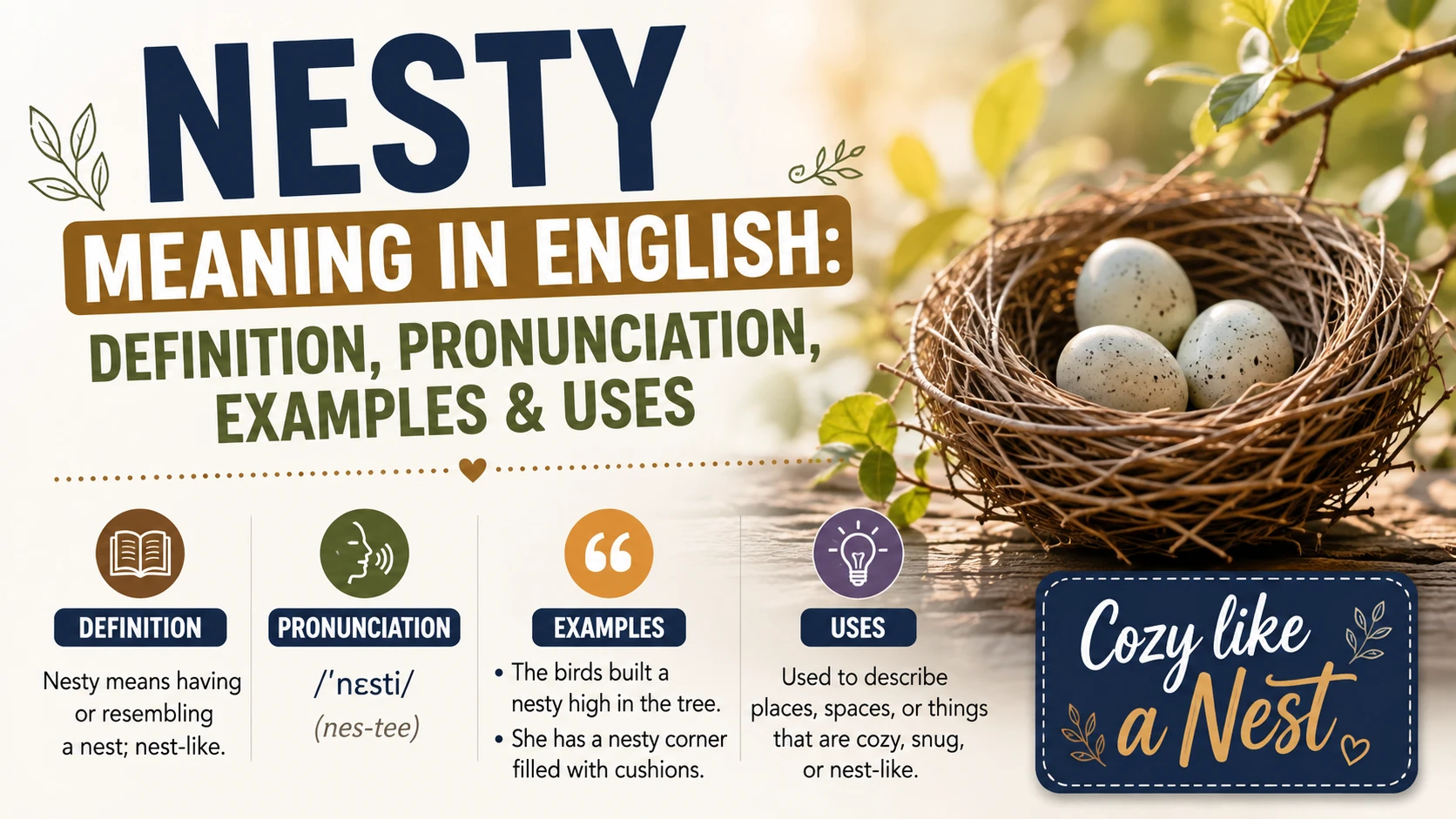
Have you come across the word and wondered what it means? You are not alone. Is an uncommon English word, and its meaning can change depending on the context in which it appears.
In general,is a rare adjective Associated with a nest or with characteristics of a nest. Historical dictionaries also record nasty as meaning “full of nests” or having markings that resemble nests. In Scottish English, however, is also recorded as a variant of nasty, meaning unpleasant, dirty, or offensive.
Because these meanings are quite different, understanding the context is important. In this guide, you will learn the meaning in English, pronunciation, word origin, examples, synonyms, differences from nasty and nest-like, and whether is commonly used today.
What Does Mean?

The word can describe something that is related to, Resembling, or characteristic of a nest. Historical English sources also use it for something full of nests or marked in a way that resembles nests.
In Scottish English, has another meaning: it can be a variant spelling of nasty, referring to something unpleasant, dirty, offensive, or disagreeable.
So, the exact meaning depends on context.
Simple definition:
Means related to or resembling a nest; in Scottish English, it can also mean nasty or unpleasant.
It is worth noting that should not automatically be interpreted as “cozy.” People may use the word informally to suggest a warm, nest-like, comfortable environment, but that is different from its more established dictionary senses.
Meaning in English
In English vocabulary, is generally understood through its connection with the noun nest.
A nest is a place where birds or other animals live, rest, or raise their young. By adding the adjective-forming suffix can describe something that has qualities associated with a nest.
For example:
- A area may contain or resemble nests.
- pattern may look like the structure or markings of a nest.
- A environment may be informally described as having a tucked-away, nest-like quality.
There is also a separate Scottish use in which is connected to nasty, rather than nest.
Therefore, readers should consider the surrounding sentence before deciding which definition applies.
Pronunciation: How to Say
is generally pronounced:
NES-tee
Phonetically, it can be represented as:
/ˈnɛsti/
The first part sounds like “nest,” followed by a short “ee” sound.
Pronunciation breakdown
- Nest → /nɛst/
- -y → /i/
- → -tee
The pronunciation is straightforward, even though the word itself is relatively uncommon.
Is a Real English Word?
Yes, is a real English word, but it is not a common everyday word.
Dictionaries and historical lexical sources document several uses of . Wiktionary records a rare adjective connected with the characteristics of a nest, while historical dictionary sources record meanings involving nests or nest-like markings. Merriam-Webster separately identifies as a Scottish variant of nasty.
This distinction is important.
A word can be legitimate English vocabulary without being widely used in modern conversation. belongs largely to the category of rare, historical, dialectal, or context-dependent vocabulary.
If you are writing for a general audience, words such as nest-like, cozy, snug, homey, or comfortable may communicate your intended meaning more clearly.
What Are the Different Meanings?
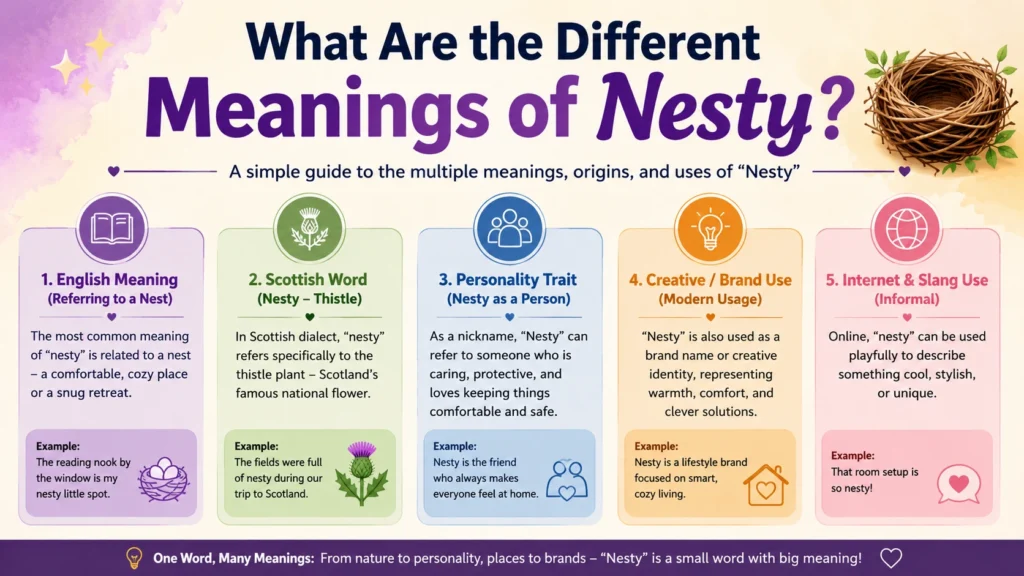
Nesty has several documented or contextual uses. The most Important ones can be divided into three groups.
Resembling or Characteristic of a Nest
The nest-related sense describes something that resembles a nest or has qualities associated with one.
For example:
The tangled branches created a nesty structure.
Here, nesty suggests that the structure looks or feels similar to a nest.
This sense is particularly useful when describing natural structures, textures, shapes, or arrangements.
Meaning: Full of Nests or Nest-Like Markings
Historical dictionary sources record nesty as meaning full of nests or having markings resembling nests.
For example:
The old tree was unusually nesty in spring.
The intended idea could be that the tree contained many nests.
This is a specialized use rather than something most modern English speakers would naturally say.
As a Scottish Variant of Nasty
A completely different meaning appears in Scottish English.
Merriam-Webster defines nesty as a Scottish variant of “nasty.”
In this context, it can refer to something unpleasant, dirty, offensive, or disagreeable.
For example:
The weather turned nesty before the journey.
If nesty is being used in a Scottish dialectal context, it should not automatically be interpreted as “like a nest.”
This is why context is especially important when reading older Scottish writing or dialectal English.
Can Mean Cozy, Snug, or Comfortable?
Sometimes, in informal or creative usage, nesty can suggest a cozy, sheltered, or nest-like feeling—but this should not be treated as the primary standard definition.
The connection is understandable.
A bird’s nest is typically associated with:
- shelter
- warmth
- protection
- home
- comfort
- privacy
Because of this association, a writer may creatively describe a room, corner, bed, or home as nesty.
For example:
This little reading corner feels wonderfully nesty.
Here, the writer is using nesty creatively to mean something like cozy, tucked away, and nest-like.
However, if you want maximum clarity, cozy, snug, homey, comfortable, or nest-like would usually be better choices in standard modern English.
Word Origin and Etymology
One major meaning of nesty comes naturally from the word nest.
English has long used suffixes such as -y to create adjectives describing something characterized by a particular quality. Words such as muddy, rocky, and cloudy demonstrate this pattern.
By the same pattern, nesty can describe something characterized by or resembling a nest.
Historical dictionaries preserve the sense of nesty as something full of nests or resembling nests, supporting its connection with nest.
The Scottish meaning has a different lexical relationship because Scottish sources record nesty/nestie as a form of nasty. The Scottish Dictionaries entry documents this dialectal usage and its meanings.
Thus, the modern reader should understand nesty as a word with multiple historical pathways, rather than assuming that every occurrence has exactly the same meaning.
How to Use in a Sentence
Because nesty is uncommon, sentence context is especially important.
Here are examples illustrating its nest-related use:
- The branches formed a nesty pattern above the garden.
- Several birds had made the old tree remarkably nesty.
- The woven material had a soft, nesty appearance.
- The corner beneath the branches looked nesty and sheltered.
- The natural fibers created a nesty texture.
- The bushes became nesty during the breeding season.
- The structure had a strangely nesty shape.
- The artist used a nesty pattern inspired by birds’ homes.
- The tree looked especially nesty in early spring.
- The arrangement had a distinctly nesty appearance.
For informal creative usage:
I love this little nesty corner of my bedroom.
Here, the word is being used to communicate a cozy, tucked-away atmosphere, rather than a strict dictionary definition.
For the Scottish sense:
The old text describes the place as nesty.
In such a sentence, additional context would be necessary to determine whether nesty means nasty/unpleasant or something nest-related.
Examples
Understanding the word becomes easier when you compare its possible meanings.
| Example | Likely meaning |
| The branches looked nesty. | Resembling a nest |
| The tree was full of nests and looked nesty. | Full of nests |
| The room felt nesty and warm. | Informal: cozy/nest-like |
| The Scottish text calls the conditions nesty. | Variant of nasty |
| The woven fibers had a nesty appearance. | Nest-like |
| The garden corner felt wonderfully nesty. | Informal: sheltered/cozy |
The key lesson is that context determines interpretation.
Synonyms and Related Words
There is no single perfect synonym for nesty because its meaning changes according to context.
For the nest-like meaning
- nest-like
- resembling a nest
- nest-shaped
- bird-nest-like
- sheltered
- tucked away
The cozy interpretation
- cozy
- snug
- comfortable
- homey
- warm
- inviting
- sheltered
For the Scottish “nasty” meaning
- nasty
- unpleasant
- disagreeable
- offensive
- dirty
- foul
- unpleasant-looking
When replacing nesty with a synonym, always identify the intended sense first.
Antonyms
The opposite of nesty also depends on which meaning you intend.
If nesty means cozy or nest-like, possible opposites include:
- uncomfortable
- exposed
- open
- uninviting
- harsh
Mans full of nests, possible contrasts include:
- nest-free
- empty
- barren
If it is being used as a Scottish variant of nasty, possible antonyms include:
- pleasant
- clean
- agreeable
- lovely
- pleasant-smelling
There is therefore no universal antonym for nesty.
Vs. Nasty vs. Nest-Like vs. Cozy
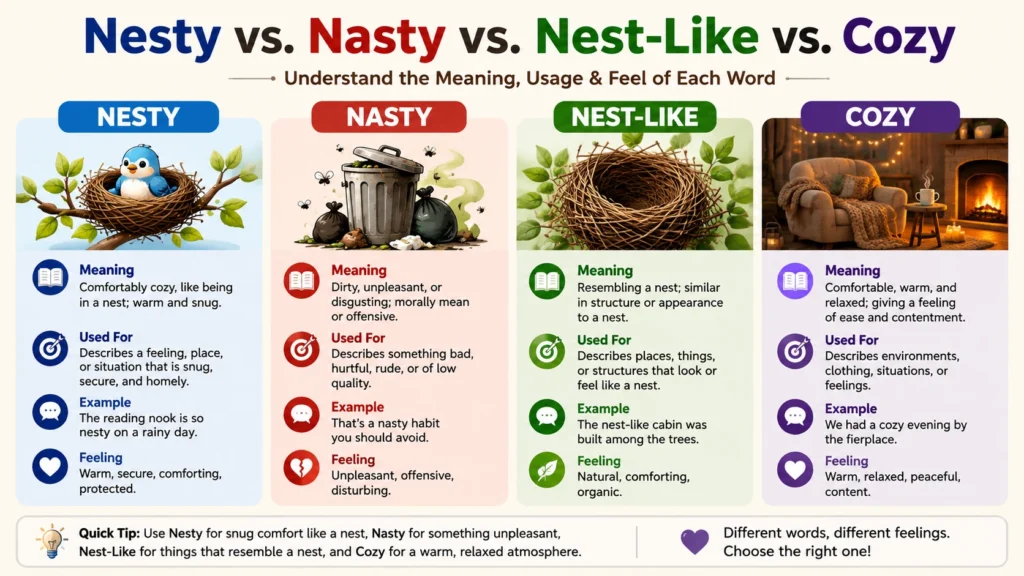
These words may appear similar, but they are not Interchangeable.
| Word | Main idea | Common today? |
| Nesty | Related to/resembling a nest; also a Scottish form of nasty | Rare |
| Nasty | Unpleasant, offensive, dirty, or disagreeable | Very common |
| Nest-like | Resembling a nest | Clear and understandable |
| Cozy | Warm, comfortable, and inviting | Very common |
| Snug | Comfortably warm, protected, or compact | Common |
| Homey | Comfortable and characteristic of a pleasant home | Common |
Vs. Nasty
Nesty and nasty can be confusing because Scottish English dictionaries record nesty as a variant of nasty.
But outside that dialectal context, a reader may understand nesty as being related to nest.
Nasty is the standard modern English word for something unpleasant or offensive.
Nest-Like
Nest-like is much clearer when you mean “resembling a nest.”
For example:
The branches formed a nest-like structure.
This is immediately understandable to almost every English reader.
Nesty can convey a similar idea, but it is much rarer.
Vs. Cozy
Cozy means comfortable, warm, pleasant, and inviting.
Nesty may be used creatively to suggest a similar feeling because a nest represents shelter and comfort, but nesty is not simply a standard synonym for cozy.
Is Commonly Used in Modern English?
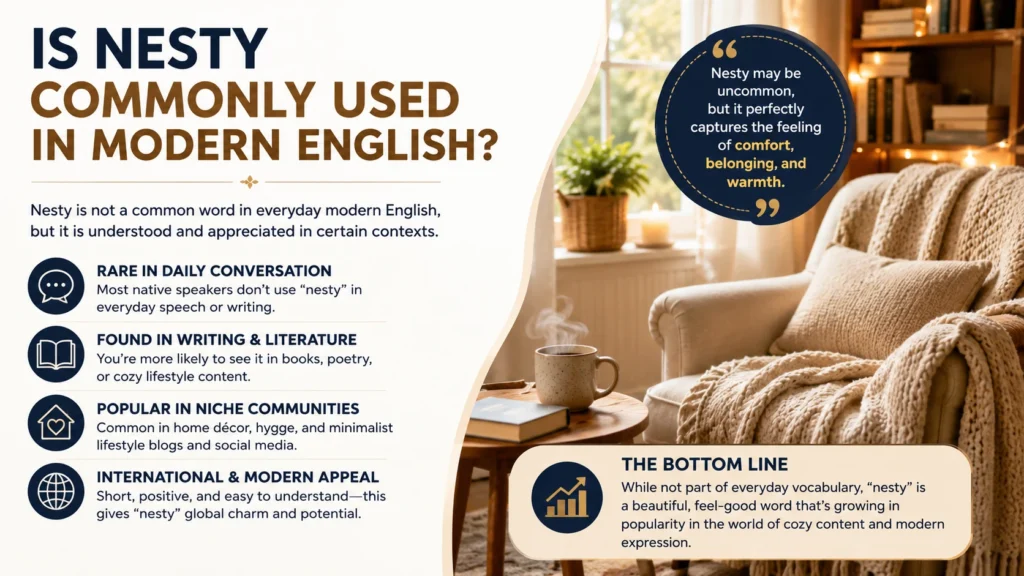
No. is not a commonly used word in everyday modern English.
Most native English speakers would be more likely to say:
- nest-like
- cozy
- snug
- homey
- comfortable
- full of nests
rather than nesty.
That does not make nesty incorrect. It simply means that the word is rare and context-dependent.
If you encounter it in literature, historical writing, Scottish English, or creative writing, the surrounding context can help determine which meaning the writer intended.
People Also Ask
What is the simplest meaning?
Nesty is a rare adjective that can mean resembling or relating to a nest. It is also documented as a Scottish variant of nasty.
Does mean cozy?
It can be used informally to suggest a cozy, nest-like feeling, but “cozy” is not the safest universal definition of nesty.
Is a proper English word?
Yes. Nesty is documented in English dictionaries and historical lexical sources, although it is uncommon in everyday modern English.
The same as nest-like?
Not exactly. Nest-like is the clearer modern expression for something that resembles a nest. Nesty is a rarer adjective with additional historical and dialectal meanings.
Conclusion
The word nesty is a rare and Interesting English adjective with more than one documented meaning. It can describe something related to or resembling a nest, something full of nests, or, in Scottish English, a variant of nasty. In informal modern writing, it may also be used creatively to suggest a cozy, snug, or sheltered feeling, although cozy and nest-like are usually clearer choices.
Understanding the context is the key to understanding nesty meaning in English. While you may not hear nesty often in everyday conversation, knowing its different meanings can help you understand dictionaries, historical texts, dialects, and creative writing more accurately. If you are using the word yourself, choose the meaning carefully and consider a more familiar synonym when clarity is important.