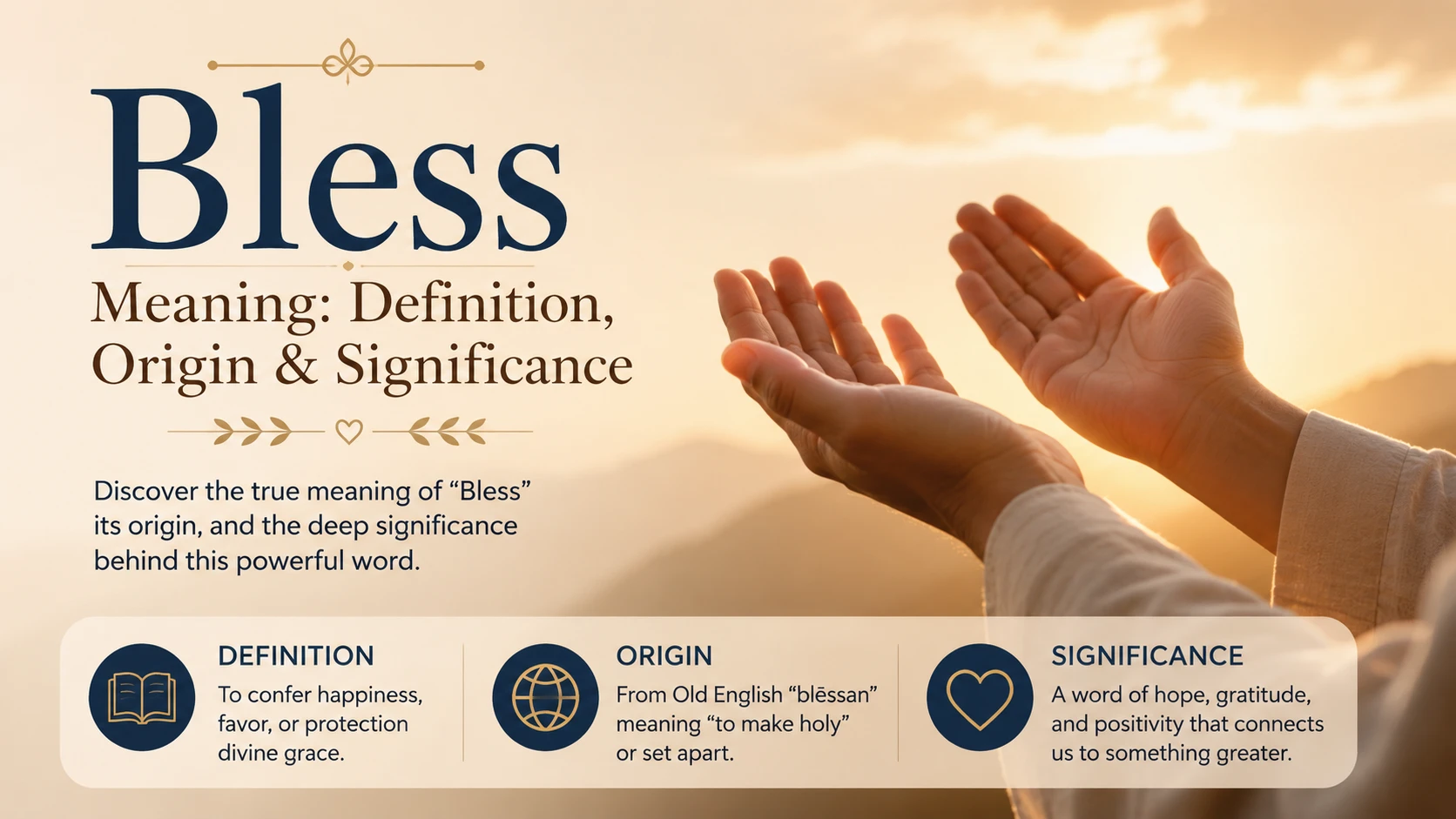
The word “Bless Meaning“ is one of the most versatile, deeply rooted, and frequently used terms in the English language. From quiet spiritual prayers to casual everyday conversations, it carries warmth, gratitude, and good wishes wherever it appears. Whether you hear someone say “bless you” after a sneeze, see a friend post that they feel “blessed,” or read a religious text about divine favor, the concept of blessing connects people across cultures, languages, and centuries.
Understanding the full scope of what “bless” means helps us communicate with greater clarity and cultural awareness. In this comprehensive guide, we will explore every dimension of the word—from its simple definitions and religious roots to everyday idioms, pronunciation rules, and name origins related to blessing.
What Does Bless Mean? Simple Definition and Explanation
At its most fundamental level, bless means to invoke divine protection, confer favor, or wish goodness, health, and happiness upon someone or something. Originating from ancient linguistic roots associated with consecration and holiness, the verb represents an act of bestowing favor or expressing deep gratitude. When you bless a person, place, or effort, you are offering positive energy, approval, or spiritual grace.
In modern usage, the term has expanded beyond strict spiritual boundaries into general human connection. It functions both as a formal act of consecration and as an informal gesture of goodwill. Understanding this simple definition provides the foundation for exploring its many nuanced applications in daily speech and literature.
Names Meaning “Bless” or “Blessed”
| Name | Meaning | Tone | Origin |
| Benedict | Blessed | Formal, Classic | Latin |
| Baruch | Blessed / Praised | Reverent, Traditional | Hebrew |
| Beatrix | She who brings happiness / Blessed | Elegant, Cheerful | Latin |
| Asher | Happy / Blessed | Warm, Contemporary | Hebrew |
| Gwyneth | Blessed / Fortunate | Graceful, Gentle | Welsh |
| Aytza | Blessing | Delicate, Unique | Hebrew |
| Barke | Abundant blessing | Uplifting, Strong | African (Swahili) |
| Cedd | Holy / Blessed | Historical, Stately | Old English |
| Sachi | Child of bliss / Blessed child | Joyful, Bright | Japanese |
| Zelig | Blessed / Happy | Warm, Vintage | Yiddish |
Bless Meaning in Simple Words
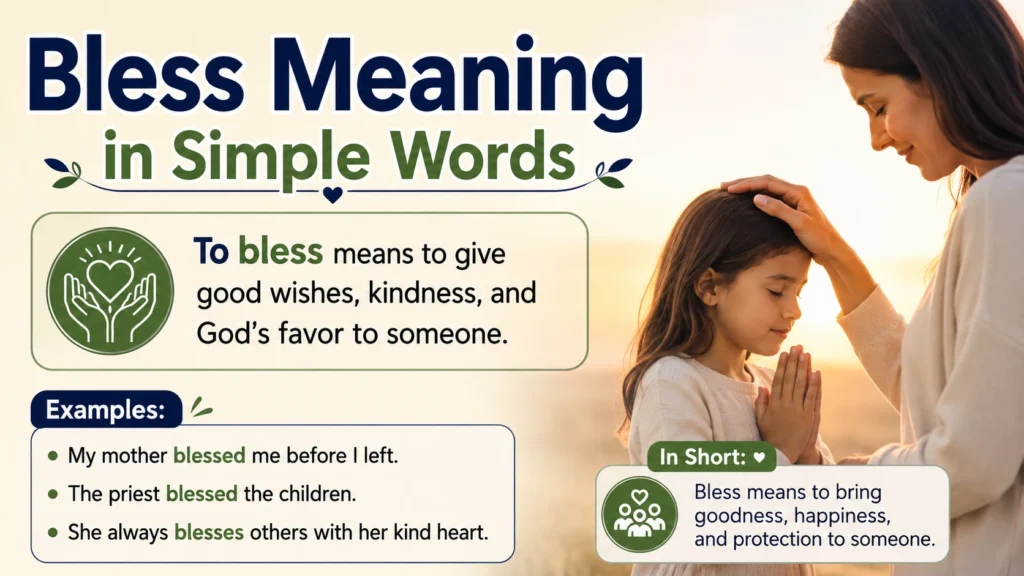
To explain bless in simple words, think of it as giving a gift of kindness, favor, or good luck. It means Asking God or a higher power to look after someone, or simply expressing heartfelt appreciation for something good in your life. It is the opposite of cursing or bringing harm; it is entirely focused on positivity, protection, and peace.
When someone says “bless this food,” they simply mean “make this food good and healthy for us.” When a parent blesses a child, they are offering their heartfelt approval and wishing them a safe, successful journey in life.
Names Meaning “Bless” or “Blessed”
| Name | Meaning | Tone | Origin |
| Beatrice | She who blesses | Classic, Friendly | Latin |
| Baraka | Blessing / White | Strong, Serene | Swahili / Arabic |
| Bennett | Little blessed one | Modern, Friendly | Latin |
| Carwyn | Blessed love | Romantic, Poetic | Welsh |
| Aine | Radiance / Blessed | Bright, Whimsical | Irish |
| Blessing | Gift of grace | Direct, Uplifting | English |
| Bento | Blessed | Casual, Energetic | Portuguese |
| Elysia | Blessed / Blissful | Dreamy, Soft | Greek |
| Felix | Happy / Blessed with luck | Cheerful, Vibrant | Latin |
| Makar | Blessed / Happy | Strong, Distinctive | Slavic |
What Are the Different Meanings of Bless?
The word bless carries multiple distinct meanings depending on how and where it is used. First, it can mean to make something holy or sacred through a religious ritual, such as consecrating water or a place of worship. Second, it can mean to grant happiness, health, or prosperity to someone, as in “nature blessed the valley with fertile soil.”
Third, it is frequently used to express praise and worship toward God (“Bless the Lord”). Finally, in everyday conversational speech, “bless” acts as an expression of sympathy, polite gratitude, or affection. Recognizing these distinct angles helps prevent confusion in different settings.
Names Meaning “Bless” or “Blessed”
| Name | Meaning | Tone | Origin |
| Macario | Ultra-blessed | Majestic, Classic | Spanish / Greek |
| Jesse | Blessing / Gift | Timeless, Grounded | Hebrew |
| Gwen | Blessed / Holy ring | Soft, Classic | Welsh |
| Fausto | Fortunate / Blessed | Lively, Spirited | Italian / Latin |
| Oni | Desired / Blessed | Warm, Expressive | West African |
| Nima | Blessing / Grace | Gentle, Modern | Arabic / Persian |
| Seeley | Blessed / Happy | Charming, Gentle | Old English |
| Keiko | Blessed child | Polite, Serene | Japanese |
| Jedidiah | Beloved / Blessed of the Lord | Scholarly, Devout | Hebrew |
| Veneza | Blessed / Graceful | Exotic, Melodic | Latin |
What Does Bless Mean in a Religious Context?
In a religious context, bless holds deep spiritual significance across many global faiths, including Christianity, Judaism, and Islam. It refers to the impartation of divine grace, holy protection, and sacred approval. Priests, ministers, and spiritual leaders perform blessings to set items aside for holy purposes or to bestow God’s peace upon a congregation.
Furthermore, religious followers use the word to praise the Divine, acknowledging that all good things flow from a spiritual source. In this context, a blessing is far more than a polite gesture—it is considered a real, spiritual bestowal of divine favor and spiritual warmth.
Names Meaning “Bless” or “Blessed”
| Name | Meaning | Tone | Origin |
| Jonathan | Gift of God / Blessed gift | Noble, Traditional | Hebrew |
| Theodore | Divine gift / Blessed | Classic, Serious | Greek |
| Berekiah | Blessed by God | Devout, Historical | Hebrew |
| Bohdana | Given by God / Blessed | Melodic, Warm | Slavic |
| Matthew | Gift / Blessing of God | Approachable, Classic | Hebrew |
| Nathanael | God has blessed/given | Formal, Devout | Hebrew |
| Grace | Divine favor / Blessing | Elegant, Pure | Latin |
| Mikelle | Blessed gift | Contemporary, Soft | Hebrew |
| Yoshe | Blessed / Favored | Unique, Gentle | Hebrew |
| Zuberi | Strong / Blessed | Confident, Bold | African |
What Does Bless Mean in Everyday English?
In everyday English, bless has shifted from strictly religious settings into casual, conversational shorthand for appreciation, warmth, and care. People use it to thank someone who performs an act of unexpected kindness, as in “Bless you for helping me bring in those groceries.” It serves as a gentle way to show emotional empathy or gratitude.
It also appears frequently in popular social media culture (often hashtagged as #blessed) to express contentment with life’s small joys, family moments, or personal achievements. In daily speech, it builds goodwill and helps communicate warm feelings effortlessly.
Names Meaning “Bless” or “Blessed”
| Name | Meaning | Tone | Origin |
| Bonita | Good / Blessed | Upbeat, Cheerful | Spanish |
| Asherah | Happy / Blessed | Mysterious, Ancient | Semitic |
| David | Beloved / Blessed | Timeless, Strong | Hebrew |
| Félix | Lucky / Blessed | Energetic, Modern | French / Latin |
| Winfred | Friend of peace / Blessed | Retro, Friendly | Old English |
| Shiloh | Tranquil / Blessed peace | Gentle, Peaceful | Hebrew |
| Naomi | Pleasantness / Blessed joy | Soft, Kind | Hebrew |
| Sonia | Blessed wisdom | Smooth, Friendly | Slavic / Greek |
| Tashi | Good fortune / Blessed | Calm, Spiritual | Tibetan |
| Joy | Delight / Blessing | Bright, Enthusiastic | English |
What Does “Bless You” Mean?

The phrase “bless you” is most famous as the standard polite response when someone sneezes. Historically, this custom dates back centuries, rooted in old beliefs that a sneeze left a person temporarily vulnerable to illness or evil spirits, or that the heart briefly stopped during a sneeze. Requesting a short blessing was thought to offer protection.
Today, however, “bless you” is simply a universally recognized etiquette standard. Beyond sneezes, people also use “bless you” to express fondness or sympathy toward someone showing innocence, vulnerability, or sweet behavior.
Names Meaning “Bless” or “Blessed”
| Name | Meaning | Tone | Origin |
| Bettina | Blessed | Sophisticated, Playful | Italian |
| Salama | Peace / Blessed safety | Peaceful, Gentle | Arabic |
| Bento | Blessed one | Friendly, Casual | Portuguese |
| Edmund | Blessed protector | Regal, Classic | Old English |
| Gwyn | Fair / Blessed | Minimalist, Cool | Welsh |
| Althea | Wholesome / Blessed healer | Poetic, Classic | Greek |
| Fortunato | Blessed with good fortune | Dramatic, Warm | Italian |
| Prosper | Fortunate / Blessed | Bold, Literary | Latin |
| Ayla | Oak tree / Blessed light | Soft, Modern | Hebrew / Turkish |
| Zoltan | Ruler / Blessed authority | Bold, Unique | Hungarian |
What Does “God Bless You” Mean?
The phrase “God bless you” is a formal and heartfelt invocation asking the Almighty to watch over, protect, and bestow good health and success upon an individual. It is often used as a warm sign-off in letters, a parting farewell between friends, or an expression of deep, personal appreciation when someone goes out of their way to assist you.
While rooted in faith, it is widely accepted across many cultures as a general sign of reverence, goodwill, and sincere warmth, carrying slightly more weight and intent than a simple “thank you.”
Names Meaning “Bless” or “Blessed”
| Name | Meaning | Tone | Origin |
| Eliana | God has answered / Blessed | Melodic, Elegant | Hebrew |
| Jane | God is gracious / Blessed | Classic, Simple | English |
| Bogdan | Given by God / Blessed | Stately, Strong | Slavic |
| Gianna | God is gracious / Blessed | Warm, Stylish | Italian |
| Devrote | Divine blessing | Serious, Rare | Sanskrit |
| John | God’s blessing of grace | Timeless, Reliable | Hebrew |
| Dorothy | Gift / Blessing from God | Vintage, Sweet | Greek |
| Amedeo | God’s love / Blessed | Dramatic, Classic | Latin |
| Hannah | Favor / Blessed grace | Gentle, Popular | Hebrew |
| Ian | God is gracious / Blessed | Sharp, Modern | Scottish |
What Does “Be Blessed” Mean?
When someone says “be blessed,” they are offering a warm wish for your overall well-being, peace, and spiritual prosperity. It is frequently used as a friendly, uplifting farewell in conversation or written messages, operating as an encouraging alternative to “take care” or “have a great day.”
By saying “be blessed,” the speaker expresses their hope that you encounter good fortune, remain safe, and feel positive about your path ahead. It carries an encouraging, peaceful, and supportive tone that fosters positive human connections.
Names Meaning “Bless” or “Blessed”
| Name | Meaning | Tone | Origin |
| Bari | Blessed / Sharp | Crisp, Modern | Hebrew |
| Dima | Blessed rain | Gentle, Nature-focused | Arabic |
| Elysium | Place of bliss / Blessed | High-toned, Ethereal | Greek |
| Helga | Holy / Blessed | Traditional, Strong | Norse |
| Inigo | Ardent / Blessed fire | Artistic, Fiery | Basque / Spanish |
| Kyomi | Pure and blessed | Delicate, Sweet | Japanese |
| Olga | Holy / Blessed | Classic, Stately | Slavic |
| Paz | Peace / Blessed calm | Minimalist, Serene | Spanish |
| Saria | Blessed rain at night | Dreamy, Soft | Arabic |
| Ventura | Good fortune / Blessed | Vibrant, Rare | Spanish |
What Does “Blessed With” Mean?
The phrase “blessed with” means to be fortunate enough to possess a particular talent, gift, circumstance, or quality. For example, saying someone is “blessed with good health” or “blessed with musical talent” means they have received these valuable traits naturally or through divine favor, rather than taking them for granted.
It frames personal advantages and happy circumstances through a lens of humility and gratitude, recognizing that many of life’s best assets—like loving families or natural abilities—are precious gifts to be cherished.
Names Meaning “Bless” or “Blessed”
| Name | Meaning | Tone | Origin |
| Alan | Handsome / Blessed peace | Classic, Gentle | Gaelic |
| Calladora | Gift of beauty / Blessed | Poetic, Flowing | Greek |
| Daria | Richly blessed | Warm, Sophisticated | Persian |
| Hiroko | Generous / Blessed child | Polished, Serene | Japanese |
| Karis | Grace / Blessed charm | Soft, Modern | Greek |
| Mireille | To admire / Blessed | Chic, Elegant | French |
| Nia | Purpose / Blessed resolve | Short, Modern | Swahili / Welsh |
| Rhiannon | Divine queen / Blessed | Mystical, Literary | Welsh |
| Thalia | Joyful / Blessed bloom | Bright, Classic | Greek |
| Zora | Dawn / Blessed light | Artistic, Radiant | Slavic |
What Does “Bless Your Heart” Mean?
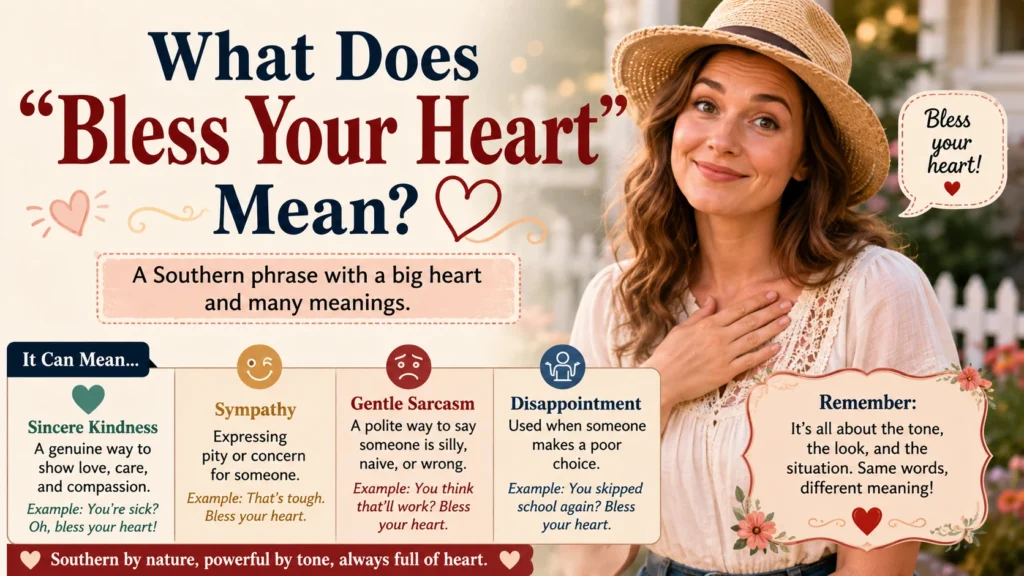
The idiomatic expression “bless your heart” is famous for its dual meanings, particularly in the Southern United States. On one hand, it is used with genuine Affection and sympathy, offered to express deep gratitude or comfort someone experiencing a minor mishap or showing sincere sweetness.
On the other hand, it can be used with subtle, polite irony or mild condescension. In this secondary context, it gently highlights someone’s foolish mistake, naivety, or awkward moment without being openly rude. Context and tone of voice determine which meaning applies.
Names Meaning “Bless” or “Blessed”
| Name | Meaning | Tone | Origin |
| Corwin | Blessed heart / Companion | Romantic, Vintage | Welsh |
| Cordelia | Heart / Blessed daughter | Regal, Classic | Latin / Celtic |
| Hugh | Heart / Mind / Blessed spirit | Classic, Grounded | Germanic |
| Lev | Heart / Blessed courage | Short, Bold | Hebrew / Slavic |
| Obba | Ancient river / Blessed heart | Earthy, Unique | West African |
| Obadiah | Servant of the Lord / Blessed | Old-fashioned, Devout | Hebrew |
| Cora | Maiden / Blessed heart | Vintage, Sweet | Greek |
| Janan | Heart / Soul blessing | Soft, Poetic | Arabic |
| Kalei | Flower wreath / Blessed | Flowing, Tropical | Hawaiian |
| Milos | Beloved / Blessed heart | Smooth, Friendly | Slavic |
Bless vs. Blessed vs. Blessing: What’s the Difference?
Understanding the grammar behind bless, blessed, and blessing ensures accurate, clear communication across all forms of writing and speech:
- Bless (Verb): The active form indicating the action itself (“Please bless this family”).
- Blessed (Adjective or Past Verb): Describes someone or something that has received favor (“She lives a blessed life”). Note that as an adjective, it is sometimes pronounced as two syllables (bless-id).
- Blessing (Noun): The actual favor, gift, prayer, or approval granted (“His friendship is a true blessing”).
| Word | Part of Speech | Function | Sentence Example |
| Bless | Verb | Action of bestowing favor | May peace bless your new home. |
| Blessed | Adjective / Verb | State of having received favor | We feel truly blessed today. |
| Blessing | Noun | The gift or grace itself | Count every single blessing. |
How Is “Bless” Used in a Sentence? Examples and Contexts
The word bless adapts smoothly across informal, formal, literary, and religious settings. Examining practical sentence examples helps clarify its versatility:
- Religious: “The pastor stepped forward to bless the newborn infant.”
- Gratitude: “You brought dinner over when I was sick? Bless you!”
- Nature/Talent: “Her rare vocal range proved that nature had blessed her talent.”
- Formal Wish: “May good health and prosperity bless your business endeavors.”
By modifying sentence structure, “bless” seamlessly transforms from a formal prayer into a warm personal compliment.
Names Meaning “Bless” or “Blessed”
| Name | Meaning | Tone | Origin |
| Karisma | Divine gift / Blessing | Vibrant, Modern | Greek |
| Lani | Heavenly / Blessed | Open, Tropical | Hawaiian |
| Milagro | Miracle / Blessing | Expressive, Classic | Spanish |
| Nen | Ancient waters / Blessed | Minimalist, Rare | Egyptian |
| Orestes | Mountain dweller / Blessed | Dramatic, Ancient | Greek |
| Pia | Pious / Blessed | Short, Elegant | Latin |
| Quiteria | Tranquil / Blessed | Unique, Historic | Spanish |
| Riko | Jasmine child / Blessed | Bright, Modern | Japanese |
| Sonia | Wisdom / Blessing | Timeless, Global | Greek |
| Tatia | Fairy queen / Blessed | Soft, Exotic | Slavic |
How Do You Pronounce “Bless” and “Blessed”?
Pronouncing bless is straightforward: it is a single-syllable word pronounced as /blɛs/ (rhyming with mess, dress, and less). However, the word blessed has two distinct pronunciations depending on its usage in a sentence:
- One Syllable (/blɛst/): Used when “blessed” acts as a past-tense verb (“The priest blessed the ring”).
- Two Syllables (/ˈblɛs.ɪd/): Used in poetic, religious, or formal settings when “blessed” functions as an adjective (“Blessed are the peacemakers” or “a bless-ed event”).
Names Meaning “Bless” or “Blessed”
| Name | Meaning | Tone | Origin |
| Urbain | City dweller / Blessed | Suave, Classic | French |
| Valentin | Strong / Blessed health | Romantic, Classic | Latin |
| Wynn | Fair / Blessed friend | Gentle, Short | Welsh |
| Xavier | Bright / Blessed home | Sharp, Popular | Basque / Arabic |
| Yara | Small butterfly / Blessed | Light, Modern | Arabic / Tupi |
| Zev | Wolf / Blessed strength | Sharp, Bold | Hebrew |
| Amara | Grace / Eternal blessing | Flowing, Global | Igbo / Latin |
| Benoit | Blessed | Sophisticated, Cool | French |
| Chava | Life / Blessed living | Earthy, Traditional | Hebrew |
| Dara | Gift of wisdom / Blessed | Clean, Unisex | Hebrew / Persian |
What Are the Synonyms and Opposites of Bless?
To expand your vocabulary, it helps to examine terms closely related to bless as well as words that represent its exact opposite.
Synonyms (Similar Meanings)
- Sanctify: To make holy or consecrate.
- Grace: To bestow honor, charm, or favor upon.
- Commend: To entrust or present with favor.
- Praise: To glorify or express warm approval.
Antonyms (Opposite Meanings)
- Curse: To invoke evil, harm, or misfortune upon someone.
- Condemn: To express strong, official disapproval.
- Dam pass/Damnation: To doom or pronounce unfavorable judgment.
Names Meaning “Bless” or “Blessed”
| Name | Meaning | Tone | Origin |
| Elba | White / Blessed dawn | Crisp, Short | Latin |
| Frayne | Ash tree / Blessed dwelling | Unique, Vintage | English |
| Gia | God’s gracious blessing | Upbeat, Short | Italian |
| Hana | Blissful / Blessed bloom | Sweet, Global | Arabic / Japanese |
| Isla | Island / Blessed serene spot | Flowing, Popular | Scottish |
| Jovielle | Joyful / Blessed life | Playful, Bright | French |
| Kiki | Double happiness / Blessed | Energetic, Playful | Japanese |
| Luana | Happy / Blessed warrior | Tropical, Warm | Hawaiian |
| Mireya | Admired / Blessed miracle | Soft, Elegant | Spanish |
| Nessa | Miracle / Blessed step | Gentle, Friendly | Hebrew / Irish |
Why Does “Bless” Have Different Meanings Depending on Context?
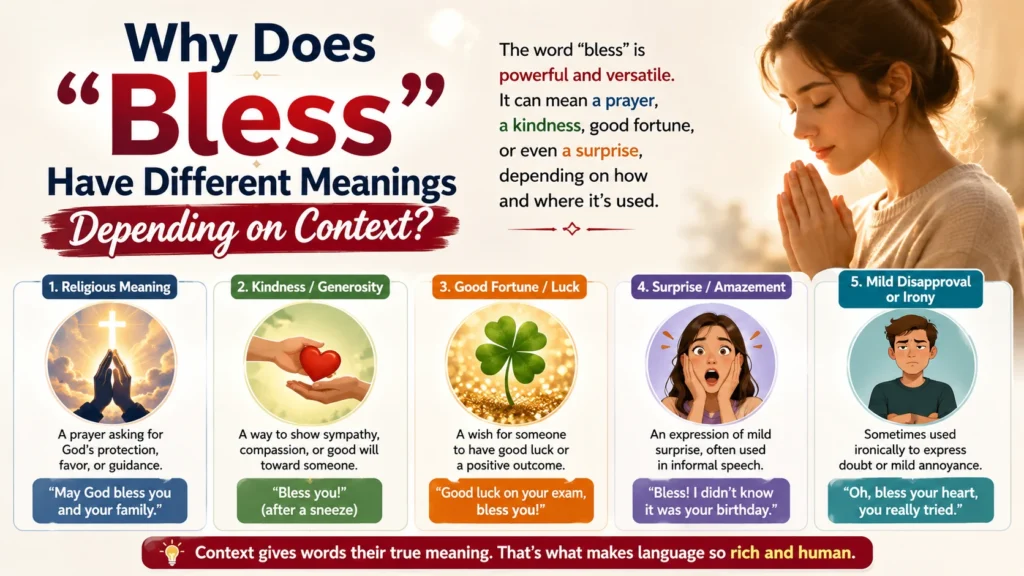
The word bless shifts in meaning because language naturally evolves to reflect human cultural, emotional, and historical changes. Originating from the Old English word Blēdsian (which was tied to ancient rituals involving blood and consecration), it was adapted by early translators to render the Latin benedicere (“to speak well of”).
Over time, this linguistic merge combined sacred consecration with general expressions of goodwill. Today, whether used formally in a religious liturgy or lightly in casual social settings, the context dictates its tone, ensuring “bless” remains a adaptable, emotionally expressive word in modern English.
Names Meaning “Bless” or “Blessed”
| Name | Meaning | Tone | Origin |
| Odelia | I will praise God / Blessed | Melodic, Vintage | Hebrew |
| Piran | Prayer / Blessed holy man | Rare, Historic | Cornish |
| Quenna | Queenly / Blessed | Bold, Unique | English |
| Raelene | Blessed princess / Grace | Soft, Western | English |
| Shira | Song / Blessed poetry | Flowing, Creative | Hebrew |
| Talia | Dew of heaven / Blessed | Soft, Popular | Hebrew |
| Ulani | Cheerful / Blessed light | Upbeat, Musical | Hawaiian |
| Vida | Life / Blessed vitality | Vibrant, Short | Spanish |
| Willa | Resolute protection / Blessed | Charming, Vintage | Germanic |
| Zelig | Happy / Blessed soul | Whimsical, Old-world | Yiddish |
People Also Ask
What is the simplest definition of “bless”?
The simplest definition of “bless” is to wish someone well, grant protection, or express heartfelt gratitude for something positive.
Is “bless” strictly a religious word?
No. While “bless” has strong spiritual and religious roots, it is frequently used in secular, everyday language to show appreciation, empathy, or general goodwill.
Why do people say “bless you” when someone sneezes?
Historically, people believed sneezes left a person vulnerable to bad spirits or illness. Today, it is simply a polite social habit used to show care.
What is the difference between “blessed” and “blessing”?
“Blessed” is an adjective describing someone who has received good fortune or grace, whereas “blessing” is a noun referring to the good gift or favor itself.
Conclusion
The word “bless” carries a rich meaning that goes far beyond its religious roots. It can express divine favor, protection, gratitude, kindness, Happiness, and goodwill. As we have explored, its meaning changes naturally depending on the context—from religious blessings and phrases like “God bless you” to everyday expressions such as “bless you,” “be blessed,” and “blessed with.” Understanding these differences makes it easier to use the word correctly and appreciate its emotional and cultural significance.
Ultimately, bless is a positive and meaningful word that connects ideas of goodness, grace, protection, and gratitude. Whether you use it in a prayer, conversation, message, or personal expression, it communicates warmth and positive intentions. By understanding the difference between bless, blessed, and blessing, along with their common phrases and uses, you can confidently understand and use this versatile word in both formal and everyday English.