Luxury Fragrances are more than beautiful bottles and prestigious brand names. The right perfume can express personality, create memories, complement an outfit, and become part of your personal identity. But with countless fragrance families, concentrations, ingredients, and luxury perfume houses available, choosing the right scent can feel overwhelming.
This ultimate guide to luxury fragrances explains what makes a perfume luxurious, how fragrance notes work, how to test and choose a scent, how to improve longevity, and how to build a collection that genuinely reflects your taste.
What Makes a Fragrance Truly Luxurious?
Luxury in perfumery is not determined by price alone. A fragrance may feel luxurious because of its craftsmanship, composition, materials, originality, presentation, heritage, or the emotional experience it creates.
A high price can reflect expensive ingredients, elaborate packaging, limited production, marketing, distribution, or brand positioning. Therefore, the most expensive perfume is not automatically the best perfume.
When evaluating a luxury fragrance, consider:
- Composition: Does every element feel balanced?
- Materials: Are the ingredients distinctive or beautifully blended?
- Craftsmanship: Does the fragrance develop smoothly?
- Originality: Does it have a recognizable personality?
- Performance: Does longevity suit your expectations?
- Versatility: Can you realistically wear it?
- Emotional appeal: Does it make you feel confident or comfortable?
- Value: Is the experience worth the price?
A sophisticated fragrance can be powerful, but it can also be subtle. Luxury does not always announce itself loudly.
Luxury Fragrance vs. Designer vs. Niche
The terms designer, niche, and luxury are often confused.
Designer Fragrances
Designer perfumes are usually created by fashion and beauty houses with broad recognition. They often prioritize versatility, accessibility, and mass appeal.
That does not mean designer perfume lacks craftsmanship. Many iconic designer fragrances have influenced modern perfumery and remain highly respected.
Niche Fragrances
Niche perfume houses generally focus more heavily on fragrance itself as an artistic product. They may explore unusual ingredients, unconventional combinations, or highly specific scent profiles.
Niche perfumes can be experimental and distinctive, but niche does not automatically mean better.
Luxury Fragrances
Luxury is a broader category that can include designer, niche, independent, heritage, and exclusive fragrance collections.
Understanding Perfume Concentration
Fragrance concentration is one of the first things shoppers encounter when comparing perfumes.
| Fragrance Type | General Character | Common Use |
| Eau de Cologne | Light and refreshing | Hot weather and quick refreshment |
| Eau de Toilette | Airy and relatively light | Everyday wear |
| Eau de Parfum | Richer and fuller | Everyday, evening, and versatile use |
| Parfum/Extrait | Dense and concentrated | Formal, intimate, or special occasions |
These categories provide useful guidance, but they are not universal guarantees of longevity or quality.
A fragrance labeled Parfum may last longer than an Eau de Toilette in some cases, but formula, materials, skin chemistry, climate, and application all influence performance.
Choose the fragrance based on how you want it to feel rather than simply selecting the highest concentration.
Eau de Parfum vs. Parfum
Eau de Parfum is often a versatile choice for people who want noticeable character without an extremely dense fragrance experience.
Parfum or Extrait de Parfum is generally more concentrated and may feel richer or smoother, although individual formulas vary considerably.
Choose Eau de Parfum if you want something flexible for regular wear. Consider Parfum when you prefer a more intimate, concentrated experience.
Neither is automatically superior. The best choice depends on the individual fragrance and your personal preferences.
Understanding the Fragrance Pyramid
Perfumes are traditionally described through three stages: top notes, heart notes, and base notes.
Top Notes
Top notes create the first impression after spraying.
Common examples include:
- Bergamot
- Lemon
- Grapefruit
- Orange
- Mint
- Lavender
- Pink pepper
- Light aromatic notes
They are usually the most noticeable immediately after application.
Heart Notes
Heart notes become more prominent as the opening settles.
Common examples include:
- Rose
- Jasmine
- Iris
- Tuberose
- Geranium
- Cardamom
- Cinnamon
- Fruity accords
The heart often gives a fragrance much of its recognizable personality.
Base Notes
Base notes create depth and help form the dry-down.
Common examples include:
- Sandalwood
- Cedar
- Vetiver
- Patchouli
- Musk
- Vanilla
- Amber accords
- Oud
- Resins
This is why you should never judge a luxury perfume after only one quick spray. The fragrance may change dramatically over several hours.
Why Perfume Smells Different on Everyone
Perfume interacts with the wearer rather than simply sitting on the skin unchanged.
Skin characteristics, temperature, moisture, environment, and individual body chemistry can influence how a fragrance develops.
This explains why a perfume that smells incredible on someone else may smell different on you.
Paper blotters are useful for discovering a fragrance’s general character, but skin testing is more valuable before making an expensive purchase.
Fragrance Families You Should Know
Learning fragrance families makes perfume shopping easier.
Floral Fragrances
Floral perfumes feature flowers such as rose, jasmine, iris, violet, and tuberose.
They can be:
- Romantic
- Elegant
- Powdery
- Fresh
- Sensual
- Dramatic
Woody Fragrances
Woody fragrances commonly feature sandalwood, cedar, vetiver, and patchouli.
They can feel sophisticated, earthy, dry, warm, or refined.
Amber Fragrances
Amber-style compositions often combine warmth, sweetness, spice, balsamic effects, and resinous depth.
They are particularly popular for evening and cooler-weather wear.
Fresh Fragrances
Fresh fragrances can feature citrus, aquatic, green, aromatic, or airy effects.
They are especially appealing for daytime use and warm weather.
Gourmand Fragrances
Gourmand perfumes are inspired by edible sensations such as:
- Vanilla
- Caramel
- Chocolate
- Coffee
- Praline
- Honey
- Tonka
They can range from playful sweetness to sophisticated and dark compositions.
Leather Fragrances
Leather perfumes may smell smoky, dry, polished, woody, sweet, or animalic.
They often create a confident and sophisticated impression.
Oud, Vanilla, Musk and Amber Explained
Certain fragrance ingredients and accords appear repeatedly in luxury perfumery.
Oud
Oud, also known as agarwood, can produce woody, smoky, resinous, leathery, sweet, or animalic effects.
The word “oud” does not guarantee that two perfumes will smell alike. The surrounding formula makes a major difference.
Vanilla
Vanilla can create creaminess, sweetness, warmth, softness, and depth.
It can be light and delicate or dark and intense.
Musk
Modern perfumery uses numerous musk materials to create softness, sensuality, diffusion, and persistence.
Many contemporary musks are synthetic rather than derived from animals.
Amber
In modern perfumery, amber often describes an accord rather than one specific natural ingredient.
Amber accords can create warmth, sweetness, resinous depth, and sensuality.
Natural vs. Synthetic Ingredients
A common misconception is that natural fragrance ingredients are always superior to synthetic ones.
Modern perfumery uses both.
Natural materials can provide distinctive textures and complexity, while synthetic materials can offer consistency, unusual effects, diffusion, stability, and creative possibilities.
The quality of a fragrance depends on how its materials work together rather than simply whether the ingredients are natural or synthetic.
For fragrance lovers, the finished composition is more important than a simplistic “natural versus synthetic” label.
Longevity, Projection and Sillage
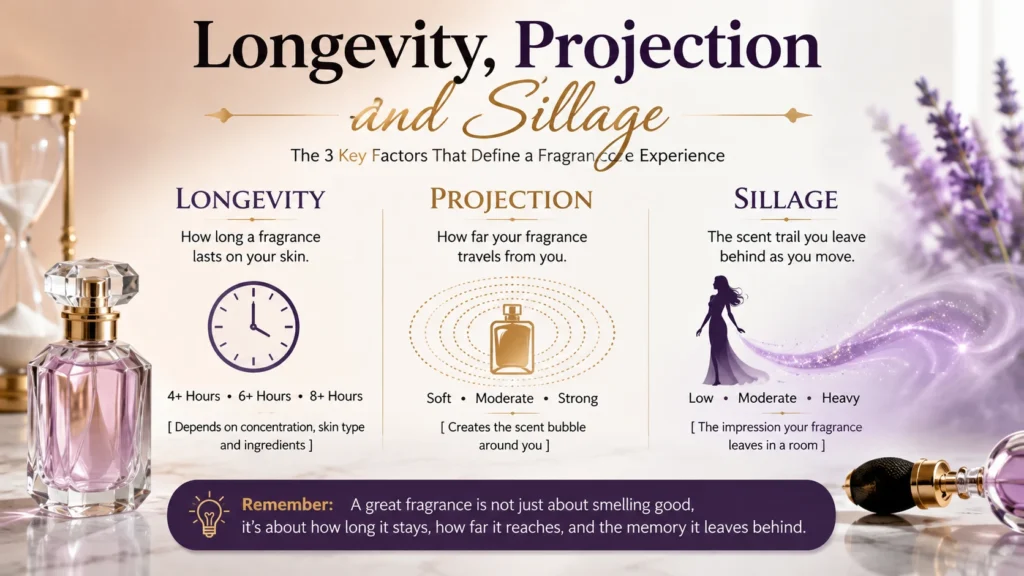
These three terms Describe different aspects of fragrance performance.
Longevity
Longevity refers to how long a fragrance remains detectable.
Projection
Projection describes how far the fragrance radiates around you.
Sillage
Sillage refers to the scented trail a fragrance leaves as you move.
A perfume can have excellent longevity without enormous projection. Another can project strongly for a short time but disappear sooner.
Understanding these differences helps you choose perfumes based on actual performance rather than marketing claims.
Why Some Luxury Perfumes Last Longer
Performance can be influenced by:
- Concentration
- Formula structure
- Ingredient volatility
- Base materials
- Skin chemistry
- Temperature
- Humidity
- Application
- Moisturization
- Clothing
Woody, musky, resinous, and ambery compositions often behave differently from bright citrus fragrances.
A citrus perfume that fades sooner is not necessarily inferior. Freshness is sometimes the intended character of the composition.
How to Test a Luxury Fragrance Properly
Testing before buying is one of the most important rules of luxury fragrance shopping.
Start with a paper blotter to understand the general direction of the scent.
Ask yourself:
- Is it fresh or warm?
- Sweet or dry?
- Floral or woody?
- Clean or smoky?
- Light or dense?
If you like the fragrance, test it on your skin.
Do not immediately decide after the first spray. Give it time to develop.
Notice the fragrance after approximately 30 minutes, then again after several hours.
For particularly expensive perfumes, buying a sample or discovery set is often much smarter than immediately purchasing a full bottle.
The 24-Hour Fragrance Test
Finally, ask yourself whether you still want to wear it after the fragrance has been on your skin for most of the day.
Consider:
- Do I still enjoy it?
- Has the fragrance improved?
- Does it become too sweet?
- Is the projection comfortable?
- Does it fit my lifestyle?
- Would I actually wear it?
- Am I attracted to the scent or the brand name?
If the answer remains positive, you are much more likely to enjoy your purchase.
How to Choose a Signature Scent
A signature scent should reflect your preferences rather than simply follow a trend.
Think about the scents you naturally enjoy.
Do you prefer:
- Citrus?
- Clean musk?
- Vanilla?
- Rose?
- Oud?
- Leather?
- Woods?
- Amber?
- Green aromatics?
- Gourmand notes?
- Spices?
An office worker may need a different fragrance from someone who attends formal events frequently.
The ideal signature fragrance is one that feels natural enough that you genuinely want to wear it again and again.
Choosing a Luxury Fragrance for Different Occasions
For Work
Choose polished fragrances with controlled projection.
Clean musk, soft woods, fresh aromatics, subtle florals, and restrained citrus can work well.
For Dates
Vanilla, musk, amber, soft woods, spices, and sensual florals are common choices.
For Formal Events
Elegant woods, florals, amber, leather, and sophisticated chypre-inspired profiles can complement formal clothing.
For Summer
Fresh citrus, green, aromatic, aquatic, and airy compositions can feel more comfortable in warm temperatures.
For Winter
Warm woods, amber, vanilla, spices, leather, and richer gourmand fragrances can work beautifully in cooler conditions.
For Everyday Wear
Choose something you enjoy wearing for several hours.
Versatility is often more valuable than maximum projection.
Luxury Fragrances for Men, Women and Unisex Wear
Traditional perfume marketing often separates fragrances into masculine and feminine categories.
But fragrance preferences are personal.
Anyone can enjoy rose, vanilla, leather, oud, woods, musk, citrus, amber, spices, or gourmand accords.
Instead of asking whether a fragrance is masculine or feminine, ask whether the scent profile feels right for you.
A perfume becomes personal when you enjoy wearing it—not when a marketing category tells you who should wear it.
How to Build a Luxury Fragrance Wardrobe
A fragrance wardrobe gives different perfumes different purposes.
A practical collection might include:
Everyday fragrance: Easy and versatile.
Fresh fragrance: Ideal for warm conditions.
Evening fragrance: Richer and more noticeable.
Formal fragrance: Polished and sophisticated.
Statement fragrance: Distinctive and memorable.
Comfort fragrance: Soft, familiar, and relaxing.
This approach can be more useful than buying multiple bottles that perform exactly the same role.
How to Make Luxury Perfume Last Longer
You cannot completely change a fragrance’s formula, but application can influence your experience.
Moisturize First
Applying fragrance to moisturized skin can help some perfumes remain noticeable longer.
An unscented moisturizer is a practical option.
Apply Strategically
Common application areas include:
- Wrists
- Neck
- Behind the ears
- Upper chest
Avoid Excessive Rubbing
Spray the fragrance and allow it to settle naturally rather than aggressively rubbing the skin.
Consider Clothing
Some fragrances remain detectable on fabric longer than on skin.
Always test first because certain formulas can mark delicate materials.
Avoid Overspraying
More perfume does not necessarily mean more sophistication.
The goal is to create a pleasant scent experience, not overwhelm everyone nearby.
Common Luxury Perfume Mistakes
Buying Because of the Bottle
Beautiful packaging can be appealing, but the bottle is not the fragrance.
Buying Because an Influencer Recommends It
Someone else’s favorite perfume may not suit your skin, climate, or preferences.
Blind-Buying Expensive Perfume
Sampling is usually a safer approach.
Assuming Stronger Means Better
A powerful fragrance is not automatically more sophisticated.
Judging Only the Opening
Some fragrances become much more beautiful during the dry-down.
Chasing Compliments
Compliments are enjoyable, but your own satisfaction should come first.
Ignoring Climate
A heavy fragrance can become overwhelming in hot weather.
Buying Too Many Bottles
Learn your preferences before building a large collection.
How Climate Affects Fragrance
Temperature can significantly affect fragrance perception.
Heat can increase diffusion and make some fragrances feel much stronger.
A perfume that feels perfect during winter may become overwhelming during a hot summer afternoon.
Cold conditions can make certain fragrances feel quieter or slower to develop.
If you live in a hot or humid region, test fragrances under similar conditions before deciding how much to apply.
How to Layer Luxury Fragrances
Layering involves combining fragrance products or perfumes to create a customized scent experience.
Some combinations that may work include:
- Vanilla + woods
- Citrus + musk
- Rose + oud
- Amber + vanilla
- Clean musk + floral notes
Start with simple combinations.
If both fragrances are extremely powerful, they may compete rather than complement each other.
Successful layering usually creates harmony rather than simply adding more intensity.
How to Store Luxury Perfume
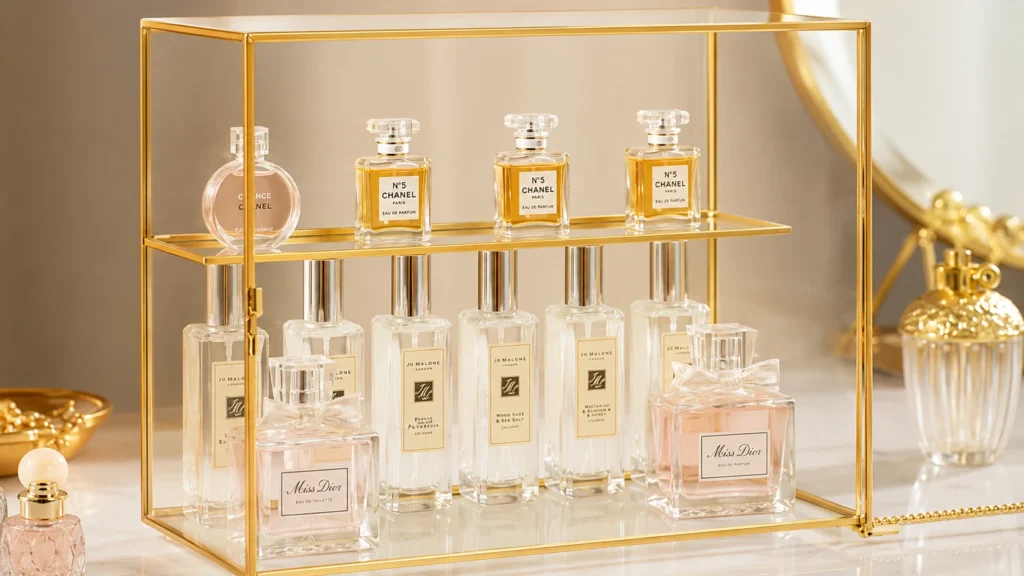
Proper Storage can help preserve your fragrance.
Keep bottles:
- Away from direct sunlight
- Away from extreme heat
- Away from major temperature changes
- Tightly closed
- In a relatively stable environment
A bathroom may be convenient, but repeated changes in temperature and humidity are not ideal for long-term storage.
A cool, dark cupboard or drawer is usually a better location.
How to Buy Authentic Luxury Fragrance
The seller is an important part of the purchasing decision.
Look for:
- Reputable retailers
- Authorized sellers where possible
- Clear product information
- Secure packaging
- Transparent return policies
- Credible customer service
- Consistent pricing
Be cautious when an expensive fragrance is offered at an unrealistically low price.
Counterfeit perfume can look convincing, which is why purchasing from reputable sellers is important.
Why Luxury Perfume Prices Vary
The price of a perfume can reflect many factors:
- Raw materials
- Formulation
- Concentration
- Bottle design
- Packaging
- Brand heritage
- Marketing
- Distribution
- Retail margins
- Limited production
- Brand positioning
Two perfumes can have very different prices without one being dramatically better.
Instead of thinking only about cost per milliliter, consider cost per wear.
A fragrance you love and wear frequently may provide more value than an expensive bottle that remains untouched.
What Is the Best Luxury Fragrance?
There is no single best luxury fragrance for everyone.
Instead, consider the best fragrance for your specific purpose.
You might be looking for:
- The best everyday fragrance
- The best summer fragrance
- The best winter fragrance
- The best office fragrance
- The best date-night fragrance
- The best formal fragrance
- The best signature scent
- The best unusual fragrance
- The best soft fragrance
- The best powerful fragrance
This approach is more useful than relying on one universal ranking.
Luxury Fragrance Myths to Ignore
Myth: The most expensive perfume is the best.
Price does not automatically equal superior craftsmanship or personal enjoyment.
Myth: Higher concentration always means better perfume.
Concentration is only one part of fragrance performance and character.
Myth: Natural ingredients are always better.
Natural and synthetic materials can both play valuable roles in perfumery.
Myth: Niche perfumes are always better than designer fragrances.
Niche and designer describe different approaches, not an automatic quality ranking.
Myth: A good perfume must last all day.
Some fragrances are intentionally delicate and short-lived.
Myth: More sprays create a more luxurious effect.
Overspraying can make an otherwise beautiful fragrance uncomfortable.
Fragrance Safety and Responsible Use
Fragrance should be enjoyed responsibly.
Safety depends on the individual material, concentration, exposure, and appropriate assessment rather than simply whether an ingredient is natural or synthetic.
Always follow product directions and stop using a fragrance if it causes irritation or discomfort.
It is also important to remember that “chemical” does not automatically mean dangerous. Natural substances are chemicals too. What matters is the specific substance and the level of exposure.
Luxury Fragrance Buying Checklist
Before buying an expensive fragrance, ask yourself:
- Do I genuinely enjoy the scent?
- Have I tested it on my skin?
- Have I experienced the dry-down?
- Does it suit my climate?
- Does it fit my lifestyle?
- Is the projection appropriate?
- Would I like it without knowing the brand?
- Have I compared alternatives?
- Can I purchase a sample first?
- Is the seller trustworthy?
- Is the price comfortable for my budget?
- Will I actually wear it?
A few minutes of thoughtful evaluation can prevent an expensive impulse purchase.
How to Start Exploring Luxury Fragrance
You do not need dozens of bottles to develop a sophisticated fragrance palate.
Start with a discovery set containing different fragrance styles.
Try:
- One fresh citrus fragrance
- One floral fragrance
- One woody fragrance
- One amber fragrance
- One gourmand or unusual fragrance
Keep notes about what you smell and how each perfume develops.
After testing several fragrances, patterns will begin to appear.
You may discover that you consistently love woods, dislike excessive sweetness, enjoy musk, or prefer unusual spices.
That knowledge is more useful than memorizing lists of famous perfume names.
How to Create a Fragrance Journal
A fragrance journal can help you understand your preferences.
For each perfume, record:
Opening: What did you notice immediately?
Heart: What changed after some time?
Dry-down: What remained?
Performance: How long could you detect it?
Projection: Was it subtle or strong?
Emotion: What did the fragrance make you feel?
Occasion: Where would you wear it?
Rating: Would you buy it?
After testing 10 to 20 fragrances, your personal scent profile can become much clearer.
Luxury Fragrance Trends
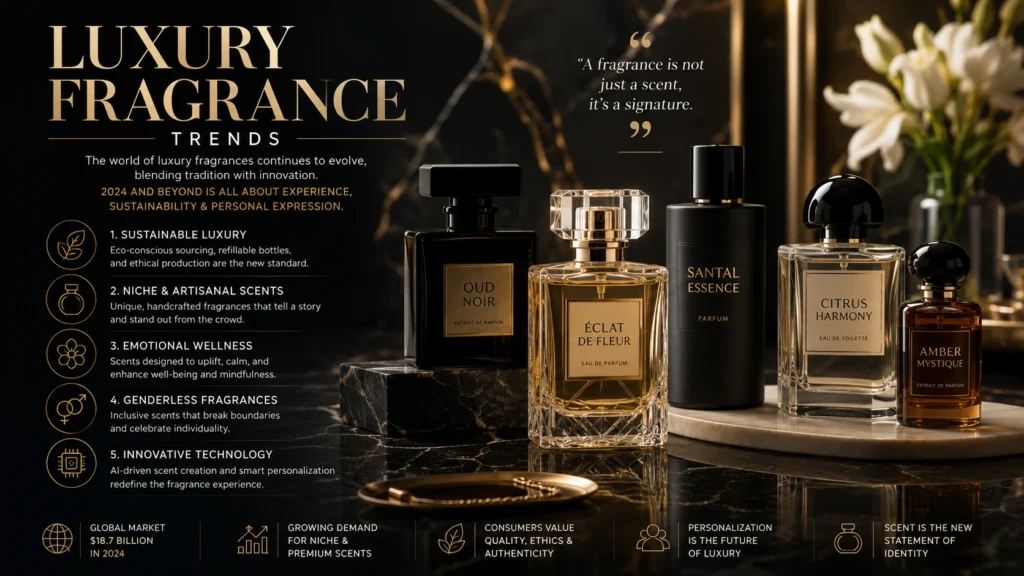
Gourmand compositions, Sophisticated fruit accords, tonka, leather, suede, woods, musks, and unusual interpretations of familiar ingredients continue to attract attention.
Another important development is the popularity of the fragrance wardrobe. Instead of searching for one permanent signature scent, many fragrance lovers choose different perfumes for different seasons, moods, occasions, and outfits.
Niche and independent perfumery also continue to encourage experimentation, giving consumers more unusual options than traditional fragrance categories once offered.
For fragrance enthusiasts, this means there is more freedom than ever to develop a scent style that feels genuinely personal.
People Also Ask
What makes a fragrance luxurious?
Luxury fragrance typically combines refined composition, craftsmanship, distinctive materials or accords, presentation, brand positioning, and an elevated overall experience. Price alone does not determine luxury.
Are luxury fragrances worth the money?
They can be worthwhile if you appreciate craftsmanship, originality, exclusivity, performance, or the experience of wearing a distinctive fragrance. The value ultimately depends on your priorities and budget.
Is niche perfume better than designer perfume?
Not necessarily. Niche and designer perfumes follow different creative and commercial models. Quality can be found in both categories.
Final Thoughts
Luxury Fragrances are best understood as carefully constructed sensory experiences rather than expensive bottles. The opening creates the first impression, the heart develops the personality, and the dry-down reveals what remains closest to the skin. Concentration, ingredients, fragrance family, skin chemistry, climate, projection, and sillage all influence the final experience.
The smartest fragrance buyer is not necessarily the person with the largest or most expensive collection. It is the person who understands personal taste, samples before committing, pays attention to how perfume behaves on their skin, chooses trustworthy sellers, and selects fragrances for real life rather than marketing alone. Explore slowly, keep notes, experiment with different families, and let your collection develop naturally. The perfect luxury fragrance is not simply one that smells expensive—it is one that feels like you.