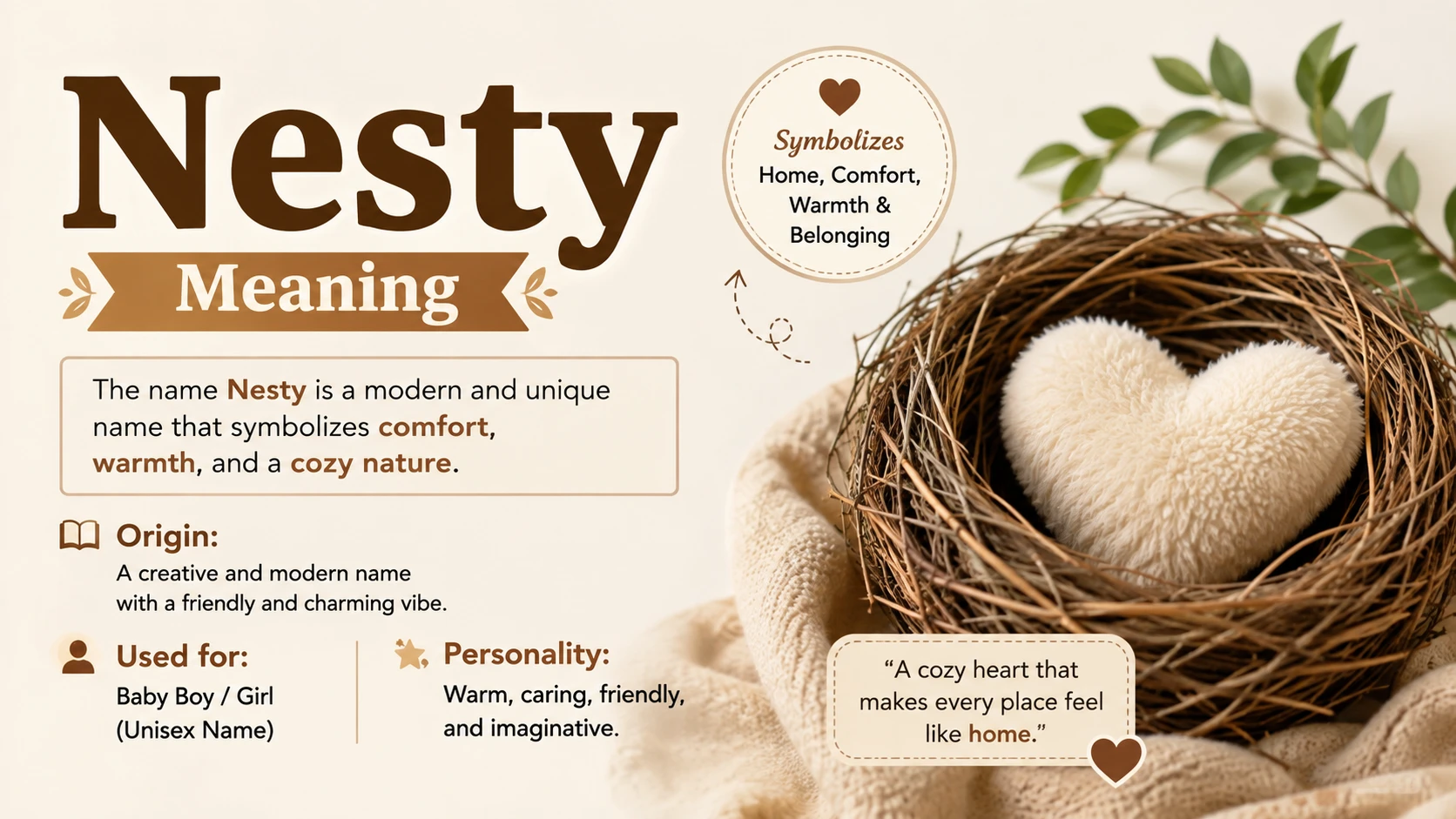
If you searched for “Nesty Meaning,” you may be surprised to learn that the word has more than one documented sense. In its rare English usage, nesty means “resembling or characteristic of a nest.” It can describe something nest-like, enclosed, sheltered, warm, or similar in character to a nest.
There is also an important second meaning: Merriam-Webster records “nesty” as a Scottish variant of “nasty.” Because of these different meanings, the context in which you encounter the word matters.
What Does Nesty Mean?
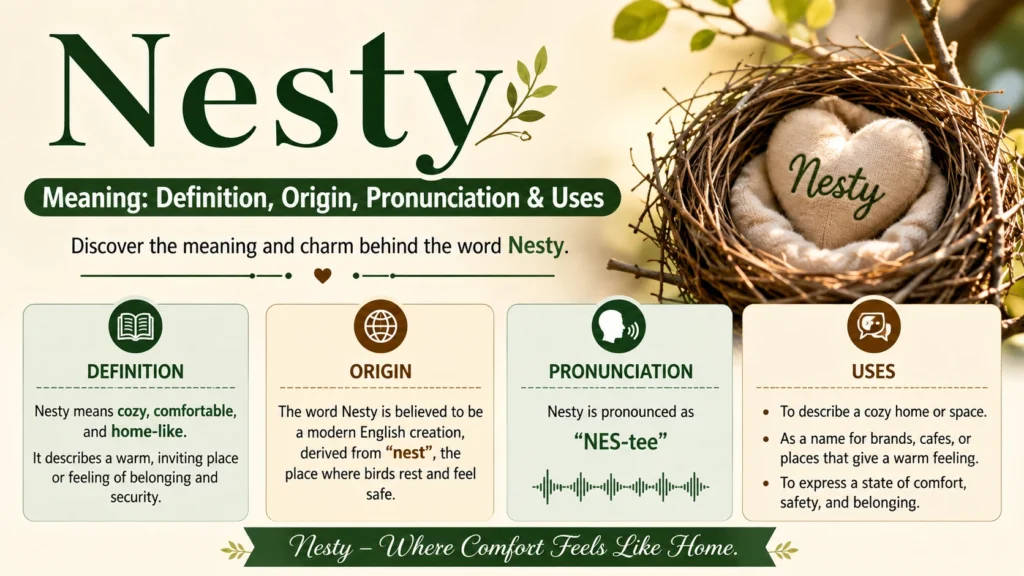
Nesty is a rare English adjective meaning resembling or characteristic of a nest. The word can be used to describe something that has qualities associated with a nest, such as being enclosed, sheltered, cozy, or nest-like.
The word is formed from nest + -y, where the suffix “-y” indicates a quality or characteristic. Thus, the basic idea behind nesty is something that possesses qualities associated with a nest.
However, nesty is uncommon in contemporary English. Most people are more familiar with expressions such as nest-like, cozy, snug, sheltered, or homey.
Nesty Meaning in Simple English
In simple terms, nesty means “like a nest” or “having the characteristics of a nest.”
For example, if someone describes a small, warm, enclosed corner as nesty, they may be emphasizing its sheltered or nest-like feeling.
There is another meaning to remember:
Nesty = nest-like in its rare English sense.
Nesty = nasty in the Scottish sense recorded by Merriam-Webster.
Therefore, you should always look at the surrounding sentence before deciding what nesty means.
Is Nesty a Real Word or a Misspelling of Nasty?
Yes, nesty is a real dictionary-recorded word, but it is rare in modern English. It should not automatically be assumed to be a spelling mistake.
The confusion comes from the fact that nesty and nasty look and sound very similar. Additionally, Merriam-Webster specifically records nesty as a Scottish variant of nasty.
So, if you see nesty in a text, there are several possibilities:
- The writer intentionally means nest-like.
- The word is being used in a Scottish context.
- The text is historical or dialectal.
- The writer may have intended nasty as a spelling mistake.
Context is the best way to determine the intended meaning.
Nesty vs. Nasty: Key Differences Explained
Although the two words are very similar, their meanings can be different.
| Word | Meaning | Usage |
| Nesty | Resembling or characteristic of a nest | Rare |
| Nesty | Scottish variant of nasty | Regional |
| Nasty | Unpleasant, offensive, dirty, disagreeable, or objectionable | Common |
In its rare English sense, nesty describes something associated with a nest. Nasty, by contrast, is a common modern adjective with meanings related to unpleasantness or objectionable qualities.
This distinction is particularly important when interpreting older books, regional writing, or unusual expressions.
What Does Nesty Mean in Scottish English?
In Scottish usage, nesty is recorded as a variant of nasty. This is separate from the rare English meaning connected with nests.
Therefore, a Scottish text using nesty may be describing something unpleasant rather than something nest-like.
This is one reason dictionary entries for unusual words can sometimes appear confusing. Different dictionaries may record different regional, historical, dialectal, or specialized senses.
Nesty Meaning: Resembling or Characteristic of a Nest
The primary rare English sense of nesty is nest-like.
The word can suggest qualities associated with a nest, including:
- Warmth
- Shelter
- Enclosure
- Comfort
- Protection
- A tucked-away feeling
- A nest-like appearance
For instance, a small reading corner surrounded by cushions and blankets could be described creatively as nesty because it creates a sheltered, nest-like atmosphere.
The word is formed naturally from nest + -y, similar to how English creates adjectives such as cloudy from cloud or windy from wind.
How Do You Pronounce Nesty?
Nesty is pronounced approximately:
NES-tee
Its IPA pronunciation is given as approximately /ˈnɛsti/.
The first syllable receives the main stress:
NES-tee
Because nesty and nasty are visually and phonetically similar, pronunciation alone may not always make the intended meaning obvious. The surrounding context can be essential.
Nesty Word Origin and Etymology Explained
The rare English adjective nesty has a straightforward formation:
nest + -y = nesty
The root word is nest, while the suffix -y creates an adjective describing something that possesses a particular quality.
Similar formations include:
- Cloud → cloudy
- Wind → windy
- Dirt → dirty
- Nest → nesty
In this sense, nesty essentially communicates the idea of having qualities associated with a nest.
The Scottish sense of nesty, however, should be understood separately because it is recorded as a variant of nasty.
How to Use Nesty in a Sentence
Because nesty is rare, it is best used when the intended meaning is clear.
Here are examples using the nest-like sense:
- The small shelter had a warm, nesty appearance.
- The reading corner felt wonderfully nesty.
- The little space had a cozy, nesty atmosphere.
- The arrangement created a distinctly nesty feeling.
- The enclosed room looked almost nesty in its design.
These examples use nesty to communicate an atmosphere or appearance associated with a nest.
For general audiences, however, nest-like, cozy, snug, or sheltered may be clearer choices.
Nesty Example Sentences and Common Contexts
Here are Additional examples showing how the rare nest-related meaning can work:
- The tiny shelter had a nesty appearance.
- The bird created a nesty space among the branches.
- The cozy corner felt warm and nesty.
- The arrangement had a distinctly nesty quality.
- The enclosed space looked almost nesty in its design.
The surrounding context makes the intended meaning easier to understand because nesty is not a familiar everyday adjective for most English speakers.
Nesty Synonyms, Related Words, and Alternatives
There is no single perfect synonym for every use of nesty. The best alternative depends on which quality you want to communicate.
For the nest-like meaning, possible alternatives include:
- Nest-like — the closest direct alternative
- Cozy — comfortable and warm
- Snug — pleasantly enclosed or comfortable
- Sheltered — protected from exposure
- Enclosed — surrounded or contained
- Homey — comfortable and familiar
- Warm — physically or emotionally inviting
- Tucked-away — located in a protected or secluded place
- Protected — safe from outside exposure
For example, nest-like works best when describing appearance, while cozy or snug may be more natural when describing atmosphere.
Is Nesty Commonly Used in Modern English?
No. Nesty is not a common everyday English word.
Although the word is legitimate and dictionary-recorded, its nest-related English sense is specifically considered rare.
Most modern speakers would probably choose a more familiar expression such as:
- Nest-like
- Cozy
- Snug
- Sheltered
- Homey
- Comfortable
The Scottish sense is also specialized rather than standard everyday English because it is specifically identified as a Scottish variant of nasty.
If your goal is clear communication, a familiar alternative will usually be better than using an obscure word simply because it sounds interesting.
Nesty in Dictionaries: Merriam-Webster vs. Wiktionary
Different dictionaries can record different meanings for the same unusual word.
Merriam-Webster records nesty as a Scottish variant of nasty.
Wiktionary records nesty as a rare English adjective meaning resembling or characteristic of a nest, with the formation nest + -y.
This difference does not necessarily mean that one source is incorrect. Dictionaries may document different varieties and forms of English, including:
- Regional meanings
- Historical meanings
- Dialectal vocabulary
- Rare words
- Specialized meanings
- Alternative senses
For an uncommon word like nesty, consulting more than one dictionary can therefore provide a fuller picture.
Nesty vs. Nesting vs. Cozy: What’s the Difference?
These words can appear related, but they have different functions.
Nesty is an adjective describing something with nest-like characteristics.
Nesting normally refers to the activity of building, occupying, or settling into a nest or similar space.
Cozy describes something pleasantly comfortable or warm but does not necessarily have anything to do with a nest.
Consider these examples:
- The room feels nesty. — describes a nest-like quality.
- The bird is nesting in the tree. — describes an activity.
- The room is cozy. — describes comfort or warmth.
A room can be cozy without being nest-like, so nesty and cozy are related in some contexts but are not exact synonyms.
When Should You Use Nesty?
You may use nesty when you intentionally want a rare or literary expression and the context clearly communicates what you mean.
It can make sense when:
- You are discussing something specifically related to a nest.
- You want to create a nest-like image.
- You are analyzing historical or dialectal language.
- Your audience understands unusual vocabulary.
- You are deliberately using a creative adjective.
You should generally avoid it when:
- You simply mean nasty.
- Your audience needs straightforward modern English.
- The meaning could easily be misunderstood.
- A clearer word such as nest-like, cozy, or snug would communicate the idea better.
Clarity is usually more valuable than using an obscure word.
Why Do People Search for “Nesty Meaning”?
People may search for nesty meaning for several different reasons.
They Encountered Nesty in a Text
Someone may discover the word in an old book, article, poem, or regional expression and want to understand what the writer meant.
They Confused It With Nasty
The spelling and pronunciation of nesty and nasty are close enough to cause confusion.
They Found It in a Dictionary
A dictionary may show an unfamiliar definition because nesty has rare or regional senses.
They Want to Check the Spelling
Someone may wonder whether nesty is a legitimate word or simply a typo for nasty.
They Want a Translation
Because nesty is uncommon, some translation tools may not provide a straightforward equivalent.
Understanding the reason behind the search helps explain why the word can produce seemingly contradictory definitions.
Common Mistakes When Using Nesty
Assuming Nesty Always Means Nasty
This is not necessarily correct. Nesty has a rare English sense related to nests, while its Scottish sense is recorded as a variant of nasty.
Treating Nesty as a Common Modern Word
Although it is legitimate, nesty is rare in contemporary English.
Ignoring Context
Context can reveal whether nesty means nest-like or represents the Scottish variant of nasty.
Automatically Correcting Nesty to Nasty
If a historical or literary writer intentionally used nesty, changing it to nasty could change the original meaning.
Using Nesty Without Explanation
Because many readers may not recognize the word, providing enough context can make your writing easier to understand.
Nesty Antonyms
Because nesty is an unusual descriptive word, its opposites depend on which characteristic is being emphasized.
If nesty means cozy, sheltered, or nest-like, possible contextual opposites include:
- Exposed
- Open
- Spacious
- Stark
- Uncomfortable
- Unprotected
- Inhospitable
These are contextual opposites rather than strict dictionary antonyms.
For example, a small sheltered space might feel nesty, while a completely exposed area could be described as the opposite.
Rare and Historical Uses of Nesty
Unusual words can sometimes have meanings that are limited to particular regions, families, periods, or communities.
The supplied research notes a 1986 issue of the Kipling Journal discussing a regional use of nesty associated with froth appearing on fermenting liquid. The discussion identifies this as a family or regional usage rather than a straightforward standard-English definition.
This is a useful reminder that vocabulary cannot always be understood from a single modern dictionary definition.
If you encounter nesty in an old book, historical document, regional text, or unusual quotation, examine the surrounding passage before deciding what the author intended.
Is Nesty the Same as Nesting?
No.
Although the words are related, they perform different grammatical roles.
Nesty is an adjective describing a quality.
Nesting is normally a present participle or gerund connected with the verb nest. It can describe building, occupying, or settling into a nest or similar space.
For example:
The room feels nesty.
Here, nesty describes the room.
The bird is nesting in the tree.
Here, nesting describes what the bird is doing.
Is Nesty the Same as Cozy?
Not exactly.
There can be some overlap between nesty and cozy, particularly when nesty is used to suggest warmth, shelter, enclosure, or comfort.
However, cozy is much more common and has a broader meaning. Something can be cozy without resembling a nest at all.
A useful distinction is:
Nesty → nest-like
Cozy → pleasantly comfortable or warm
The two words can overlap, but they should not automatically be treated as interchangeable.
Quick Nesty Meaning Comparison
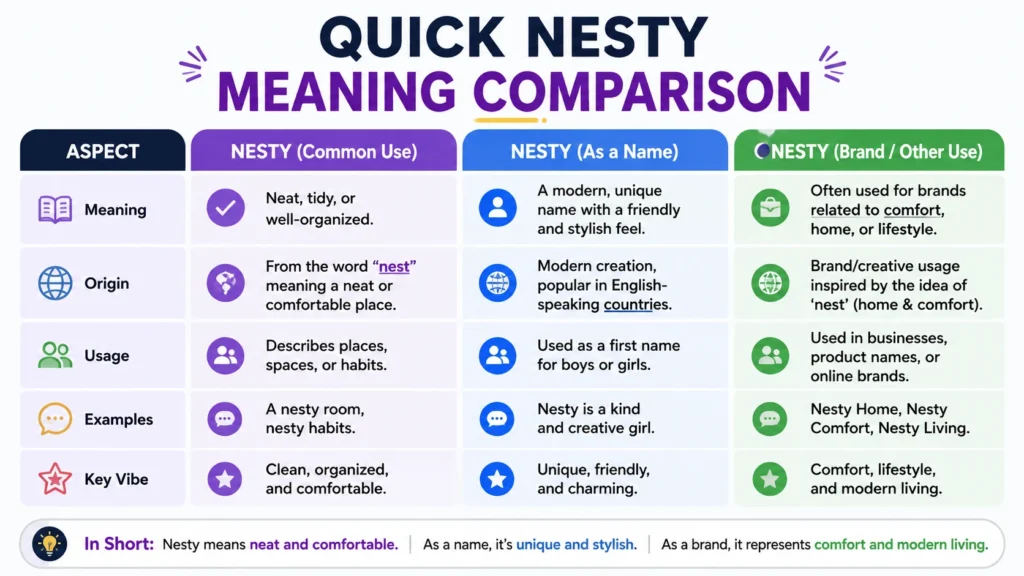
| Question | Answer |
| What does nesty mean? | Resembling or characteristic of a nest |
| Is nesty a real word? | Yes |
| Is nesty common? | No, it is rare |
| How is nesty pronounced? | Approximately “NES-tee” |
| What is its formation? | nest + -y |
| Can nesty mean nasty? | Yes, in the Scottish sense recorded by Merriam-Webster |
| Is nesty the same as cozy? | No, although meanings can overlap |
| Is nesty the same as nesting? | No |
| What is the closest everyday alternative? | Nest-like, cozy, or snug |
People Also Ask
What does nesty mean?
Nesty can mean “resembling or characteristic of a nest.” It is a rare English adjective. Merriam-Webster also records nesty as a Scottish variant of nasty.
Is nesty a real word?
Yes. Nesty is a dictionary-recorded word, although it is rare in contemporary English.
Is nesty another word for nasty?
Not always. The Scottish sense of nesty is a variant of nasty, but the rare English adjective has a separate nest-related meaning.
Conclusion
The nesty meaning depends on context. In its rare English sense, nesty is an adjective meaning resembling or Characteristic of a nest. It comes from nest + -y and is pronounced approximately NES-tee.
At the same time, nesty is also recorded as a Scottish variant of nasty, so it should not automatically be interpreted as meaning nest-like in every text. Because the word is uncommon, examining the surrounding context is the safest approach. For everyday communication, nest-like, cozy, snug, or another familiar alternative will often be clearer.