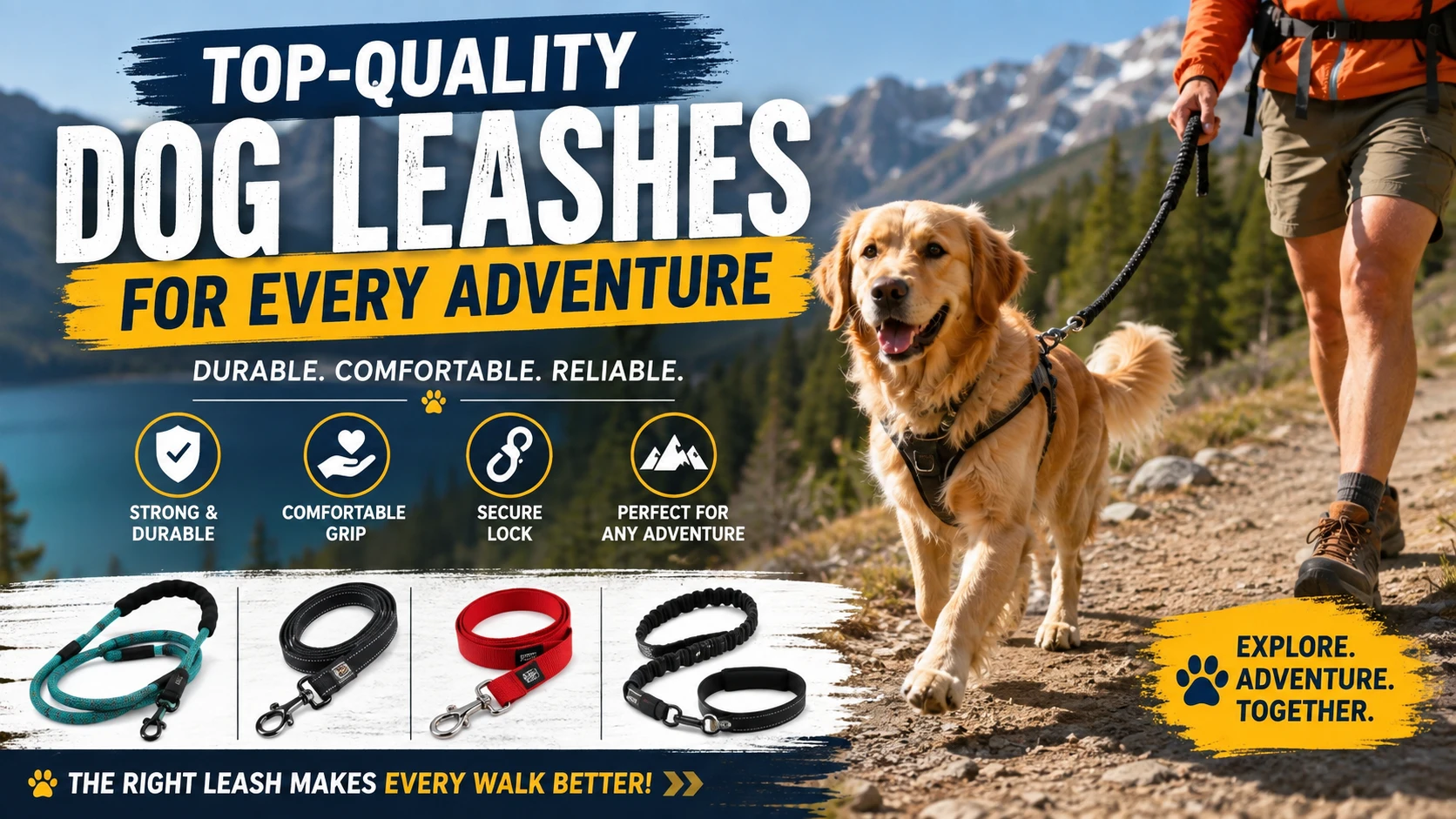
Top Quality Dog Leashes for Every Adventure. A quality leash helps you maintain control, keep your dog comfortable, and enjoy different activities with greater confidence.
Whether you’re walking around the neighborhood, hiking a forest trail, running through a park, practicing recall, or spending time near the water, the right leash depends on your dog’s size, behavior, environment, and activity. There is no single leash that works perfectly for every situation.
What Is the Best Dog Leash for Every Adventure?
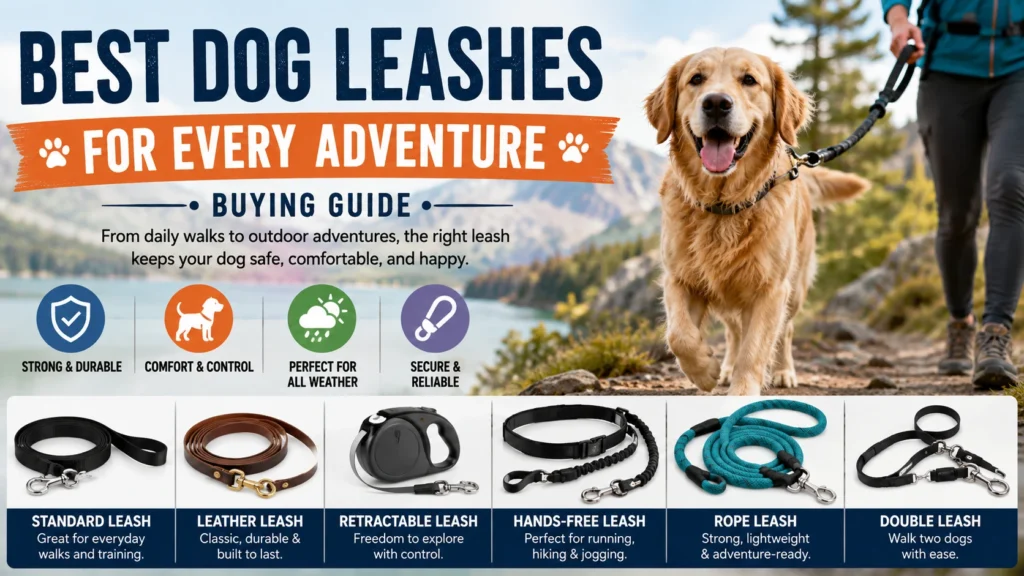
For most everyday walks, a durable 5- or 6-Foot Fixed Leash is an excellent starting point. It offers a practical balance between giving your dog room to move and keeping enough control when you need it.
For more specialized activities, however, another design may be more suitable. A hands-free or bungee leash can work well for running and hiking, while a 15- to 30-foot long line can provide additional freedom during recall training in appropriate open spaces.
The best leash isn’t necessarily the most expensive or the heaviest. It is the one that matches the situation.
What Makes a Top-Quality Dog Leash?
A high-quality dog leash should combine durability, comfort, secure hardware, and appropriate design.
Strong Construction
Check the webbing, stitching, seams, and attachment points. Even strong material can fail if the stitching or construction is poor.
Secure Hardware
The clip deserves special attention. It should close securely and be appropriately sized for your dog’s strength and weight.
Comfortable Handle
A padded or well-designed handle can make long walks more comfortable, especially when your dog occasionally pulls or changes direction.
Appropriate Length
The leash should give your dog enough room to move naturally without creating more distance than you can safely control.
Suitable Material
Nylon, rope, leather, and Biothane all have different advantages. Your choice should depend on how and where you use the leash.
Visibility
Reflective stitching or high-visibility materials can be particularly helpful during early-morning or nighttime walks.
Best Dog Leash for Everyday Walking
A standard fixed-length leash is the most versatile option for many owners. A 5- or 6-foot leash works well for neighborhood walks, sidewalks, parks, potty trips, basic leash training, and vet visits.
Look for durable webbing or rope, a comfortable handle, secure metal hardware, strong stitching, and reflective details if you regularly walk in low-light conditions.
For most households, this is the first leash worth owning.
Best Dog Leashes for Hiking and Outdoor Adventures
Hiking introduces challenges that aren’t normally present on sidewalks. Your dog may encounter rocks, steep slopes, mud, streams, wildlife, cyclists, other dogs, and narrow trails.
A hiking leash should prioritize:
- Secure attachment
- Durability
- Comfortable handling
- Visibility
- Appropriate length
- Weather resistance
- Quick close-control access
A traffic handle can be useful when another hiker or dog approaches because it allows you to shorten the distance quickly. On technical terrain, precise control can be more important than giving your dog maximum freedom.
Best Dog Leash for Running
Running requires equipment that can handle repeated movement and sudden changes in speed.
A hands-free bungee leash can be convenient because it leaves your hands available and may soften some sudden changes in tension. Look for a secure waist belt, reflective material, lightweight construction, reliable hardware, and a secondary handle.
However, a bungee leash isn’t automatically the best option. If your dog frequently crosses in front of you or suddenly changes direction, a traditional leash may provide better control.
Best Long-Line Dog Leash for Recall Training
A long line gives a dog additional freedom while keeping a physical connection with the handler. Common lengths include approximately 15 to 30 feet.
Long lines are useful for:
- Recall training
- Distance commands
- Open fields
- Controlled exploration
- Preparing a dog for more reliable off-leash behavior
They should not normally be used like ordinary sidewalk leashes. In crowded areas, excess length can create trip and entanglement hazards.
Never wrap a long line around your wrist while your dog is running at a distance because sudden acceleration can create significant force.
Best Waterproof Dog Leashes for Beach, Rain, and Mud
Water, mud, and rain can quickly expose weaknesses in ordinary dog gear.
Biothane is particularly useful for wet and muddy adventures because it is waterproof, relatively lightweight, durable, and easy to clean.
For outdoor use, consider:
- Waterproof construction
- Quick-drying material
- Corrosion-resistant hardware
- Easy-to-clean surfaces
- Secure clips
- Comfortable grip
Leather can be durable and comfortable, but it requires more maintenance and is less convenient when exposed repeatedly to wet and muddy conditions.
Nylon vs. Rope vs. Leather vs. Biothane Dog Leashes
It is a practical all-purpose option for everyday walking.
Its disadvantages include possible fraying, moisture retention, and vulnerability to chewing.
Rope
Rope leashes offer flexibility and strength. Climbing-rope-style designs can be appealing for outdoor activities.
However, rope can become dirty, some textures may feel rough, and chewing can damage the fibers.
Leather
Leather provides a classic appearance and can become softer with use. A quality leather leash can offer a comfortable handling experience and long-term durability.
The trade-offs are higher maintenance, greater cost, and less convenience in wet conditions.
Biothane
Biothane is coated webbing that has become popular for outdoor and working-dog applications. Its main advantage is convenience.
It is especially suitable for:
- Rain
- Mud
- Beach trips
- Hiking
- Recall training
- Dogs that frequently get dirty
No material is universally best. The right choice depends on your environment and priorities.
How to Choose the Right Dog Leash Length
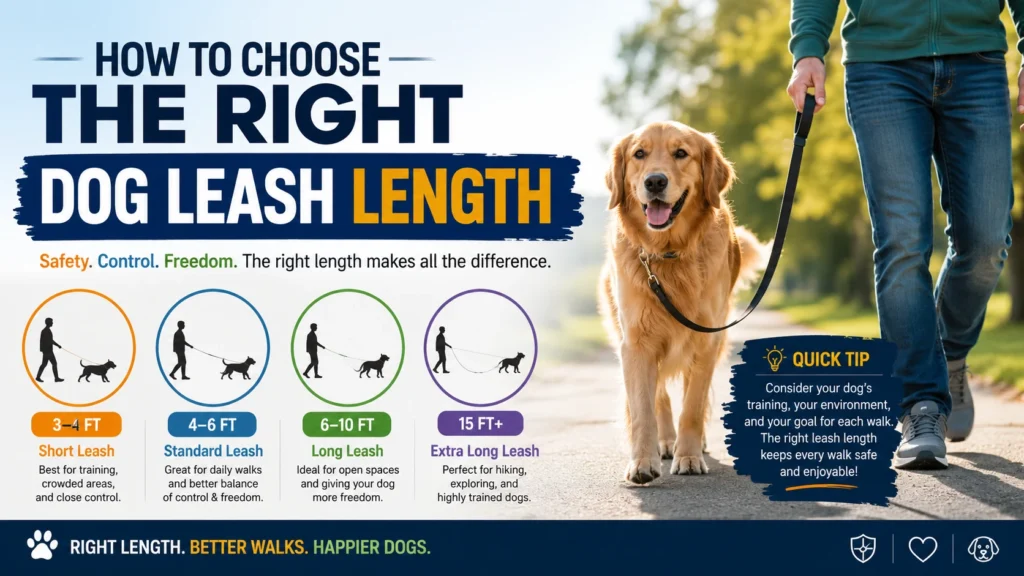
Leash length should be based on the Environment and activity.
| Leash Length | Best Use |
| 4 feet | Busy areas and close control |
| 5 feet | Urban walks and general use |
| 6 feet | Everyday walking |
| 10 feet | Controlled exploration |
| 15–20 feet | Recall and distance training |
| 30+ feet | Specialized training and open-space work |
A 5- or 6-foot leash provides a useful everyday balance between freedom and control. Shorter options can be more practical in crowded environments, while long lines are better suited to open-space training.
How to Choose a Dog Leash for Small, Medium, and Large Dogs
Small Dogs
Small dogs don’t necessarily need extremely strong or heavy equipment. A bulky leash can be uncomfortable and unnecessarily difficult to handle.
Choose lightweight construction, a smaller secure clip, comfortable handling, and an appropriate length.
Medium Dogs
Medium dogs can generally use a broad selection of standard leashes. However, behavior matters as much as body weight.
A calm dog may require less robust equipment than an energetic dog of the same size.
Large Dogs
Large and strong dogs require greater attention to:
- Webbing width
- Stitching
- Clip strength
- Handle construction
- Attachment points
- Overall durability
A double-handle leash can be useful because the second handle allows you to bring the dog closer when additional control is needed.
What Is the Best Leash for Dogs That Pull?
A leash by itself does not solve pulling.
For a strong puller, prioritize durable construction, secure hardware, comfortable handling, appropriate width, reliable attachment points, and good control.
A traffic handle can also help when you need to bring your dog closer quickly.
The leash, collar or harness, and training approach should work together. Simply buying a product labeled “heavy duty” does not guarantee better control.
Are Retractable Dog Leashes Safe?
Retractable leashes are not automatically unsuitable, but they have limitations that make them inappropriate for some environments.
Potential concerns include:
- Reduced close-range control
- Tangling
- Sudden lunges
- Thin cords
- Mechanical failure
- Difficulty controlling a dog around traffic or other animals
If you use a retractable leash, choose an appropriate open area, keep your dog away from roads, avoid grabbing the moving cord, inspect the locking mechanism, and prevent the line from wrapping around people or dogs.
For controlled freedom in suitable open spaces, a properly managed long line can be an alternative worth considering.
Dog Leash Safety Tips for Every Adventure
Even a high-quality leash cannot eliminate every risk. Safe handling and regular inspection remain essential.
Inspect the Leash Regularly
Look for:
- Frayed webbing
- Broken stitching
- Rust
- Bent clips
- Damaged swivels
- Cracked handles
- Weak attachment points
Replace the leash before serious damage becomes a failure.
Check the Clip
Before every walk, make sure the clip is fully closed and correctly attached to the collar or harness.
Match the Leash to the Environment
A long line may be excellent in an open field but inappropriate on a crowded sidewalk.
Avoid Long Lines Near Traffic
Extra length can make emergency control more difficult.
Use Reflective Features at Night
Reflective material can improve visibility during low-light walks.
Be Careful Around Wildlife
Dogs can suddenly react to squirrels, deer, birds, and other wildlife. In these situations, immediate control can be more valuable than maximum freedom.
Leash vs. Harness: Which Is Better?
A leash and harness serve different purposes.
The leash provides connection and control, while a harness distributes leash forces through the dog’s body depending on its design and fit.
For dogs that pull, a properly fitted harness may be part of a broader training setup. The appropriate choice depends on the individual dog.
Fit is particularly important. A poorly fitted harness can be uncomfortable or allow a dog to escape.
Best Dog Leash for Each Adventure
| Adventure | Recommended Leash |
| Daily neighborhood walk | 5–6 ft fixed leash |
| Busy city sidewalk | 4–5 ft leash |
| Hiking | Durable standard or hands-free leash |
| Trail running | Hands-free bungee leash |
| Recall training | 15–30 ft long line |
| Beach | Waterproof Biothane leash |
| Rainy weather | Waterproof-coated leash |
| Large strong dog | Heavy-duty double-handle leash |
| Puppy training | Standard fixed leash |
| Night walking | Reflective leash |
| Open-field exploration | Long line |
The central idea is simple: the best leash depends on the adventure.
How to Choose a Top-Quality Dog Leash: 10-Point Checklist
Before buying, ask yourself:
- Is the leash appropriate for my dog’s size?
- Can the clip handle my dog’s strength?
- Is the material suitable for the weather?
- Is the length appropriate for where I walk?
- Does the handle feel comfortable?
- Are the seams and stitching reinforced?
- Does the clip close securely?
- Would a traffic handle be useful?
- Would reflective details improve nighttime visibility?
- Am I buying the leash for the activity I actually perform?
These questions help you choose equipment based on real-world needs rather than appearance alone.
How to Care for Your Dog Leash
Proper maintenance can extend the useful life of your leash.
Nylon: Follow the manufacturer’s cleaning instructions and allow the leash to dry completely.
Rope: Check for fraying and damaged fibers, and keep it clean and dry.
Leather: Avoid prolonged unnecessary moisture and use an appropriate leather conditioner when required.
Biothane: Wipe away mud and dirt and allow the leash to dry.
Always inspect the metal hardware because corrosion or mechanical damage can compromise the attachment.
Common Dog Leash Buying Mistakes
Buying Only for Appearance
A stylish leash isn’t necessarily a durable or safe leash.
Choosing the Longest Leash
More freedom isn’t always better. Long leashes can reduce control in crowded environments.
Ignoring Hardware
Strong webbing cannot compensate for a weak clip.
Using One Leash for Everything
Active owners may benefit from separate equipment for everyday walking, training, and specialized outdoor activities.
Assuming Heavy-Duty Means Better
A very heavy leash can be unnecessary and uncomfortable for a small dog.
Forgetting Visibility
Reflective features can be valuable if you regularly walk before sunrise or after sunset.
Do You Need More Than One Dog Leash?
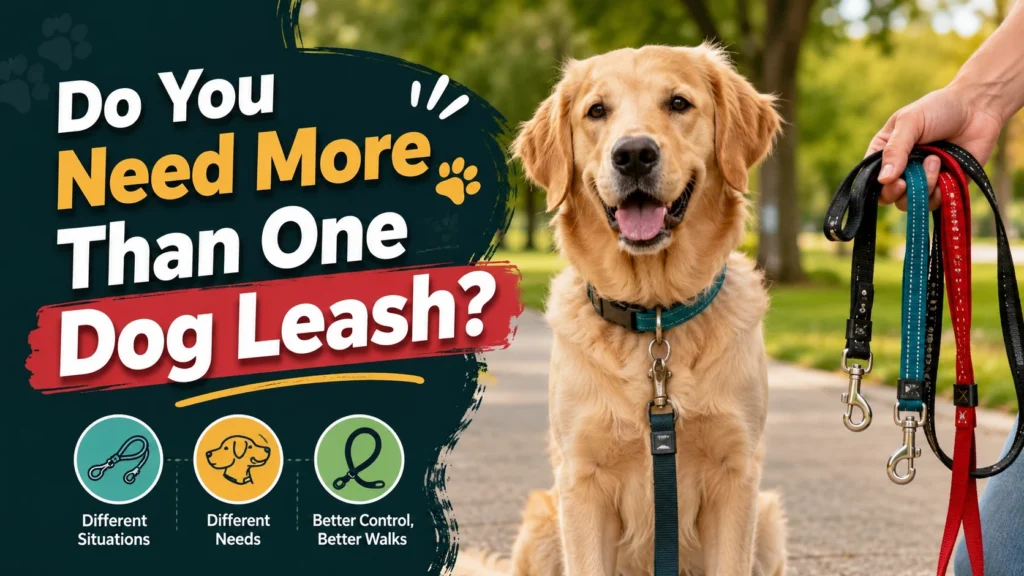
For many active dog Owners, having more than one leash can be practical.
A simple three-leash setup could include:
Everyday leash: A 5- or 6-foot fixed leash for normal walks.
Adventure leash: A hands-free or durable outdoor leash for hiking, running, or longer outings.
Training long line: A 15- to 30-foot leash for recall and controlled distance training.
Instead of forcing one leash to handle every situation, matching equipment to the activity can make outings safer and more convenient.
People Also Ask
What is the best dog leash for everyday walking?
A durable 5- or 6-foot fixed leash is a practical all-purpose choice because it balances freedom and control.
What is the best leash for hiking with a dog?
Choose a durable leash suited to your terrain and your dog’s training. Hands-free options can work well for active hiking, while a standard leash may offer better control on technical or crowded trails.
What leash is best for a dog that pulls?
Look for strong construction, secure hardware, comfortable handling, and appropriate control features. Training and a properly fitted harness may also be important.
Are retractable dog leashes bad?
Not necessarily, but they have limitations. They provide less immediate control and can create tangling and injury risks, making them unsuitable for some environments.
Is Biothane better than nylon for dog leashes?
Neither is universally better. Nylon is flexible, affordable, and versatile, while Biothane is particularly useful for waterproofing, easy cleaning, and outdoor use.
How long should a dog leash be?
For normal walks, 5–6 feet is a practical range. Shorter leashes can work well in crowded areas, while 15–30-foot long lines are commonly used for recall training in suitable open spaces.
What is the safest leash for a large dog?
Look for durable material, strong stitching, secure hardware, and a handle that gives you sufficient control. A double-handle design can be useful when you need to shorten the distance quickly.
Should I use a hands-free leash for a puppy?
A standard fixed leash is generally easier for teaching basic leash manners and maintaining close control. A hands-free system may become more useful once the dog develops better leash skills.
Can I use a long line for everyday walks?
A long line is generally better for controlled training and open-space exploration. In crowded environments, it can become an entanglement and safety hazard.
How often should I replace a dog leash?
There is no universal replacement schedule. Inspect the leash regularly and replace it when you notice serious fraying, damaged stitching, weakened hardware, cracks, or other signs that its strength may be compromised.
Conclusion
The best dog leash isn’t necessarily the most expensive, strongest-looking, or feature-packed option. The right leash provides an appropriate balance of Control, comfort, durability, freedom, and safety for the activity you’re doing.
For everyday walks, a dependable 5- or 6-foot fixed leash remains an excellent starting point. Hiking and running, a properly designed hands-free or bungee leash can be useful. Recall training, a long line provides additional freedom while maintaining a connection. For wet and muddy adventures, Biothane offers convenient waterproof and easy-clean characteristics.
Most importantly, choose according to your dog and your environment, not simply the product label. Consider size, strength, training level, behavior, terrain, weather, and the activity you plan to enjoy.
A top-quality dog leash should give you confidence whenever you clip it on. When the leash matches the adventure, you and your dog can spend less time worrying about equipment and more time enjoying the experience together.
Disclaimer: This article is for general educational and informational purposes. Always choose dog-walking equipment appropriate for your individual dog’s size, behavior, training, and environment.